10-Sentence Summary
- The speed of reaching a financial goal depends on three variables: principal, return rate, and time.
- Increasing the monthly contribution has the most immediate impact.
- Even a small increase in contributions can shorten the timeline significantly.
- Higher return rates accelerate growth but come with higher risk.
- Longer investment periods boost compound-interest effects.
- Time is the most flexible variable among the three.
- Adjusting all three variables together improves your probability of success dramatically.
- Relying on only one variable—return, principal, or time—is rarely sustainable.
- Before setting a goal, evaluate your income, spending habits, and capacity to invest consistently.
- A simulation tool helps you quickly find the optimal balance.
To reach your financial goal faster, you need a balanced strategy involving principal, return, and investment duration. Each element has advantages and limitations, and combining them within realistic boundaries is essential.
Related reads: Monthly investment calculator guide, Annual vs monthly compounding, and Simple vs compound interest.

1. Introduction
Most people want to accelerate their asset growth, but the speed of reaching a target amount is not determined by motivation alone.
It depends on how principal, expected return, and investment period work together.
Understanding this structure helps create a more realistic and achievable plan.
2. Core Structure Behind Reaching a Target Amount
The Role of Principal
Principal is the easiest variable to adjust.
Increasing your contribution immediately improves your results.
For example, increasing your monthly investment from $160 to $240 can shorten the timeline by several years.
However, contributing beyond your financial capacity is not sustainable, so consistency matters more than aggressive increases.
The Role of the Return Rate
Return rate has the strongest long-term impact but also the highest risk.
Higher returns accelerate growth but introduce more volatility.
For long-term investing, an annual return of 5–7% is generally considered stable and realistic.
3. Adjusting the Time Horizon and Case Comparison
Time is the most flexible variable and plays a key role in maximizing compound interest.
Even when monthly contributions remain the same, extending the investment period significantly increases the final amount.
Below is an example using a monthly contribution of $240, showing differences across return rates and durations:
| Period | 4% Return | 6% Return | 8% Return |
|---|---|---|---|
| 10 years | approx. $34,400 | approx. $39,200 | approx. $44,800 |
| 15 years | approx. $57,600 | approx. $71,200 | approx. $87,200 |
| 20 years | approx. $90,400 | approx. $111,200 | approx. $140,000 |
These numbers illustrate how longer periods strengthen compound-interest effects and how different return rates create significant long-term gaps.
4. Practical Application
The most effective way to reach your goal faster is to adjust all three variables at the same time.
First, consider the principal.
Even increasing your monthly contribution by $40–80 can significantly shorten your timeline.
Second, set a return rate that is realistic.
Rather than chasing aggressive returns, aim for stability within the 5–7% range.
Third, extend your investment horizon where possible.
Time is the foundation of compound interest, and longer periods amplify its impact.
For a precise analysis, you can use the FinMap Target Amount Simulator:
5. Conclusion
Reaching a target amount faster requires a balanced adjustment of principal, return, and investment period.
Relying on only one variable is rarely effective.
By making realistic adjustments, you can significantly increase your probability of achieving your financial goals.
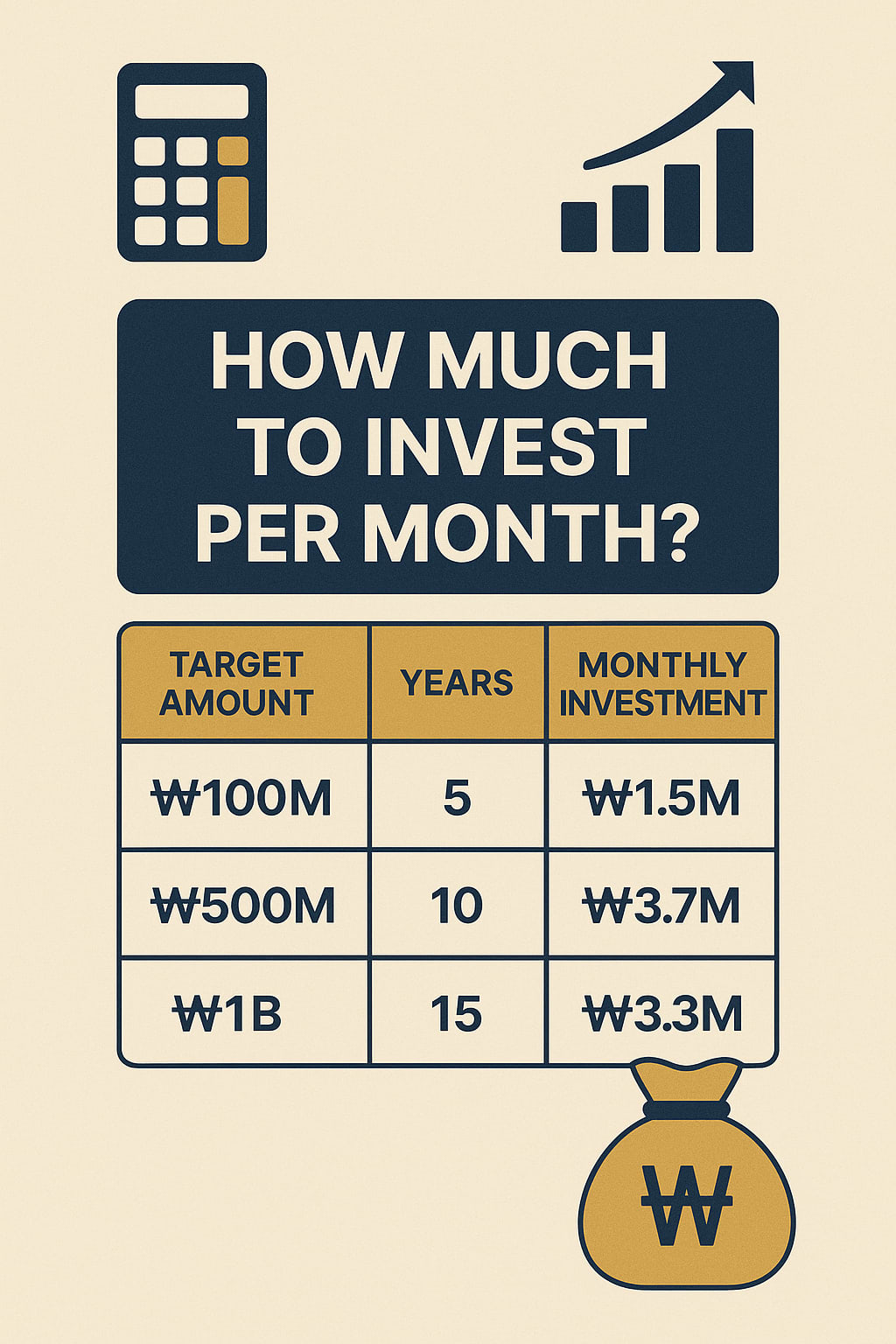
FAQ
1. Which variable shortens the timeline most effectively?
Increasing the monthly principal has the most immediate impact.
2. What is a reasonable return rate to assume?
For long-term investing, 5–7% annually is a realistic and sustainable range.
3. Is shortening the period always better?
Not necessarily. Longer periods stabilize returns and maximize compound interest.