
Monthly compounding can grow money slightly faster than annual compounding when the nominal annual rate is the same, because growth is credited more often. The difference gets larger as the rate and time horizon rise, but you should not apply monthly compounding again if a quoted APY or effective annual rate already includes the compounding effect.
This article is educational. Compound interest examples are estimates, not guaranteed investment results or financial advice.
Compare compounding assumptions
Enter your starting amount, monthly contribution, annual return, and years to test future value under your own planning assumptions.
Compare annual and monthly compoundingQuick Answer
| Question | Short answer |
|---|---|
| Which grows faster? | Monthly compounding grows faster than annual compounding at the same nominal annual rate. |
| Is the difference large? | Usually small over short periods, but it grows with time and higher rates. |
| What matters more? | Return rate, time horizon, and additional contributions usually matter more than compounding frequency. |
| Which calculator should I use? | Use the calculator for your own principal, contribution, rate, and time inputs. |
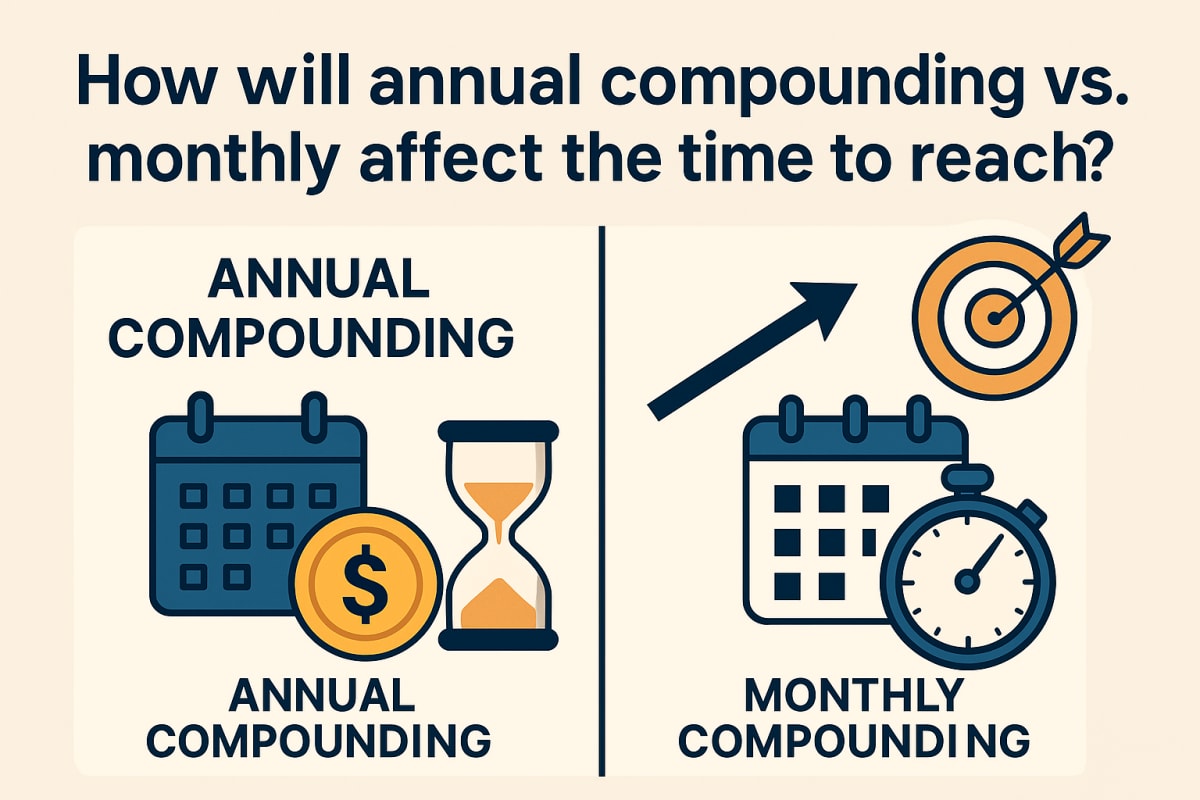
Annual vs Monthly Compounding: The Difference
Annual compounding means growth is credited once per year. Monthly compounding means growth is credited 12 times per year.
At a 6% nominal annual rate:
- Annual compounding uses 6% once per year.
- Monthly compounding uses 0.5% per month.
- Monthly compounding creates an effective annual rate of about 6.17%.
That difference looks small in one year. It becomes easier to see over long periods.
Example Table: Same Principal, Same Rate, Same Period
Assume a $10,000 starting balance and no additional contributions.
| Nominal annual rate | Years | Annual compounding | Monthly compounding | Difference |
|---|---|---|---|---|
| 5% | 10 | $16,288.95 | $16,470.09 | $181.14 |
| 5% | 20 | $26,532.98 | $27,126.40 | $593.42 |
| 7% | 10 | $19,671.51 | $20,096.61 | $425.10 |
| 7% | 20 | $38,696.84 | $40,387.35 | $1,690.51 |
The lesson is simple: compounding frequency matters more when the rate is higher and the period is longer.
To test your own rate, period, and starting amount, use the Compound Interest Calculator.
Why Monthly Compounding Can Matter More Over Time
Monthly compounding creates growth on growth more frequently. The effect is small at first, but the gap widens because each month starts from a slightly higher base.
That said, investors should not over-focus on compounding frequency. A realistic plan usually depends more on:
- the expected return range,
- the number of years invested,
- how consistently contributions are made,
- fees and taxes,
- whether the investment plan survives volatility.
For the basic mechanics of compounding, see Simple vs. Compound Interest. For long-horizon return tables, see Compound Growth at 3%, 5%, 7%, and 10%.
Monthly Contributions: The Bigger Practical Lever
Most real investing plans are not just lump sums. They include regular contributions.
Assume:
- starting balance: $5,000
- monthly contribution: $300
- nominal annual return: 6%
- time horizon: 15 years
| Scenario | Ending value estimate | What it shows |
|---|---|---|
| Annual compounding, $300/month | about $91,900 | Baseline estimate |
| Monthly compounding, $300/month | about $92,400 | Slightly higher because growth is credited more often |
| Monthly compounding, $350/month | about $106,900 | Contribution size moves the result much more |
The exact result can vary depending on whether contributions happen at the beginning or end of each period. The point is still useful: monthly compounding helps, but increasing a sustainable contribution often matters more.
Use the Goal Simulator if you want to estimate how much you need to contribute to reach a target amount.
A Practical Calculator Workflow
Use this sequence:
- Start with your target amount and time horizon.
- Use a conservative return range instead of one optimistic number.
- Run the same assumptions with annual and monthly compounding.
- Compare the difference.
- If the difference is small, focus on contribution rate and time horizon first.
For monthly investing or DCA plans, the DCA Calculator can be more useful than a pure lump-sum compound interest calculator.
Bottom Line
Monthly compounding is mathematically better than annual compounding at the same nominal annual rate. But it is usually a fine-tuning variable, not the foundation of the plan. The bigger levers are time, return assumptions, fees, taxes, and consistent contributions.
FAQ
Is monthly compounding always better than annual compounding?
Mathematically, yes, if the nominal annual rate is the same. But the practical difference may be small over short periods or at low rates.
What is monthly compound interest?
Monthly compound interest means the balance earns growth each month, and the next month starts from the updated balance.
Does monthly compounding apply to ETFs?
ETFs do not usually "credit interest" like a bank product. But monthly investing plans can behave like monthly compounding because new contributions and market returns interact over time.
Which matters more: compounding frequency or contribution amount?
For many investors, contribution amount matters more. A small increase in monthly contributions can move the ending value more than switching from annual to monthly compounding.
Should I use annual or monthly compounding in a calculator?
Use the frequency that matches the product or plan. For long-term monthly investing scenarios, monthly compounding is often a reasonable modeling assumption, but it is still only an estimate.