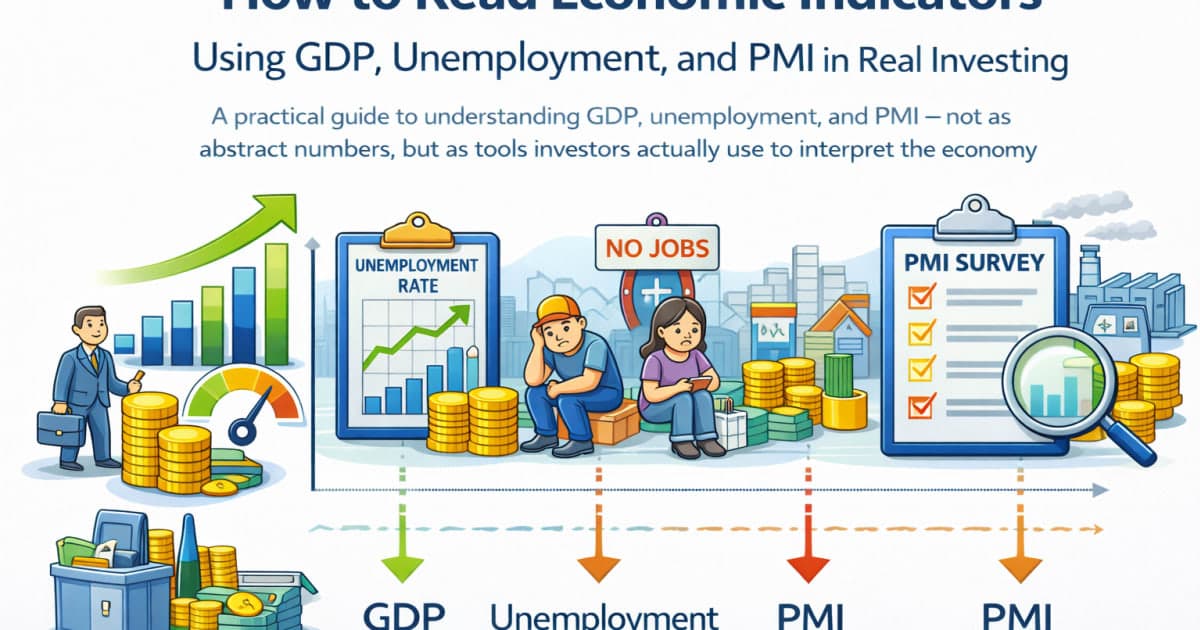
Economic indicators are most useful when investors read them as market signals, not as isolated headlines. GDP, PMI, jobs, inflation, and interest rates each answer a different question about growth, momentum, labor pressure, purchasing power, and policy conditions.
This article is educational. Economic indicators can help structure market analysis, but they do not guarantee investment results or provide trading advice.
Quick Answer
| Question | Short answer |
|---|---|
| What is the best way to read indicators? | Read them as a system: growth, momentum, labor, inflation, and rates. |
| Which indicators lead markets? | PMI and new orders often turn earlier than GDP or unemployment. |
| Why do markets sometimes rise on bad data? | Bad data can lower rate expectations or improve policy support expectations. |
| How should Korea investors use them? | Connect global indicators with KOSPI, USD/KRW, yields, foreign flows, and sector moves. |
Start with the FinMap Market Indices dashboard when you want to connect macro signals to Korea market prices.

The Market Signal Map
Economic indicators do not all answer the same question. The first step is to map each indicator to the market signal it usually provides.
| Indicator | Main signal | Market question it helps answer |
|---|---|---|
| GDP | Growth level and direction | Is the economy expanding or slowing? |
| PMI | Business momentum | Are companies seeing improving or weakening demand? |
| Jobs and unemployment | Labor pressure and cycle maturity | Is the labor market still tight or starting to crack? |
| Inflation | Price pressure and purchasing power | Is policy likely to stay tight or ease? |
| Interest rates and yields | Policy and discount-rate pressure | Are financial conditions tightening or loosening? |
The goal is not to memorize every data release. The goal is to understand which part of the economic story each release updates.
Leading, Coincident, and Lagging Indicators
Market confusion often comes from mixing indicators with different timing.
| Timing type | Examples | How investors usually use it |
|---|---|---|
| Leading | PMI new orders, yield curve, credit conditions | Early warning that the cycle may be changing. |
| Coincident | GDP nowcasts, retail sales, industrial production | Current confirmation of economic momentum. |
| Lagging | Unemployment rate, some wage data, official recession confirmation | Confirmation that the cycle has already shifted. |
PMI can weaken before GDP slows. Unemployment can stay low until late in the cycle. That is why one headline rarely tells the whole story.
For a deeper market-data framework, read How to Use Market Indicators Without Overreacting.
GDP: Growth Context, Not a Timing Tool
GDP tells investors whether the economy is expanding or contracting, but it is published with a delay and often revised. That makes it useful for context, not precise market timing.
| GDP pattern | Possible interpretation | What to check next |
|---|---|---|
| GDP strong, PMI improving | Growth momentum may be broadening. | Earnings revisions and cyclical sectors. |
| GDP strong, PMI falling | Late-cycle risk may be building. | Rates, margins, inventories, and demand signals. |
| GDP weak, PMI stabilizing | Markets may look ahead to recovery. | Policy support, yields, and forward earnings. |
Markets often move before GDP confirms the story.
PMI: Momentum and Turning Points
PMI is useful because it asks companies about current business conditions. A reading above 50 usually suggests expansion, while below 50 suggests contraction.
For investors, the direction and surprise matter more than the level alone.
| PMI signal | Market interpretation |
|---|---|
| PMI rising from low levels | Early recovery signal, especially if new orders improve. |
| PMI above 50 but falling | Expansion continues, but momentum may be slowing. |
| PMI below 50 and falling | Contraction risk is increasing. |
| PMI improving while inflation cools | A more favorable mix for risk assets. |
PMI is especially useful for export-sensitive markets because business momentum can turn before official GDP data.
Jobs, Inflation, and Interest Rates
Jobs data, inflation, and rates should be read together.
| Data mix | Why it matters | Possible market focus |
|---|---|---|
| Strong jobs, sticky inflation | Policy may stay tight. | Higher yields and valuation pressure. |
| Cooling jobs, cooling inflation | Rate-cut expectations may rise. | Duration assets and risk appetite. |
| Weak jobs, sticky inflation | Stagflation concern. | Defensive sectors, FX stress, and earnings risk. |
| Strong jobs, falling inflation | Soft-landing narrative. | Broader equity participation. |
For background, see Inflation Basics, Interest Rate Basics, and Real Rates and Breakevens.
Korea Market Dashboard Connection
For Korea market analysis, global macro indicators become more useful when connected to local market signals.
| Macro signal | Korea market link | Dashboard check |
|---|---|---|
| U.S. yields rising | Discount-rate pressure on growth stocks | U.S. 10Y, Nasdaq, KOSPI growth sectors |
| Dollar strengthening | USD/KRW pressure and foreign-flow risk | USD/KRW, DXY, foreign-sensitive sectors |
| Oil rising | Import-cost and margin pressure | WTI, KRW, energy-sensitive industries |
| PMI improving | Export-cycle support | KOSPI, semiconductors, global equity sentiment |
| Inflation cooling | Policy pressure may ease | yields, real rates, equity multiples |
Use the Market Indices dashboard to compare KOSPI, USD/KRW, U.S. yields, WTI, and global equity benchmarks in one place.

Market Signal Checklist
Before reacting to an economic headline, ask five questions:
- Was the data better or worse than expectations?
- Is it leading, coincident, or lagging?
- Does it change the interest-rate path?
- Does it affect earnings expectations or just sentiment?
- Does Korea market price action confirm it through KOSPI, USD/KRW, and foreign flows?
This checklist prevents a common mistake: treating one indicator as a complete investment thesis.
Example: Reading Mixed Data
| Scenario | Simple headline | Better market reading |
|---|---|---|
| GDP strong, inflation sticky, yields rising | "Economy is strong" | Equities may still struggle if discount rates rise. |
| PMI weak, inflation cooling, yields falling | "Economy is slowing" | Markets may rise if policy easing expectations improve. |
| Unemployment low, PMI falling | "Labor market is fine" | The cycle may already be slowing beneath the surface. |
| USD/KRW rising while KOSPI falls | "Korea stocks are weak" | Check dollar strength, foreign flows, and export-cycle worries together. |
Good macro reading is about combinations, not isolated numbers.
Bottom Line
GDP, PMI, jobs, inflation, and rates are not magic market predictors. They are signals that update expectations about growth, policy, earnings, liquidity, and risk appetite. For Korea investors, the practical workflow is to connect those signals to KOSPI, USD/KRW, U.S. yields, oil, and foreign flows before making any conclusion.
FAQ
Which economic indicator matters most for investors?
No single indicator matters most all the time. PMI often helps with turning points, while GDP gives growth context, jobs confirm labor pressure, and inflation/rates drive policy expectations.
Why do markets sometimes rise after weak economic data?
Markets can rise after weak data if investors believe it increases the chance of lower interest rates or policy support. The surprise and policy channel matter more than the headline alone.
Is GDP useful for market timing?
GDP is useful for context, but it is usually too delayed and revised to be a precise timing tool. Markets often move before GDP confirms the cycle.
How should Korea investors connect indicators to the market?
Compare global macro data with KOSPI, USD/KRW, U.S. yields, oil prices, foreign flows, and sector leadership. Local confirmation matters.
Should I trade based on one economic release?
Most investors should avoid making decisions from one release alone. Read the trend, compare it with expectations, and check whether market prices confirm the signal.