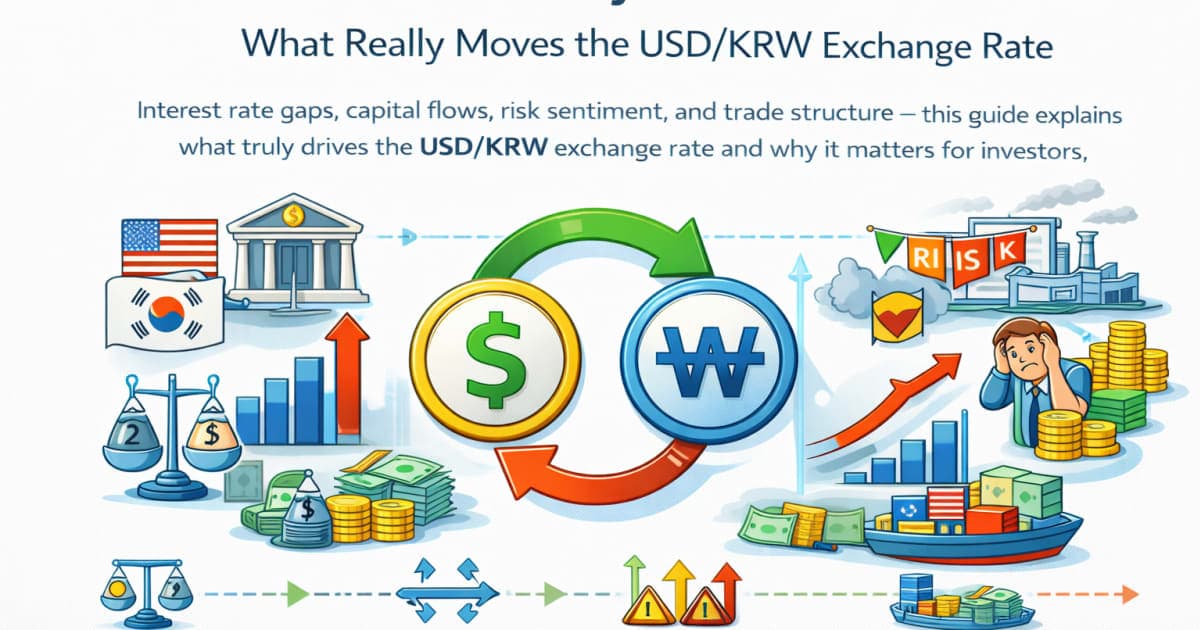
Summary (10 key points)
- Many investors believe exchange rates move randomly, but they do not.
- USD/KRW is primarily driven by interest rate gaps and global capital flows.
- Higher U.S. rates tend to strengthen the dollar structurally.
- Risk-off environments push global funds toward USD assets.
- Korea’s export-heavy economy increases FX sensitivity.
- Exchange rates affect stock markets, ETFs, and foreign investor flows.
- FX moves are usually the result, not the cause, of macro shifts.
- Short-term volatility hides long-term structural drivers.
- Understanding FX improves portfolio risk management.
- Exchange rates connect macro, equity, and bond markets into one system.
The USD/KRW exchange rate is not just a number—it is a summary of global interest rates, risk appetite, and capital allocation decisions.

1. Why Exchange Rates Matter More Than Most Investors Think
Many retail investors treat exchange rates as background noise.
They focus on stock prices, index levels, or ETF returns, assuming currency movements are secondary.
In reality, exchange rates sit at the center of the global financial system.
For Korea, USD/KRW is especially important because:
- Korea is highly dependent on exports
- Foreign investors play a major role in equity liquidity
- Capital inflows and outflows directly affect stock valuations
When USD/KRW moves sharply, it is rarely accidental.
It reflects deeper macro forces already in motion.
If you want the “full chain view” (FX → foreign flows → equity behavior),
start here:
- USD/KRW → KOSPI chain (earnings, inflation, foreign flows)
- How the S&P 500 moves Korea: the FX–rates–foreign-flow chain
2. The Core Structure Behind USD/KRW Movements
Interest Rate Differentials Drive Capital Decisions
At the most basic level, currencies follow relative returns.
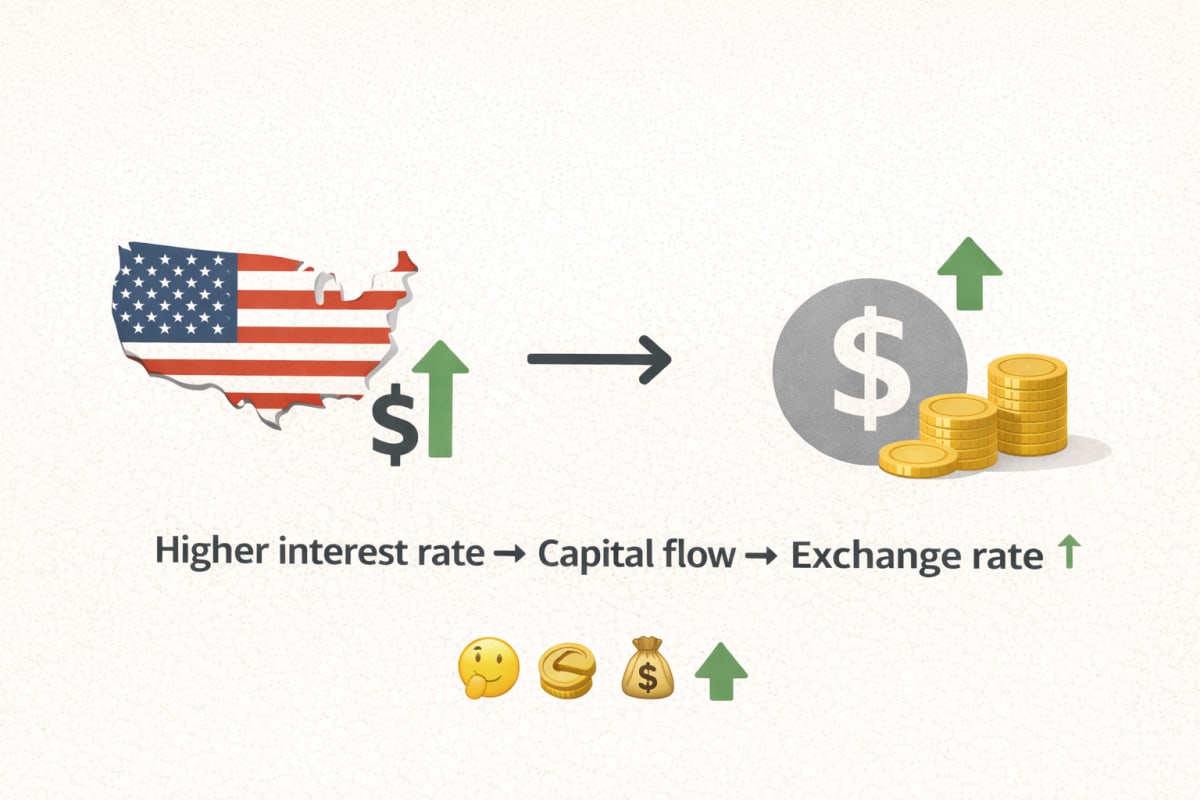
If U.S. interest rates rise faster than Korean rates:
- Dollar-denominated assets become more attractive
- Global capital reallocates toward U.S. bonds and equities
- Demand for USD increases structurally
This is not speculation—it is portfolio optimization.
Even long-term investors such as pension funds and sovereign funds adjust allocations based on yield differentials.
If you want a practical framework for why “rate cuts” sometimes do not lower real borrowing costs (and why FX can still move the opposite way), +read:
And if you want the single rate that often anchors global “USD strength” narratives:
3. Risk Sentiment and the Dollar’s Safe-Haven Role
Interest rates alone do not explain everything.
During periods of global stress—financial crises, geopolitical shocks, or liquidity squeezes—investors seek safety.
In those episodes, “fear” is only half the story. The other half is funding and USD liquidity mechanics. If you want the cleanest one-page model for that translation, read:
The U.S. dollar plays a unique role:
- Deepest bond market
- Global reserve currency
- Highest liquidity under stress
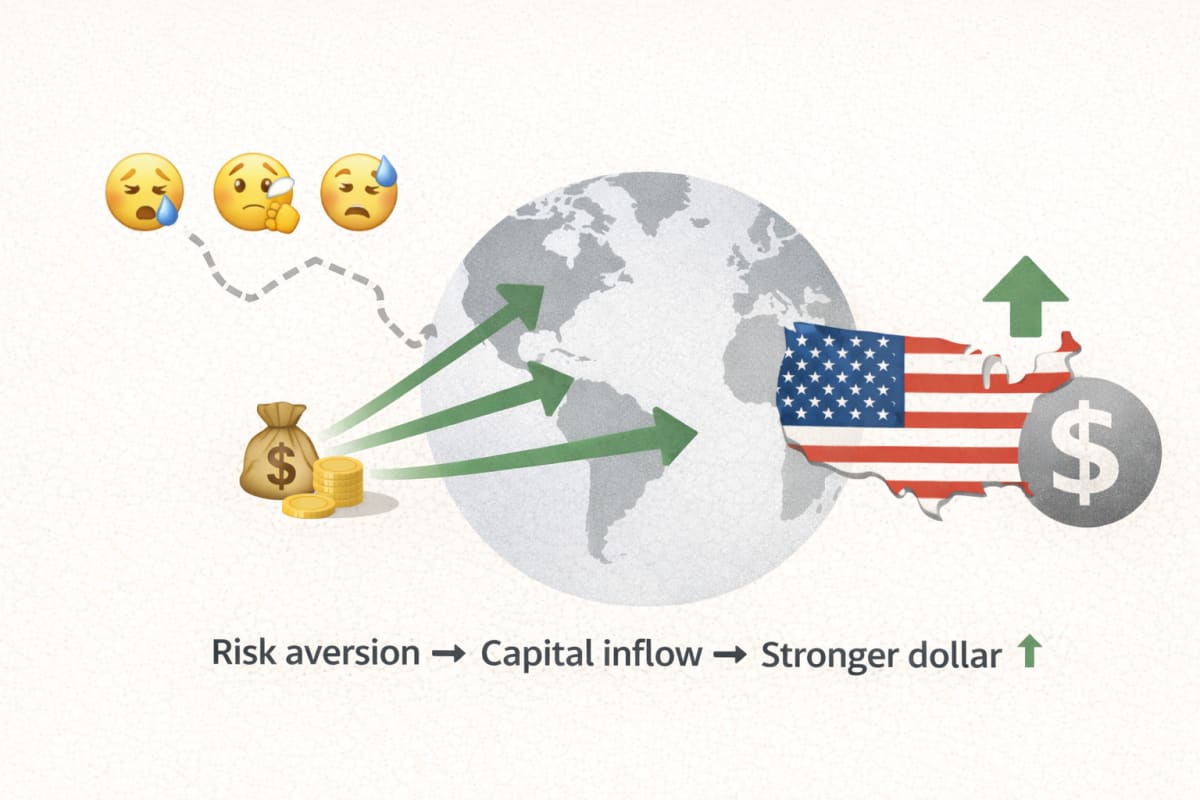
When risk appetite collapses:
- Global funds reduce exposure to emerging markets
- USD demand rises regardless of relative growth
This is why USD often strengthens even when U.S. economic data weakens.
4. Korea’s Structural FX Sensitivity
Korea’s economy has specific traits that amplify FX movements:
- Export-driven growth model
- Heavy exposure to semiconductors and cyclical industries
- High participation of foreign investors in equity markets
This means USD/KRW reacts not only to U.S. policy, but also to:
- Global tech cycles
- Semiconductor demand
- Changes in risk appetite toward Asia
In practice, DXY headlines often proxy “USD strength,” but what matters is how DXY moves the system. Go deeper:
FX volatility is therefore a structural feature, not a temporary anomaly.
5. Visualizing the FX Mechanism
The following visuals summarize how USD/KRW responds to macro forces.

6. Exchange Rates and the Stock Market Connection
USD/KRW movements directly influence Korean equities in three ways:
Foreign investor behavior
A weaker KRW increases FX risk for foreign holders, often accelerating outflows.Valuation compression
Higher global rates raise discount rates, hurting growth-heavy indices.Sector-level impact
Exporters may benefit short-term, but valuation effects often dominate.
This explains why FX spikes often coincide with equity volatility.
If your goal is “actionable interpretation,” these two are the best next steps:
- Who wins and loses when KRW weakens? A KOSPI sector map
- How U.S. 10Y yields impact Korea and global markets
And if you’re tracking oil shocks as a KRW catalyst:
7. Common Misconceptions About USD/KRW
Common Misunderstandings
- “FX moves are unpredictable”
- “Exchange rates don’t affect stocks”
- “Short-term FX charts explain everything”
Reality
- FX reflects macro fundamentals
- Equities and FX are tightly linked
- Long-term drivers matter more than noise
8. Practical Takeaways for Investors
Understanding FX does not require trading currencies directly.
Instead, it helps investors:
- Interpret foreign capital flows
- Anticipate equity volatility
- Manage ETF and overseas asset exposure
- Avoid misreading short-term market moves
FX awareness improves risk context, not speculation accuracy.
9. Related FinMap Articles (A good piece of writing to read together)
- What Is CAGR and Why It Matters
- Inflation and Interest Rate Basics
- How U.S. 10Y Yields Impact Korea
- ETF Selection and Macro Sensitivity
FX + liquidity (why USD strengthens)
- When geopolitics turns into dollar strength: USD liquidity model
- How DXY moves the market: USD/KRW and KOSPI impact
Rates (why “cuts” don’t always ease conditions)
- Policy vs market rates: the practical separation
- Why 2s10s and 3m10y disagree (recession-signal reading)
Korea market chain (FX → flows → equities)
Oil / tariffs as FX catalysts
10. Using FX Insight with FinMap Tools
Apply FX Awareness to Your Investment Plan
FinMap’s calculators help you evaluate returns, risks, and long-term outcomes while considering macro environments like interest rates and currency trends.
Try Compound Interest CalculatorFAQ
Q1. Is USD/KRW driven more by U.S. or Korean factors?
Both matter, but U.S. interest rates and global risk sentiment usually dominate.
Q2. Does a weaker KRW always help Korean stocks?
Not necessarily. Export benefits often get outweighed by valuation and capital outflows.
Q3. Should long-term investors worry about FX?
They should understand it, even if they do not trade it directly.
Q4. Can FX trends reverse quickly?
Short-term moves can reverse, but structural drivers persist longer than most expect.