Summary (10 key sentences)
- Many investors say “7% per year is enough,” but very few understand what the number actually represents.
- A 7% annual assumption must be interpreted as CAGR, not as a simple expectation.
- Failing to distinguish expected returns from actual CAGR leads to major long-term miscalculations.
- Especially in ETF or index investing, “7%” often becomes a psychological illusion rather than a realistic figure.
- Historical S&P 500 data shows a long-term CAGR of around 9–10%.
- But real-life CAGR is affected by volatility, inflation, taxes, and withdrawal timing.
- Higher volatility almost always reduces CAGR compared with simple average returns.
- Compound interest calculators or goal simulators reveal the real impact of a 7% annual growth assumption.
- The number “7%” can be conservative or unrealistic depending on timeline, market regime, and savings rate.
- This article thoroughly analyzes what “7% annual return” truly means in a long-term investing context.
One-paragraph summary
Investors frequently assume that earning “7% per year” is both realistic and achievable, but the number only makes sense when interpreted as long-term CAGR—not as a simple average. The S&P 500’s historical CAGR ranges from 6% to 12% depending on the time period, and volatility, inflation, and taxes significantly reduce real returns. This article provides a detailed, data-based explanation of how a 7% assumption behaves in real markets and how investors should use compound interest and goal calculators to set realistic expectations.
Related reads: CAGR calculator guide, Monthly investment calculator guide, and DCA consistency guide. Compare your own assumptions in the CAGR Calculator and Goal Simulator.

1. Introduction
When discussing investing, one of the most common statements is:
“If I can just earn 7% a year, I’ll be fine.”
The problem is that this sentence hides many important questions:
- Is the 7% return before or after taxes?
- Does it assume inflation?
- Does it ignore volatility?
- Is the number based on actual historical CAGR?
- Does it hold during long corrections, crashes, and sideways markets?
Most investors never explore these questions, which leads to unrealistic expectations.
This article removes that illusion and interprets 7% through the lens of actual long-term CAGR.
2. The Hidden Meaning Behind “7% Per Year”
A familiar number that hides important details
“7% per year” only makes sense when interpreted as long-term CAGR. Market volatility, recessions, and drawdowns can dramatically reduce actual CAGR even when the average return appears higher. This section breaks down what the 7% assumption really means.
Key Points
- “7% per year” must refer to CAGR, not simple averages
- Expected returns and actual long-term CAGR differ significantly
- S&P 500 CAGR varies widely depending on the period analyzed
3. The Common Misunderstanding: Expected Returns vs. Actual CAGR
When people say “7% return,” they usually mean expected returns (arithmetic average).
But what actually matters is CAGR (geometric return).
Why?
✔ Expected return and CAGR are fundamentally different
- Expected return: simple average of yearly returns
- CAGR: actual compounded growth after volatility
And these two can diverge A LOT.
Example
Yearly returns: +20%, -10%, +20%, -10%
- Simple average = +5%
- Actual CAGR = ≈ 0%
Volatility destroys CAGR.
4. Table 1 — Expected Return vs. Real CAGR
| Scenario | Yearly Returns | Simple Average | Actual CAGR |
|---|---|---|---|
| A | +10%, +10%, +10% | +10% | +10% |
| B | +20%, -10%, +20% | +10% | ≈ 4.9% |
| C | +30%, -30%, +30% | +10% | ≈ 0% |
➡ Even with the same average return, CAGR collapses under higher volatility.
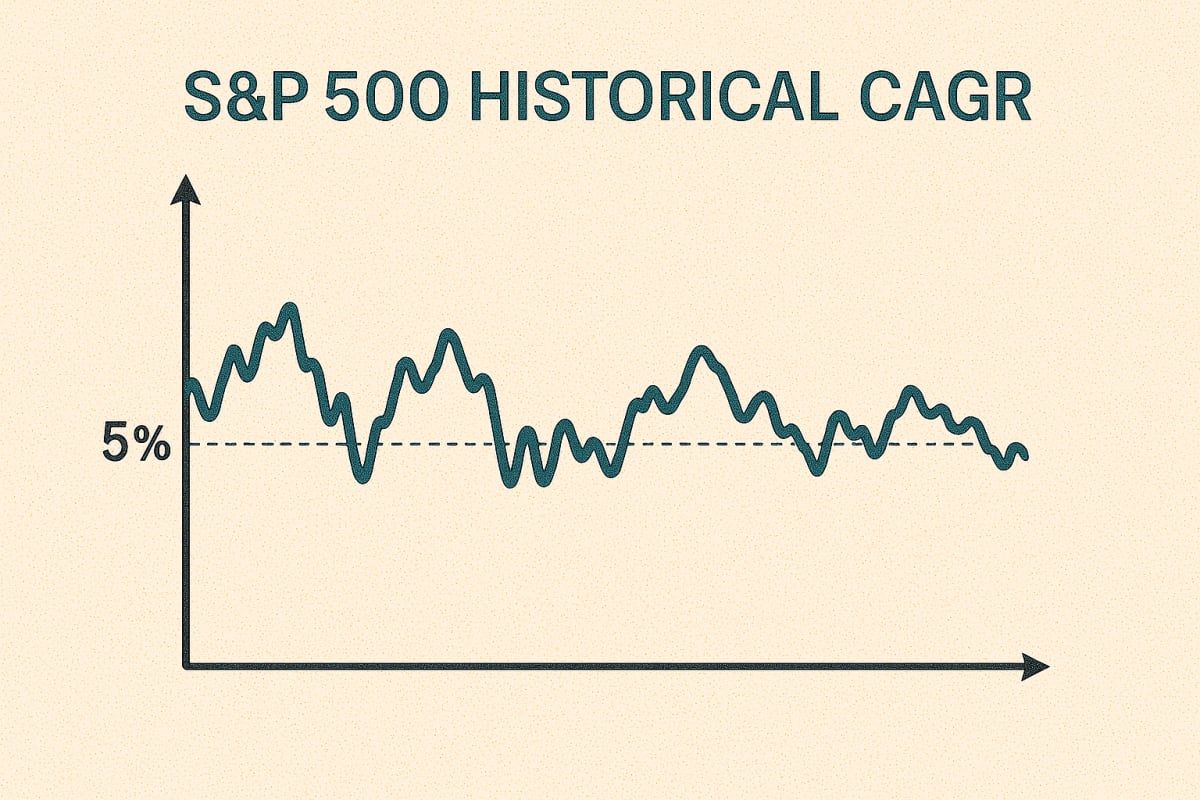
5. S&P 500 Long-Term CAGR — Is 7% Realistic?
| Period | CAGR | Notes |
|---|---|---|
| 1928–2023 | ~9.8% | Full historical dataset |
| 1980–2023 | ~11.6% | Strong bull cycle |
| 2000–2023 | ~6.6% | Includes IT bubble + Financial crisis |
| 2010–2023 | ~12.1% | Ultra-low rates + liquidity boom |
✔ “7% CAGR” is realistic — but not guaranteed
- Lower than long-term averages → conservative
- Higher than crisis-period averages → optimistic
The truth:
7% sits right in the middle of long-term reality.
But volatility determines whether you actually get 7% or 4% or 10%.
6. Visualizing the Power of 7% CAGR


7. Beginners vs. Experts — How Each Should Use the 7% CAGR
✔ 1) Beginner Investors
For beginners, savings rate matters more than CAGR.
Key guidelines:
- Focus on consistent monthly contributions
- Avoid chasing high returns
- Use conservative growth assumptions (5–7%)
- Use goal simulators to test different scenarios
→ Early on, your savings grow faster than your investments.
✔ 2) Experienced Investors
Experts treat 7% very differently.
- They manage volatility to protect CAGR
- They balance stocks, bonds, and dividends
- They focus on long horizons (20–30 years)
- They optimize taxes and reinvestment efficiency
- They know 1–2% CAGR difference doubles or halves wealth
→ For experts, CAGR is not just a number;
it’s a long-term risk-adjusted performance target.
8. What 7% CAGR Actually Generates
✔ Example: $400/month investment at 7% for 30 years
(~₩500,000 → $400 conversion)
| Item | Result |
|---|---|
| Total Contributions | ~$144,000 |
| Compound Growth | ~$320,000 |
| Final Portfolio | ≈ $460,000 |
➡ A modest 7% results in over triple the contributed capital.
9. Callout — The Real Meaning of “7% CAGR”
10. Checklist — Making 7% CAGR Realistic
- Do not rely solely on historical averages
- Separate expected return from actual CAGR
- Review long-term (20–30 year) datasets
- Understand how volatility reduces geometric returns
- Maintain consistent saving habits
- Simplify portfolios using diversified ETFs
- Keep investment periods as long as possible
11. Conclusion
- A 7% annual return must be interpreted as long-term CAGR, not a simple expectation.
- Historical data suggests that 7% is realistic but not guaranteed due to volatility.
- Long-term consistency, savings, and diversification are essential to achieving such CAGR.
12. FinMap Tool CTA
Check 7% with FinMap’s CAGR Calculator
Convert starting value, ending value, and holding period into CAGR before treating 7% as a planning assumption.
Try CAGR Calculator13. FAQ
Q1. Is the 7% assumption before or after tax?
A: Typically before tax. After tax, net CAGR is usually 1–2% lower.
Q2. Does the S&P 500 guarantee 7%?
A: No. Depending on the timeframe, CAGR can range from 0% to 12%.
Q3. Can beginners safely use 7% as a planning number?
A: Yes, but savings rate matters far more early on.
Q4. What helps increase actual CAGR?
A: Lower volatility, proper diversification, and consistent contributions.