Summary (10 sentences)
- Dollar-cost averaging (DCA) is less about “beating the market” and more about staying invested through real life.
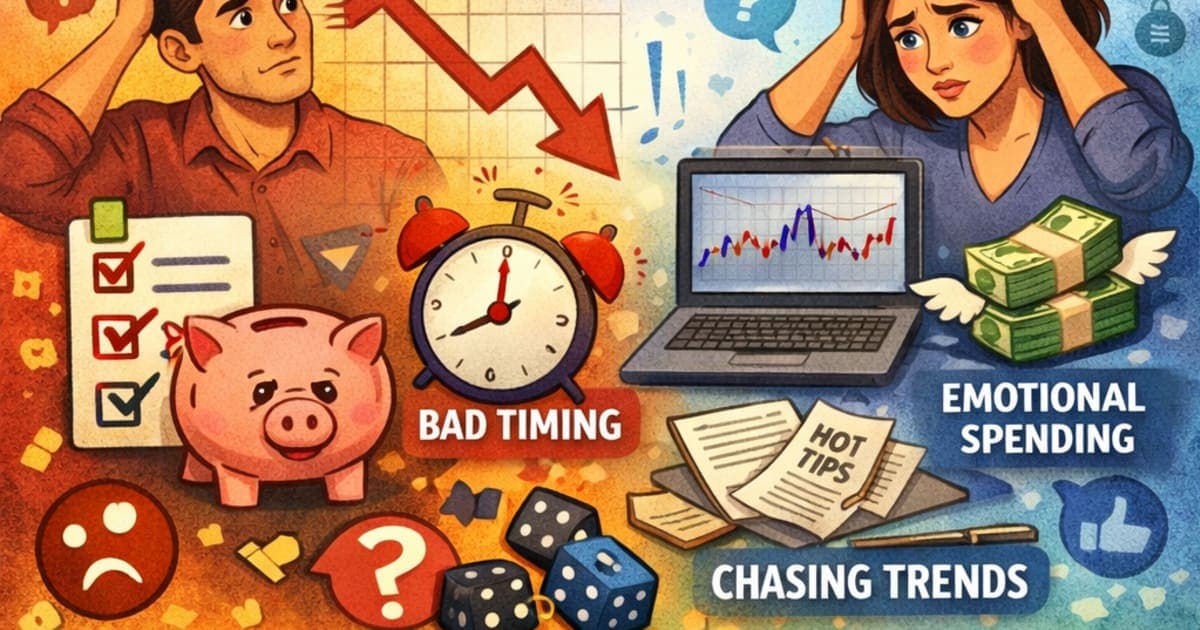
- Most DCA plans don’t fail because the market is hard—they fail because the plan is too fragile to survive volatility.
- The biggest mistake is setting contributions at your maximum, not your sustainable level.
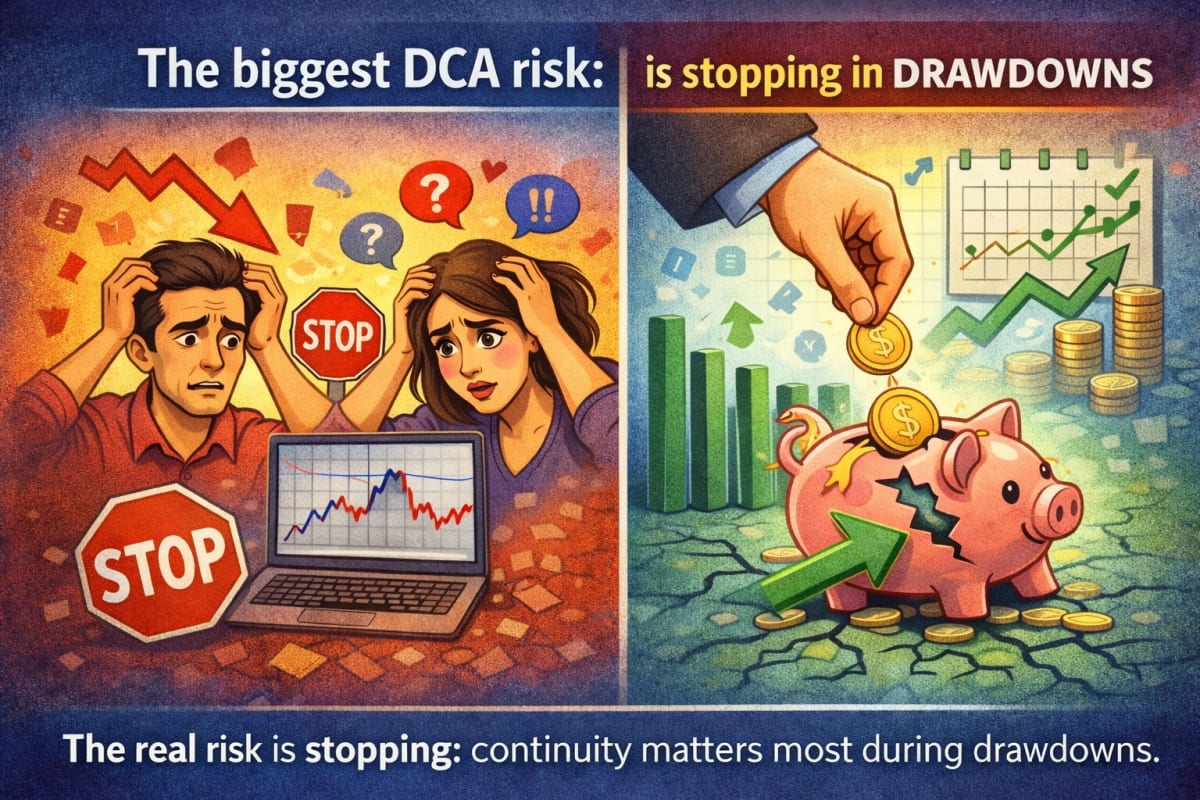
- The second biggest is pausing contributions during drawdowns—exactly when the strategy’s logic matters most.
- Increasing contributions only when prices are rising is another form of emotional timing.
- DCA works best when paired with a risk rule (rebalancing) and a cash-flow rule (buffers and pause conditions).
- Expected return assumptions (like “7% a year”) should be treated as scenarios, not promises.
- Fees, taxes, and FX friction quietly erode long-horizon outcomes if you ignore them.
- The right success metric isn’t “this month’s gain,” but CAGR, drawdown tolerance, and contribution continuity.
- This post breaks down seven failure patterns and gives you a simple rulebook to rebuild a DCA system you can keep.
One-paragraph overview
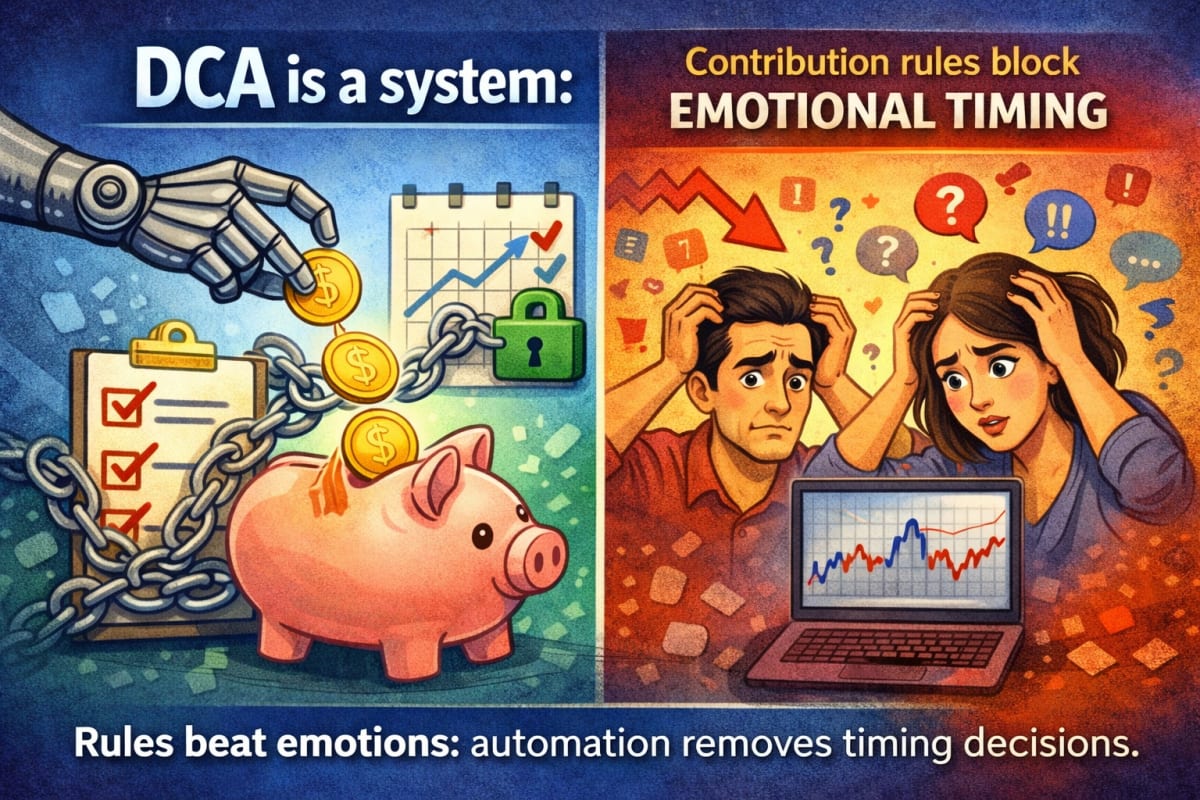
Many investors treat DCA as a performance trick—“average down and win.” But DCA is really an operating system for investing: it reduces timing mistakes by replacing decisions with rules. The trade-off is that you must design the rules for durability: sustainable contributions, clear pause conditions (rare), and a rebalancing framework to keep risk stable. Below you’ll find seven common ways DCA collapses, plus tables, checklists, and a practical setup you can apply today.

1) The biggest DCA misconception: it’s not a return strategy, it’s an error-reduction system
DCA is commonly described as “averaging down,” but that framing pushes people toward the wrong behavior: watching the price and trying to feel smart. A better mental model is this:
- DCA replaces timing decisions with a schedule.
- The schedule only works if it survives drawdowns.
- Therefore the main goal is contribution continuity.
If you judge DCA by monthly performance, you’ll keep changing it. If you judge it by whether you can run it for years without breaking, you’re using it correctly.
2) A durable DCA system has three rules, not one
DCA operating system
A sustainable DCA plan is built on three rule types: (1) an input rule (when and how much you buy), (2) a risk rule (how you keep allocation from drifting), and (3) a cash-flow rule (buffers and rare, pre-defined pause conditions). If you only have an input rule, volatility will eventually force you to improvise—and improvisation is where plans break.
Fast self-check
- Is my contribution level sustainable for 36 months?
- Do I have a rebalancing rule?
- Do I have a “pause only for life events” rule?
3) The 7 DCA failure patterns (signals → cause → fix)
Failure #1) Setting contributions at your maximum (not your sustainable level)
- Signal: Your plan competes with rent, emergencies, and real life
- Cause: You optimized for speed, not survivability
- Fix:
- Set contributions at a 36-month sustainable level, not a best-case month
- Build a buffer (emergency fund) outside the portfolio
- Automate contributions so emotions can’t “vote”
Failure #2) Pausing contributions during drawdowns (the core strategy breaker)
- Signal: You stop the plan when the chart looks scary
- Cause: You see drawdowns as “danger,” not “expected cost”
- Fix:
- Define pause conditions only for life events (job loss, medical, cash emergency)
- Write the pause rules down before volatility arrives
- If you must reduce, do it by a pre-defined percentage—don’t go to zero
Failure #3) Increasing contributions only in rallies (emotional timing)
- Signal: You “feel safe” only when prices are already higher
- Cause: Trend-chasing disguised as DCA
- Fix:
- Increase contributions only on a calendar rule (e.g., once a year +5–10%)
- Treat bonuses separately (one-time contribution rule)
- Avoid “I’ll add more if the market looks good” logic
Failure #4) Using a single optimistic return assumption (the “7% trap”)
- Signal: Your plan looks perfect in a spreadsheet but fails in reality
- Cause: You confuse long-term CAGR with short-term performance
- Fix:
- Use three scenarios (conservative/base/optimistic)
- Stress-test your plan with drawdowns, not just averages
- Track your real results as CAGR rather than headline gains
- Related reading: Why “7% per year” needs a reality check (CAGR lens)
Failure #5) No rebalancing rule (risk silently drifts until it breaks you)
- Signal: One asset dominates after a run, and the portfolio becomes fragile
- Cause: Input rule exists, but risk rule doesn’t
- Fix:
- Choose either calendar rebalancing (semiannual/annual) or band rebalancing (±5%p drift)
- Rebalancing is not “taking profit”—it’s risk control
- A macro lens also helps contextualize stress regimes: Global indicators that most affect KOSPI (overview)
Failure #6) Ignoring friction (fees, taxes, and FX) — the slow leak
- Signal: Your account grows slower than your model
- Cause: You modeled gross returns, but you live in net returns
- Fix:
- Estimate annual total friction (fees + taxes + spreads + FX costs where relevant)
- If transaction costs are meaningful, consider adjusting frequency (monthly → every two months)
- If you invest across currencies, understand the FX layer:
Failure #7) Measuring the wrong thing (monthly returns instead of durability)
- Signal: You change the plan every quarter
- Cause: Short-horizon measurement forces short-horizon decisions
- Fix:
- Evaluate on CAGR + drawdown tolerance + continuity
- For performance hygiene, use a CAGR-based lens:
4) Bad DCA vs Durable DCA
Bad DCA
- Optimizes for maximum contribution
- Stops during drawdowns
- Increases only when markets feel good
- Uses one rosy return number
- Has no rebalancing rule
- Tracks monthly performance and panics
Durable DCA
- Optimizes for 36-month sustainability
- Pauses only for life events
- Increases on a calendar rule
- Plans with scenarios, not promises
- Rebalances to keep risk stable
- Measures CAGR, drawdowns, and continuity
5) Table 1 — Build your DCA rulebook (input + risk + cash-flow)
| Rule type | The question | Example rule template | What it prevents |
|---|---|---|---|
| Input rule | When/how much do I buy? | Fixed day monthly autopay | emotional timing |
| Increase rule | When do I raise it? | once a year +7% | rally-chasing |
| Risk rule | How do I control allocation? | annual or ±5%p band | silent risk drift |
| Pause rule | When can I stop? | life events only | drawdown panic |
| Friction rule | How do I treat costs? | annual friction estimate | slow leakage |
6) Visual Overview

7) Starter mode: 3 rules that cover 80% of outcomes
If you’re early in the journey, you don’t need a complex system. Start with three rules:
- Auto-invest monthly on a fixed date
- Pause only for life events (written in advance)
- Change your plan only once per year
That alone eliminates most self-inflicted mistakes.
8) Advanced mode: measure what matters (CAGR + drawdown + continuity)
Experienced investors ask different questions:
- Not “Did I win this month?” but “Did I follow the rulebook this year?”
- Not “Was my average price low?” but “Did I avoid plan-breaking behavior?”
- Not “Did it go up?” but “Is risk drifting beyond my tolerance?”
This is why a CAGR-based review (with drawdown awareness) is often a better compass than short-term gains.
9) Table 2 — Drawdown response: decide before the stress arrives
| Situation | Emotional response (risk) | Rule-based response (recommended) | Goal |
|---|---|---|---|
| -10% correction | “pause for a bit” | keep autopay, review annually | prevent stop |
| -20% drawdown | “sell and re-enter later” | keep plan, check buffer | survival first |
| volatility spike | “skip this month” | keep schedule | remove emotion |
| rebound | “add a lot now” | follow annual increase rule | avoid overreach |
10) Checklist: is your DCA built for real life?
- Contribution level is sustainable for 36 months
- Contributions are automated (no monthly decisions)
- Pause conditions are written and limited to life events
- Increases happen on a calendar rule (not emotion)
- Rebalancing rule exists (calendar or band)
- Fees/taxes/FX friction are estimated annually
- Performance is reviewed in CAGR terms, not monthly noise
- You run conservative/base/optimistic scenarios for planning
11) Conclusion (3 lines)
- DCA isn’t a return hack—it’s a durability system for long-term investing.
- Most failures come from fragile rules and emotional overrides, not from the market itself.
- Build a rulebook (input + risk + cash-flow), and measure success by continuity.
12) CTA — Stress-test your DCA plan with numbers
Is your DCA plan actually sustainable?
When you model contribution size, return scenarios, and friction (fees/taxes), you’ll quickly see where “too aggressive” turns into “future pause risk.” Use a simulation to set a plan you can keep.
Open the FinMap DCA SimulatorWant to start from a goal instead of a contribution?
If you prefer to define a target amount and timeline first, reverse-engineer the required monthly investment and adjust until it’s sustainable.
Open the Goal Simulator13) A good piece of writing to read together
- Why “7% per year” needs a reality check (CAGR lens)
- Diagnose your investing skill with CAGR (with drawdown & volatility)
- Why you should check CAGR when picking ETFs/funds
- FX basics confirming the USD/KRW layer
- How USD/KRW influences Korea and KOSPI
- Global indicators that most affect KOSPI (overview)