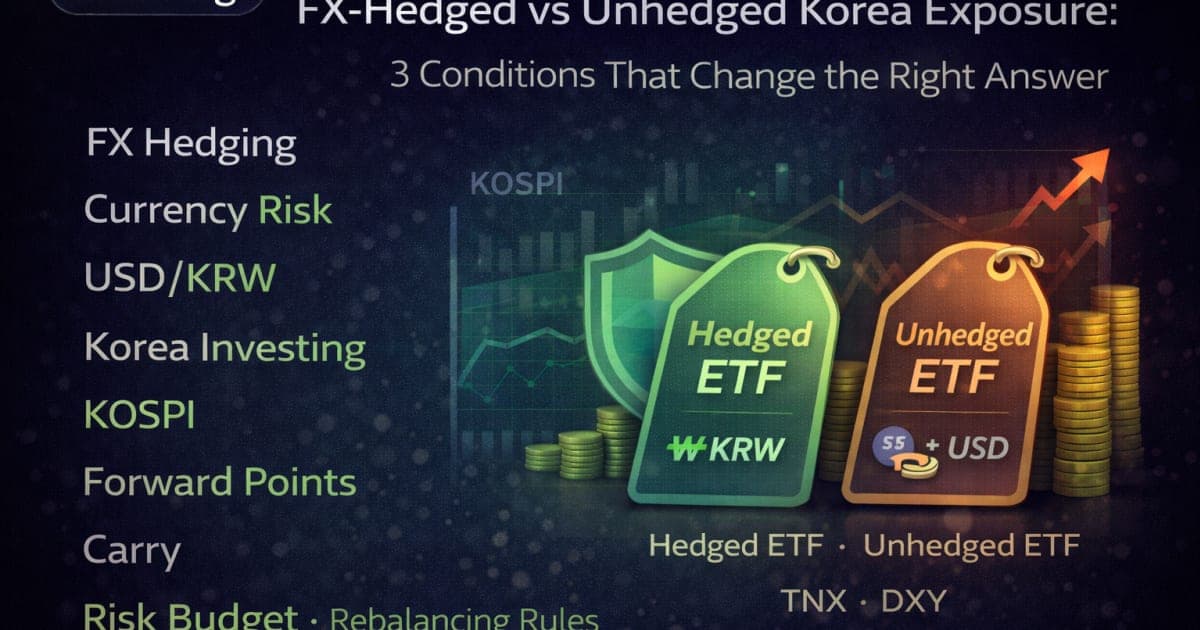
INVESTING · FX RISK · KOREA OVERLAY
If you’re a U.S.-based investor buying Korea equities, Korea bond ETFs, or Korea-focused funds, the most common mistake is trying to answer a question that has no universal truth: “Should I hedge the KRW or stay unhedged?”
The better question is: What job is this position supposed to do inside my portfolio? Hedging is not about being “safe” or “smart.” It’s about choosing which risk you want to own: local asset risk vs local asset risk + currency risk.
- Condition 1: Your liability currency (what you’ll spend in) decides what “risk” means.
- Condition 2: Hedge cost (forward points / carry) can quietly dominate returns.
- Condition 3: The role of Korea in your portfolio (diversifier vs satellite bet) flips the decision.
Scope note: This is not a product recommendation. It’s a decision framework + rules you can actually follow.

The core concept: you’re not hedging “Korea”—you’re hedging KRW
When you buy a Korea equity ETF or a Korea bond ETF from the U.S., you’re taking two layers of risk:
- Local asset risk (Korea stocks/bonds moving in KRW terms)
- Currency risk (USD/KRW moving between your buy date and sell date)
A hedged position tries to remove layer (2).
An unhedged position keeps both layers.
The catch: layer (2) is not “noise.” In certain regimes, currency moves can dominate the entire result—even if the underlying Korea market performs fine.
So the “right” answer depends on which outcome you are trying to protect.
Start with the only question that matters: what currency will you spend in?
Most debates about hedging miss the real anchor:
- If you are a U.S.-based investor spending in USD, your real-life goal is USD purchasing power.
- That means currency exposure is not optional—it’s part of your lived reality.
Condition 1 (Liability Currency)
Hedge more when:
- your goals are near-term and USD-specific (home down payment, tuition, planned spending)
- you cannot tolerate a currency-driven drawdown at the worst possible time
- this Korea position is meant to be “stable capital,” not an adventure
Hedge less when:
- your horizon is long (10+ years) and you can accept multi-year currency cycles
- this is a small “satellite” allocation where volatility is acceptable
- you already own a lot of USD assets and want some non-USD behavior in the portfolio
If the money has a calendar date (spending deadline), prioritize hedging.
If the money has a decade (long horizon), prioritize portfolio role and hedge costs.
Hedge cost is not a detail—it can be the entire story
Most investors think of hedging as “insurance.”
But FX hedging isn’t free. The cost often comes from:
- interest-rate differentials (USD rates vs KRW rates)
- forward points and market pricing
- sometimes cross-currency basis (market funding stress / liquidity effects)
Condition 2 (Hedge Cost / Forward Points)
You don’t need to predict FX. You just need to respect this:
If hedging costs are persistently high, hedging can turn a decent local return into a disappointing USD return.
A simple mental model (not exact, but directionally useful)
- Hedged return ≈ local asset return (in KRW) minus hedge cost
- Unhedged return ≈ local asset return plus FX move (KRW vs USD)
That means:
- Hedging removes FX volatility, but replaces it with an often-steady cost/benefit stream.
- In some eras, that stream is negative enough to matter more than market performance.
If your goal is stability, pay the hedge cost—but only for the portion of your portfolio where stability is the job.
If your goal is diversification, don’t automatically pay a high hedge cost just to feel “clean.”
The three conditions that flip the answer
Here’s the framework in one screen. You’ll use it to choose hedged vs unhedged vs partial hedge.
Condition 1: What’s the spending currency + time horizon?
- USD spending soon → hedge more
- long horizon → hedge decision depends on costs + role
Condition 2: What’s the hedge cost regime?
- low/neutral hedging costs → hedging becomes more attractive
- high hedging costs → hedging should be limited to “stability bucket”
Condition 3: What job does Korea play in your portfolio?
- diversifier / risk-off behavior → often unhedged is the point
- tactical bet / return engine → hedge decision depends on whether you want FX to be part of the bet
Korea exposure behaves differently depending on what’s moving global markets
For U.S.-based investors, Korea is not just “another country.”
Korea is often a high-beta market with strong linkages to:
- global risk sentiment
- USD strength (often proxied by DXY)
- U.S. rates (often proxied by TNX)
- global liquidity cycles
That’s why hedging can change not just volatility, but the meaning of the position.
If you want the macro chain behind this (rates → USD → flows → equity multiples), these help:
- How U.S. 10Y Yield (TNX) Affects ETFs: Growth, Value, EM, and Korea
- USD/KRW Exchange Rate: What It Means for Korea’s Economy and the KOSPI
Hedged vs unhedged: what you gain and what you give up
Unhedged Korea exposure: you own the full story
You gain
- potential diversification if KRW behaves differently from USD assets
- a natural “macro overlay” (USD strength/weakness shows up in returns)
- one less moving part (no hedge-roll mechanics, no tracking issues)
You give up
- cleaner performance attribution (was it Korea or currency?)
- stability during USD spikes or KRW drawdowns
- predictable return profile for short/medium horizons
Hedged Korea exposure: you buy the local asset more purely
You gain
- cleaner exposure to Korea asset returns (in KRW)
- more stable USD results when FX is volatile
- a framework that’s easier for goal-based planning
You give up
- you pay hedge cost
- you may lose diversification benefits
- you may underperform in periods where KRW strengthens vs USD
A practical decision tree (U.S. investor version)
Use this as a rule-based approach.
Step 1) Put the position in a “bucket”
- Bucket A: Goal money (deadline, USD spending) → hedge default
- Bucket B: Long-term growth (10+ years) → role + hedge cost decide
- Bucket C: Tactical macro bet → define whether FX is part of the bet
Step 2) Choose hedge ratio (not binary)
Instead of “hedge or not,” choose:
- 0% hedge (unhedged)
- 50% hedge (partial hedge)
- 100% hedge (fully hedged)
Why partial hedging works:
It reduces the chance that FX dominates returns, while still keeping some diversification.
- Goal money: 100% hedged
- Long-term growth: 0–50% hedged depending on hedge cost and risk budget
- Tactical: define first; then choose hedge ratio that matches the thesis
The “3-condition” checklist: decide in 60 seconds
1) Deadline check (liability)
- Do you need the money in USD within 3 years?
- Yes → hedge most/all
- No → go to next
2) Hedge cost check (regime)
- Is hedging meaningfully costly right now?
- Yes → hedge only the stability portion
- No → hedging becomes more attractive
3) Role check (portfolio job)
- Is Korea meant to diversify your U.S. core, or amplify it?
- diversify → unhedged or partial hedge
- amplify/tactical → decide whether FX is part of the thesis
A clean way to talk about “risk” without spreadsheets: risk budget language
Currency debates get emotional because “risk” is fuzzy.
So use a clearer definition:
- Risk = the chance you abandon the plan (sell at the wrong time)
- A hedge is valuable if it prevents abandonment in a stress regime
So the question becomes:
Will FX volatility make me abandon my Korea position at the worst time?
If yes, hedge more.
If no, don’t pay for emotional insurance you don’t need.
What to watch if you’re investing into Korea from the U.S.
You don’t need 20 indicators. You need a small set that explains regimes:
- U.S. rates (TNX): affects global discount rates and USD behavior
- USD strength (DXY): tends to pressure non-USD assets and EM-like exposures
- USD/KRW: the direct channel into your returns
If you want the market interpretation chain:
Implementation rules that survive real life
Rule 1) Hedge your “goal bucket” and stop thinking about it
If you keep changing hedge decisions for near-term money, you’re reintroducing timing.
Rule 2) For long-horizon allocations, revisit hedge ratio on a calendar
Pick a rhythm:
- semiannual or annual review (not reactive)
Rule 3) Use partial hedging when you can’t justify extremes
If you keep arguing with yourself, it’s often because both sides are partly correct.
Rule 4) Don’t mix “macro trading” with “goal planning”
If you want to bet on KRW, label it as a tactical sleeve—don’t contaminate your plan.
A short “Korea overlay” for U.S. investors
Korea’s market structure often amplifies global cycles (rates, USD, liquidity).
That means:
- in risk-off regimes, KRW may weaken and Korea equities may fall simultaneously
- your unhedged exposure can feel “double volatile”
Hedging does not make the position “better.”
It makes the position’s job more specific.
If you want a broader map of how global variables transmit into the KOSPI:
Where people fail (and how to avoid it)
- Making it a moral identity (“I’m an unhedged person”)
- Overreacting to FX headlines (switching hedge on/off emotionally)
- Ignoring hedge cost (thinking stability is free)
- Not defining the portfolio job (diversifier vs return engine)
Hedging is not about being right—it’s about keeping your plan alive when regimes change.
FAQs
1) Is FX hedging always safer?
It’s safer in one dimension (FX volatility), but it introduces another (hedge cost and hedge-roll behavior). “Safer” depends on what job the position has.
2) If I believe KRW will strengthen, should I stay unhedged?
That’s a macro bet. It can be valid—but label it as tactical. Don’t mix it into your goal bucket.
3) Why not always hedge 100% to isolate Korea equity risk?
Because hedging can reduce diversification benefits, and hedge costs can materially reduce returns. Full hedging is best reserved for money that needs stability.
4) Is partial hedging just indecision?
No. Partial hedging is a risk-budget tool: reduce the chance FX dominates outcomes while keeping some diversification.
5) What horizon makes hedging less important?
In practice, the longer your horizon, the more the decision shifts from “stability” to “role + cost.” But long horizons do not eliminate currency regimes—they just make them survivable.
6) Which indicators best explain the regime for a U.S. investor into Korea?
TNX (global rates), DXY (USD strength), and USD/KRW (direct FX channel) are usually enough to interpret most regimes.
7) If I already own mostly U.S. assets, does unhedged Korea exposure help diversification?
Sometimes. It depends on how KRW behaves relative to your existing assets during stress. The point is not “always diversifying,” but “different behavior when it matters.”
8) How often should I reconsider my hedge decision?
Prefer calendar-based reviews (semiannual/annual) unless your portfolio goals materially change (timeline, cash flow, risk budget).