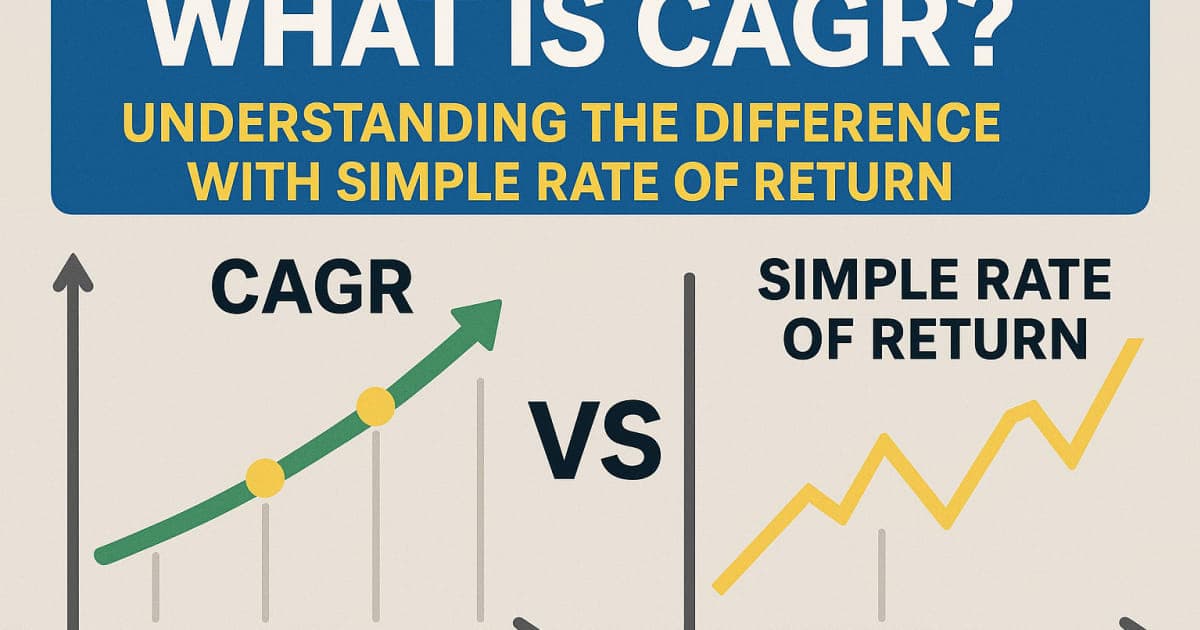
CAGR, or compound annual growth rate, answers one practical question: if an investment moved from one value to another over several years, what steady annual return would produce the same result? It is the annualized return investors use to compare long-term results across ETFs, funds, portfolios, and other assets.
This article is educational. CAGR is a measurement tool, not a promise of future returns or investment advice.
Quick Answer
| Question | Short answer |
|---|---|
| What is CAGR? | The steady annual growth rate that connects a starting value to an ending value over a set number of years. |
| How is it different from simple return? | Simple return shows total gain; CAGR converts that gain into an annualized compound rate. |
| When is CAGR useful? | When comparing ETFs, funds, portfolios, or strategies over different holding periods. |
| What does CAGR hide? | The path. It does not show drawdowns, volatility, fees, taxes, or the timing of contributions. |
Use the FinMap CAGR Calculator when you know the starting value, ending value, and number of years.

CAGR Formula
The CAGR formula is:
CAGR = (Ending Value / Starting Value)^(1 / Years) - 1
The formula assumes the investment grew at a steady compound rate. Real investments rarely move in a straight line, but CAGR gives a clean annualized number for comparison.
CAGR Example: Starting Value, Ending Value, and Years
Suppose an investment grows from $10,000 to $15,000 over 5 years.
| Input | Value |
|---|---|
| Starting value | $10,000 |
| Ending value | $15,000 |
| Holding period | 5 years |
| Simple return | 50.0% |
| CAGR | 8.45% per year |
The simple return says the investment gained 50% in total. CAGR says that the same result is equivalent to earning about 8.45% per year, compounded for 5 years.
That distinction matters because a 50% gain over 2 years and a 50% gain over 10 years are very different outcomes.
Simple Return vs CAGR
Simple return is useful for a quick headline. CAGR is better for long-term comparison.
| Scenario | Start | End | Years | Simple return | CAGR |
|---|---|---|---|---|---|
| Portfolio A | $10,000 | $15,000 | 5 | 50.0% | 8.45% |
| Portfolio B | $10,000 | $15,000 | 10 | 50.0% | 4.14% |
| Portfolio C | $10,000 | $20,000 | 10 | 100.0% | 7.18% |
Portfolio A and Portfolio B have the same simple return, but Portfolio A compounded much faster. CAGR makes that difference visible.
Why CAGR Helps Compare ETF and Fund Returns
ETF and fund pages often show total return over a period. That number can be hard to compare when the periods are different.
Imagine two funds:
| Fund | Total return | Period | CAGR | What it means |
|---|---|---|---|---|
| ETF A | 80% | 8 years | 7.62% | Strong long-term compounding |
| ETF B | 45% | 4 years | 9.70% | Faster annualized growth over a shorter window |
| ETF C | 120% | 12 years | 6.79% | High total return, but slower annualized pace |
Without CAGR, ETF C may look best because the total return is largest. With CAGR, ETF B had the fastest annualized pace over its own period.
For a deeper ETF-specific workflow, see Why You Must Check the CAGR When Choosing ETFs and Funds.
What CAGR Does Not Tell You
CAGR is powerful, but it is incomplete by itself.
- It does not show volatility.
- It does not show maximum drawdown.
- It does not show whether gains came early or late.
- It does not include fees, taxes, or currency effects unless you include them in the ending value.
- It is not designed for irregular contributions unless you use a more detailed cash-flow method.
That is why CAGR should be read alongside risk metrics and actual behavior. The guide Diagnosing Your Investing Skill Using CAGR explains how to combine CAGR with drawdown, volatility, and Sharpe ratio.
Calculator Workflow
Use this workflow when comparing long-term returns:
- Enter the starting value.
- Enter the ending value after fees and taxes if possible.
- Enter the number of years.
- Compare the CAGR across funds or portfolios.
- Check the path separately: drawdown, volatility, and whether the result depended on one unusually good year.
Try it here: CAGR Calculator.
If you want to model how a CAGR assumption compounds into a future value, use the Compound Interest Calculator. If you want a reality check on common return assumptions, read What Does a 7% Annual Return Really Mean?.
Bottom Line
CAGR is the cleanest way to convert a long-term result into an annualized return. It is especially useful for comparing ETFs, funds, and portfolios across different time periods. But it should not be treated as a forecast or a guarantee. Always pair CAGR with risk, fees, taxes, and the actual path of returns.
FAQ
Is CAGR the same as annual return?
Not exactly. CAGR is an annualized compound rate over a multi-year period. A single-year annual return is the actual return for one year.
Why can CAGR be lower than the average return?
Volatility reduces compound growth. A portfolio that gains 50% and then loses 50% has an average return of 0%, but the ending value is lower than the starting value.
Is CAGR good for comparing ETFs?
Yes, CAGR is useful for comparing ETF and fund performance over different periods. It should still be paired with drawdown, expense ratio, dividend treatment, and currency exposure.
Can CAGR be negative?
Yes. If the ending value is lower than the starting value, CAGR becomes negative and shows the annualized rate of loss.
Should I use CAGR for monthly investing?
CAGR works best for a starting value and ending value. For regular monthly contributions, use a DCA or goal calculator because cash-flow timing matters. Start with the DCA Calculator if contributions are part of the plan.