10-sentence summary
- DXY reflects the relative strength of the U.S. dollar.
- Rising DXY often signals risk-off sentiment and shrinking global liquidity.
- Higher U.S. interest rates generally push DXY upward.
- Dollar strength hurts U.S. multinational companies by reducing overseas revenue.
- DXY and USD/KRW show strong correlation, with DXY strength leading to KRW weakness.
- KRW weakness increases foreign investors’ FX risk, often causing selling pressure in KOSPI.
- When DXY exceeds the 105–106 range, emerging markets often face capital outflows.
- Falling DXY improves liquidity conditions and supports risk assets.
- Analysts evaluate DXY together with interest rates and liquidity to understand market cycles.
- Investors should treat DXY as a core macro indicator, not just a currency measurement.
One-paragraph summary
DXY is a key macro indicator that influences global risk sentiment, liquidity, U.S. stock performance, USD/KRW, and Korea’s KOSPI. A rising DXY is usually negative for risk assets, while a falling DXY supports market recovery.

1. Introduction
DXY plays a central role in global markets because it reflects not only the value of the dollar but also interest rate trends, liquidity conditions, and capital flows.
If you want a simple “map” for how DXY translates into Korea specifically (FX → foreign flows → KOSPI):
And when headlines feel geopolitical (risk-off), DXY strength is often better explained by USD liquidity + positioning than by “trade” stories:
2. Market Reactions When DXY Rises
✔ 2-1. Stronger demand for the dollar
Risk-off sentiment increases and investors move toward safe assets.
✔ 2-2. Negative pressure on U.S. stocks
Dollar strength reduces overseas revenue for multinational companies.
✔ 2-3. High correlation with USD/KRW
Rising DXY → KRW depreciation → higher FX risk for foreign investors.
If you want to turn “DXY up → KRW down” into a practical checklist (what to watch, what to ignore):
- 🔗 Currency Basics: What Really Moves the USD/KRW Exchange Rate
- 🔗 USD/KRW → KOSPI chain (earnings, inflation, foreign flows)
✔ 2-4. Negative effect on KOSPI
Foreign outflows increase during periods of KRW weakness.

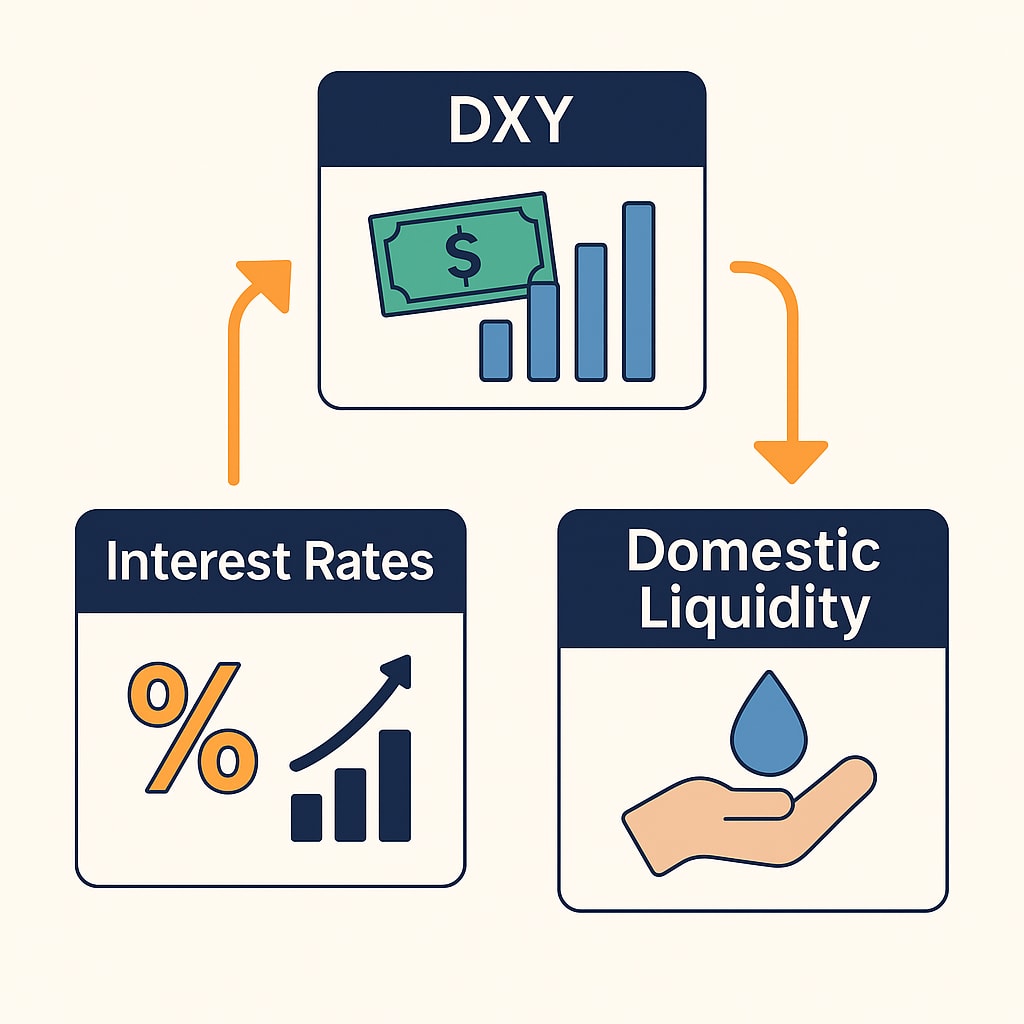
3. DXY vs Interest Rates vs Liquidity
A crucial three-way relationship:
✔ (1) Higher U.S. interest rates → DXY strengthens
Higher yields attract global capital.
To avoid getting misled by “rate cut” headlines, separate policy rates from market rates (and check the curve shape):
- 🔗 Policy vs Market Rates: Why a Rate Cut Doesn’t Guarantee Lower Borrowing Costs
- 🔗 Yield Curve Reading: 2s10s vs 3m10y Recession Signals
✔ (2) Stronger DXY → Global liquidity tightens
Emerging-market outflows accelerate.
When tariffs or oil shocks hit, they often transmit as a “USD + liquidity” package (not one variable at a time):
- 🔗 Tariffs as a Package Shock: Growth, Margins, FX, and Inflation
- 🔗 Oil Shocks and USD/KRW: Trade Balance, Import Inflation, and Flows
✔ (3) Lower liquidity → Stock markets weaken
Both U.S. tech stocks and KOSPI become more volatile.
4. Practical Tips
- Monitor DXY alongside the U.S. 10-year yield (TNX).
- Manage allocation carefully during periods of KRW depreciation.
- Use FinMap tools to evaluate your investment risk and long-term returns.
5. Conclusion
- DXY is a key indicator that affects nearly all asset classes.
- It connects interest rates, liquidity, and risk sentiment.
- KRW-based investors should monitor it regularly.
Continue reading (A good piece of writing to read together)
DXY / FX foundations
Korea transmission (FX → flows → KOSPI)
- USD/KRW Exchange Rate: What It Means for Korea’s Economy and the KOSPI
- S&P 500 → Korea: The FX–Rates–Foreign Flow Chain
- Who Wins and Loses When the KRW Weakens? (KOSPI Sector Map)
Rates / liquidity regime tools
Shock channels (geopolitics / tariffs / oil)
FAQ
Q1. Does rising DXY always mean U.S. stocks fall?
Not always, but it often creates earnings pressure for big-tech companies.
Q2. Why should Korean investors care about the DXY?
Because DXY strongly affects USD/KRW and foreign investor behavior in KOSPI.
Q3. How are interest rates related to DXY?
Higher U.S. interest rates make dollar assets more attractive, pushing DXY higher.