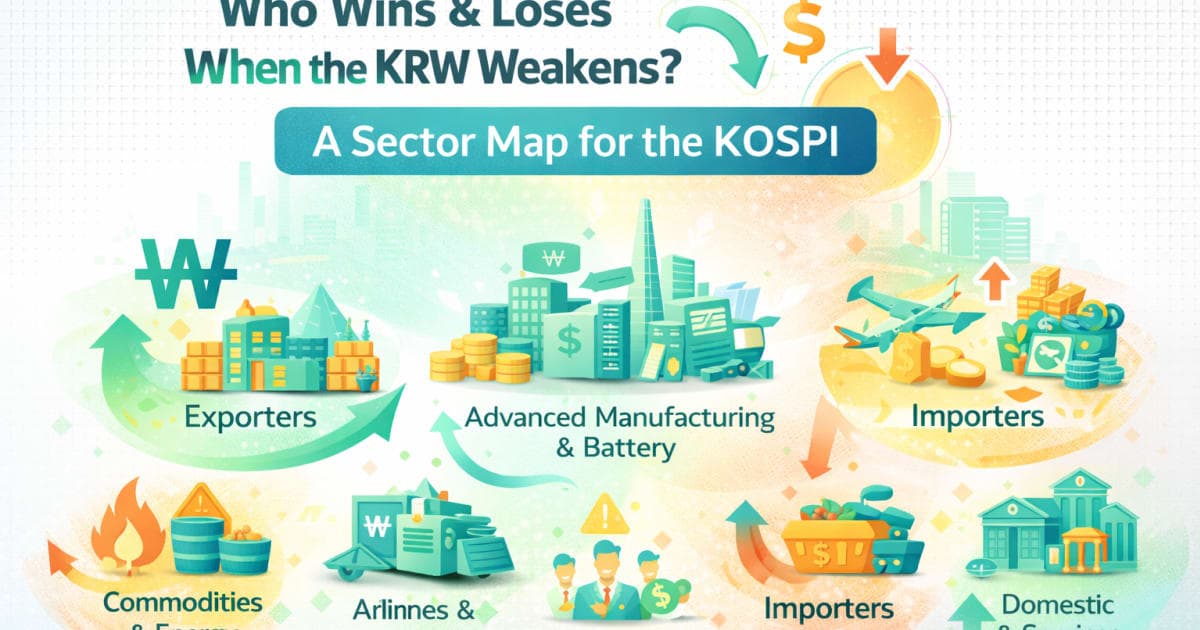
Summary (10 key points)
- A rising USD/KRW means a weaker Korean won, but market impact varies by sector.
- Export-oriented companies may benefit from currency translation effects.
- Import-dependent sectors often face higher cost pressure.
- Consumer and domestic sectors are affected indirectly through inflation.
- Commodity and energy prices amplify FX effects when they move together.
- Battery and advanced manufacturing sectors face mixed outcomes.
- Airlines and transport are among the most FX-sensitive industries.
- FX volatility often leads foreign investors to reduce risk exposure.
- Exchange rates matter most through business structure, not headlines.
- This article provides a sector-by-sector checklist for weak-won regimes.
One-paragraph overview
When the Korean won weakens, investors often ask a simple question: “Which stocks benefit?”
The real answer is more nuanced. A weaker KRW changes revenue translation, input costs, inflation expectations, and foreign capital flows—each affecting sectors differently. This guide breaks down how major KOSPI sectors tend to respond when USD/KRW rises, using tables and practical checklists rather than broad generalizations.
What you will get from this guide: a sector map for weak-won regimes, not a generic “exporters win” answer. You will learn which sectors usually benefit, which sectors face cost pressure, and which signals to check before changing a Korea or KOSPI allocation.
| Sector setup | Weak KRW effect | What to verify |
|---|---|---|
| USD revenue, KRW costs | Potential earnings translation benefit | Export demand and hedging policy |
| USD costs, local revenue | Margin pressure | Pass-through power and oil/commodity prices |
| High foreign ownership | Flow and FX-volatility risk | USD/KRW speed, DXY, and foreign net buying |
Related reads: How USD/KRW shapes the KOSPI, DXY dollar index basics, and Korea ETFs and TNX sensitivity. For portfolio planning, compare scenarios in the DCA simulator.
1. First Principle: A Weak Won Is Not “Good” or “Bad”
A weaker currency does not automatically mean higher stock prices.
Instead, it reshapes profit and risk distribution across sectors.
Before labeling a stock as a “beneficiary,” ask:
- Does it earn revenue in USD?
- Does it pay costs in USD?
- Can it pass higher costs to customers?
- Is foreign ownership significant?
These factors determine outcomes far more than the FX headline itself.
2. Four Main Channels Through Which FX Affects Sectors
◈ 1) Revenue translation
Companies with USD-denominated revenue may report higher KRW earnings.
◈ 2) Cost inflation
Firms importing raw materials or components in USD face rising costs.
◈ 3) Inflation and rates
Higher import prices can raise inflation expectations and pressure valuations.
◈ 4) Foreign investor behavior
Rising FX volatility often leads to cautious positioning and reduced exposure.
For the broader macro framework, see
[How USD/KRW Affects the KOSPI]
How USD/KRW Affects the KOSPI
3. Core Table ① — Sector Impact Overview in a Weak-Won Environment
| Sector | Typical Impact When KRW Weakens | Key Factors to Check |
|---|---|---|
| Export manufacturing | Potential benefit | USD revenue share, hedging |
| Import & retail | Cost pressure | Pricing power |
| Domestic services | Indirect impact | Inflation, consumer sentiment |
| Commodities & energy | Often negative | FX + global prices |
| Battery / advanced tech | Mixed | Export vs raw materials |
| Airlines & transport | Vulnerable | Fuel costs, FX exposure |
| Financials | Neutral to volatile | Rates, capital flows |
This table describes structural tendencies, not guaranteed price moves.
4. Sector-by-Sector Checklists
4-1. Export-Oriented Sectors (Tech, Autos, Machinery)
Potential upside, but not automatic.
Checklist:
- High USD revenue exposure?
- Input costs also USD-based?
- FX hedging ratio disclosed?
- Global demand still intact?
◈ Weak KRW + stable global demand
→ earnings expectations may improve.
4-2. Import-Heavy and Consumer Sectors
Generally under pressure.
Checklist:
- Imported input share?
- Ability to raise prices?
- Consumer sentiment already weak?
◈ FX-driven cost increases are hardest to absorb when demand is soft.
4-3. Domestic and Service Sectors
Indirect exposure dominates.
Checklist:
- Speed of inflation pass-through
- Interest-rate expectations
- Sensitivity to foreign investor flows
◈ FX matters mainly through inflation and rates, not revenue.
4-4. Commodity and Energy-Sensitive Industries
Double-impact risk.
Checklist:
- Are global prices rising alongside FX?
- Can costs be hedged or passed through?
◈ Weak KRW + rising oil prices
→ margin pressure intensifies.
For this linkage, see
[Inflation and Interest Rates Explained]
Inflation and Interest Rates Explained
4-5. Battery and Advanced Manufacturing
Most complex category.
Checklist:
- Export share vs imported raw materials
- Long-term supply contracts
- Exposure to USD-priced metals
◈ Currency benefits and cost pressures often coexist.
4-6. Airlines and Transportation
Among the most FX-sensitive sectors.
Checklist:
- Fuel cost exposure in USD
- FX + oil price correlation
- Fare adjustment flexibility
◈ Weak KRW combined with rising oil prices is the worst-case scenario.
5. Core Table ② — Investor Checklist for Weak-Won Phases
| Question | If “Yes” | If “No” |
|---|---|---|
| USD costs exceed USD revenue? | Margin risk | Re-check structure |
| Limited pricing power? | Earnings pressure | Competitive position |
| High foreign ownership? | Volatility risk | Flow monitoring |
| Rising oil/commodities too? | Double pressure | Separate drivers |
| Low FX hedging ratio? | Higher volatility | Disclosure review |
6. Three Common Misconceptions
1) “A weak won always helps exporters.”
→ Cost structure and demand conditions matter.
2) “FX is separate from equities.”
→ FX directly affects foreign flows and valuation.
3) “Watching USD/KRW alone is enough.”
→ Rates, commodities, and global risk sentiment must be included.
7. How to Use This Map in Practice
- Focus on business structure, not labels.
- Break “winners and losers” into checklists.
- Monitor foreign flows and rate expectations.
- Accept that companies within the same sector differ.
Frequently Asked Questions (FAQ)
Does a weaker KRW always benefit exporters?
Not necessarily. While USD-denominated revenue increases in KRW terms, higher input costs and FX hedging can offset the benefit.
Why are airlines sensitive to exchange rates?
Fuel costs are typically paid in USD. When the KRW weakens and oil prices rise together, cost pressure intensifies.
How does USD/KRW affect foreign investors?
Higher FX volatility increases currency risk, often leading foreign investors to reduce exposure to Korean equities.
Is FX impact stronger than interest rates?
FX and interest rates are closely linked. In many cases, FX moves transmit their impact through rate expectations.
Should investors focus on the exchange rate level or volatility?
Volatility matters more than absolute levels, especially for foreign capital flows.
Related FinMap Posts (A good piece of writing to read together)
- How USD/KRW Shapes the KOSPI
- Understanding Inflation and Interest Rates
- What Is the Dollar Index (DXY)?
- Why Korean ETFs Are Sensitive to U.S. 10Y Yields
Conclusion (3 lines)
A weaker Korean won redistributes opportunity and risk across sectors.
The key variable is not the FX move itself, but how each sector is built.
Use structure-driven checklists to reduce noise and improve decisions.