Summary (10 sentences)
- WTI is more than an energy quote—it’s a macro variable that changes Korea’s cost structure.
- Korea’s heavy reliance on imported energy makes oil shocks transmit quickly into trade, prices, and corporate margins.
- Higher oil prices often raise transport and input costs, pressuring profits unless companies can pass costs through.
- Oil also influences consumer inflation, which can shift rate expectations and valuation (discount-rate) pressure.
- Because crude is priced in USD, oil moves frequently interact with USD strength and USD/KRW dynamics.
- USD/KRW matters for both foreign investor returns and for corporate P&L via import costs and revenue translation.
- The same “oil up” headline can mean different things: demand-led reflation vs supply disruption.
- Demand-driven oil strength can coexist with improving earnings, while supply-driven spikes can feel like a tax on growth.
- KOSPI reactions depend on the bundle: WTI + inflation/rates + USD/KRW (and DXY) + positioning/flows.
- In practice, oil becomes market-moving when it changes the expectations for inflation, rates, and FX at the same time.
One-paragraph overview
For Korea, WTI acts like a multi-channel switch: it can lift inflation, tighten financial conditions via rates, and amplify FX stress through USD pricing—all while reshaping sector earnings. That’s why oil shocks can change not only the direction of the KOSPI but also the type of market you get (sector rotation, margin compression, or risk-off flow pressure). This post lays out a clear chain of transmission, shows what to watch in each channel, and provides scenario tables and a checklist so you can diagnose whether oil is “just noise” or the main driver.
What you will get from this guide: a practical chain for reading oil headlines in Korea. Instead of asking “is oil up good or bad?”, you will learn whether WTI is creating an inflation shock, an FX shock, a margin shock, or a sector-rotation opportunity.
| WTI move | Korea market channel | What to watch next |
|---|---|---|
| Demand-led rise | Cyclical earnings and exports may improve | KOSPI breadth, semis, global PMIs |
| Supply-led spike | Inflation, margins, and risk-off pressure rise | USD/KRW, DXY, rates, energy import costs |
| Oil + USD both rise | KRW import cost shock can intensify | Foreign flows and margin-sensitive sectors |
Related reads: USD/KRW and the KOSPI, DXY market impact, and Inflation and rates basics. To keep volatility tied to a plan, use the DCA simulator.

1) Why oil matters more in Korea than many investors expect
Korea is a large manufacturing and export economy with limited domestic energy resources. That makes oil price changes feel less like “a commodity chart” and more like a macro input cost that can hit multiple layers at once:
- Corporate layer: fuel, logistics, petrochemical feedstock, and broader input costs
- Household layer: energy bills and transport costs that shape inflation expectations
- Macro layer: import bill and trade balance sensitivity (especially when oil rises fast)
Because the oil price is typically quoted in USD, Korea also faces a currency overlay—oil shocks can coincide with USD strength, creating a “double hit” for KRW-based costs.
If you prefer to keep a broader dashboard of global drivers for the KOSPI, this internal post provides a structured map:
For a full “U.S. → Korea” transmission checklist (rates + FX + foreign flows), this post connects the dots:
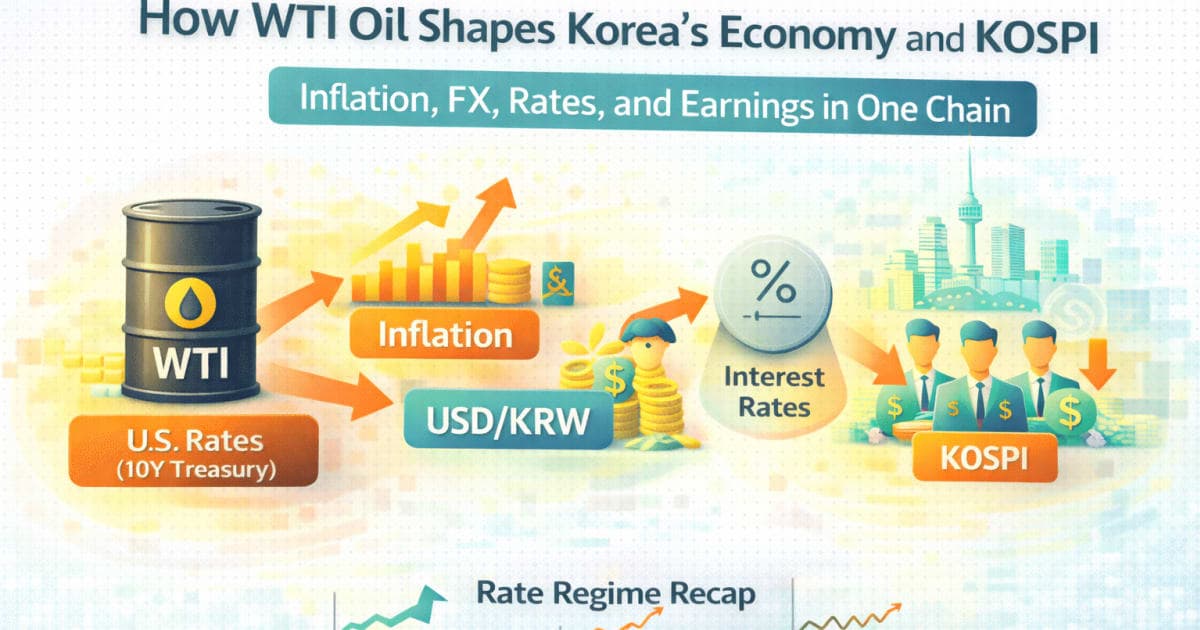
2) Hero Layout: the 5-step transmission chain (WTI → KOSPI)
Core framework
In Korea, WTI typically transmits through a five-step chain: (1) input and transport costs → (2) inflation pressure (CPI/PPI and expectations) → (3) interest-rate expectations and discount rates → (4) USD pricing and USD/KRW dynamics → (5) earnings revisions and foreign investor flows. The KOSPI reacts most sharply when oil shocks lift inflation expectations and push USD/KRW higher at the same time.
Three lines to remember
- WTI ↑ → costs and inflation pressure ↑
- Inflation ↑ → rates/discount pressure can rise
- USD pricing → USD/KRW can amplify the shock
3) Channel 1 — Costs and margins: the earnings mechanics investors miss
Oil affects corporate profitability through a simple but powerful question: Can companies pass higher costs to customers?
If they can, margins may hold. If they can’t, margins compress and earnings estimates drift lower.
In Korea, oil-linked cost exposure shows up across multiple areas:
- transport and logistics costs
- fuel-intensive operations (shipping, airlines, some industrials)
- petrochemical feedstocks and broader materials costs
- indirect cost inflation through supply chains
This is why market reactions often look like rotation rather than a clean index move. Some segments may be relatively resilient if demand is strong and pass-through works, while others underperform sharply when the move is abrupt.
4) Channel 2 — Inflation: when oil becomes a “macro tax” on consumption
Oil shocks don’t stay inside corporate P&Ls. They influence consumer prices and inflation expectations, especially when they move quickly. For an importing economy, that can feel like a macro “tax”:
- households face higher energy/transport costs
- real purchasing power can weaken
- discretionary consumption can slow
This matters because equity markets are forward-looking: if oil forces inflation expectations up, the next step is often a repricing of rates.
If you want a simple inflation-and-rates lens you can reuse across topics, these internal posts help:
- Inflation and rates basics: why markets react to price pressure
- How interest rates work: from policy rates to loans and bonds
- TNX explained: why the U.S. 10-year yield drives markets
5) Channel 3 — Rates and discount factors: why “oil up” can hit growth valuations
Inflation pressure can translate into tighter financial conditions. Even before policy changes, markets often adjust rate expectations and discount rates when inflation risk rises.
In equity terms:
- higher discount rates can compress valuation multiples
- long-duration assets (growth-heavy segments) are typically more sensitive
- higher rates can also tighten financing conditions and reduce risk appetite
Oil becomes especially market-moving when it shifts the narrative from “temporary noise” to “persistent inflation risk.”
6) Channel 4 — FX: USD pricing makes USD/KRW a critical companion chart
Crude is generally priced in USD, which creates an important linkage for KRW-based investors and Korean corporates. When oil rises and the USD strengthens simultaneously, the import-cost pressure can compound.
USD/KRW matters through two paths:
- Corporate path: higher KRW cost for energy and USD-priced inputs
- Flow path: FX moves change foreign investors’ USD returns on KRW assets
For a clean foundation on reading FX signals (beyond the daily noise), these internal posts are useful:
7) Channel 5 — DXY and risk sentiment: when oil moves align with “risk-off”
Sometimes oil rises because demand is strong (reflation). Other times it rises because supply is constrained (shock). The second case often comes with a broader risk-off tone—especially if it threatens inflation and tightens conditions.
DXY can help you distinguish “KRW-specific FX” from “broad USD strength.”
If DXY is rising, the market is often pricing tighter global conditions, which can be more challenging for EM assets.
8) Table 1 — The transmission map (WTI → Korea → KOSPI)
| Channel | What you often see in the KOSPI | Companion indicators | How to interpret |
|---|---|---|---|
| Costs & margins | sector dispersion, margin-sensitive selloffs | margin narrative, pass-through | focus on “who can pass costs” |
| Inflation | defensive tilt, uncertainty rises | inflation lens | speed of oil move matters |
| Rates/discount | valuation compression risk | rates lens | growth sensitivity rises |
| FX (USD/KRW) | amplified stress when KRW weakens | USD/KRW | FX can turn oil into a bigger shock |
| USD breadth (DXY) | EM risk premium rises | DXY | confirms broad USD strength |
9) Don’t oversimplify oil’s message
Oversimplification
- WTI up → KOSPI down (always)
- Refiners automatically win from higher oil
- FX is secondary—oil alone explains it
- One headline explains the whole move
Better framework
- Classify the move: demand-led vs supply-led
- Watch the bundle: WTI + inflation/rates + USD/KRW + DXY
- Think in margins and pass-through, not sector labels
- Separate “flow shock” from “earnings reprice”
10) Table 2 — The same oil move can feel very different in Korea
| WTI move | USD/KRW & USD tone | Inflation/rates lens | Likely KOSPI “feel” | First checks |
|---|---|---|---|---|
| Up (gradual) | FX stable | rates stable | can be “growth/reflation” | sector leadership |
| Up (spike) | USD strong, KRW weak | rates pressure | compounding stress | FX speed + DXY |
| Down (gradual) | FX stable | easing inflation risk | relief rally potential | consumption/defensives |
| Down (sharp) | USD strong (fear) | yields down (fear) | mixed: rates help, earnings fear | growth vs cyclical split |
11) Table 3 — Sector impact is about structure (costs, pass-through, margins)
| Segment | Potentially favorable when… | Potentially harmful when… | What to watch |
|---|---|---|---|
| Refining/energy-linked | margins improve, demand steady | margins compress, demand weakens | margins/spreads, not just WTI |
| Chemicals/materials | pass-through works | feedstock up + demand soft | pricing power |
| Airlines/shipping/transport | oil stable/down | fuel spike + FX stress | fuel cost share, hedging |
| Consumer/domestic | inflation contained | real income squeezed | inflation expectations |
| Growth/tech | rates stable/down | oil → inflation → rates up | discount sensitivity |
12) Visual Overview


13) Checklist (10 items): is oil the driver, or just background noise?
If you want a one-screen macro view that combines WTI, USD/KRW, DXY, and U.S. rates, start with Market Indicators That Move Korea: A One-Screen Macro Dashboard.
- Is the move demand-led (growth) or supply-led (disruption)?
- Is WTI rising gradually or spiking (speed shock)?
- Is USD/KRW moving up sharply at the same time?
- Is DXY rising (broad USD strength) or not?
- Are inflation expectations re-accelerating?
- Is the rates/discount narrative turning tighter?
- Are margin-sensitive sectors leading the selloff?
- Is the market rotating defensively, or repricing growth broadly?
- Are foreign flows turning negative alongside FX stress?
- Are you trying to explain everything with one headline?
14) Conclusion (3 lines)
- In Korea, WTI impacts the KOSPI through a chain that runs across costs, inflation, rates, FX, and flows.
- The same WTI move can be benign or painful depending on whether it tightens inflation/rates and weakens KRW.
- Bundle WTI + USD/KRW + an inflation/rates lens + DXY to read the market faster and more consistently.
15) CTA — When macro variables swing, a rules-based plan helps
Prefer a process over timing?
Oil shocks can trigger fast rotations and noisy headlines. A simple DCA simulation helps you define contribution size and horizon so volatility becomes a plan—not a surprise.
Build a monthly DCA plan16) A good piece of writing to read together
- Inflation and rates basics: why markets react to price pressure
- How interest rates work: from policy rates to loans and bonds
- TNX explained: why the U.S. 10-year yield drives markets
- FX basics: what really moves USD/KRW
- How USD/KRW influences Korea and KOSPI
- DXY and market impact (stocks, FX, KOSPI)
- How the S&P 500 affects Korea and KOSPI
- Global market environment that most affects KOSPI (overview)
FAQ
Q1) Does higher WTI always mean the KOSPI will fall?
No. Demand-led oil strength can coincide with improving earnings, while supply-led spikes can feel like a cost shock. The decisive factor is how USD/KRW and rate expectations respond.
Q2) What’s the quickest way to tell demand-led vs supply-led?
Look at the broader setup: are growth-sensitive assets and cyclicals strong (demand-led), or is the market turning defensive with USD strength and tighter conditions (supply/disruption risk)?
Q3) Why is USD/KRW so important alongside oil?
Because crude is priced in USD. When oil rises alongside USD strength, KRW import costs and inflation pressure can compound, which can also affect foreign flow behavior.
Q4) Which sectors should I watch first?
Watch margin-sensitive and fuel-intensive sectors during spikes, and compare them to defensives and rate-sensitive growth. Focus on pass-through and margins, not labels.
Q5) What’s the simplest daily monitoring set?
WTI direction/speed, USD/KRW, an inflation/rates lens, and DXY to confirm broad USD strength.