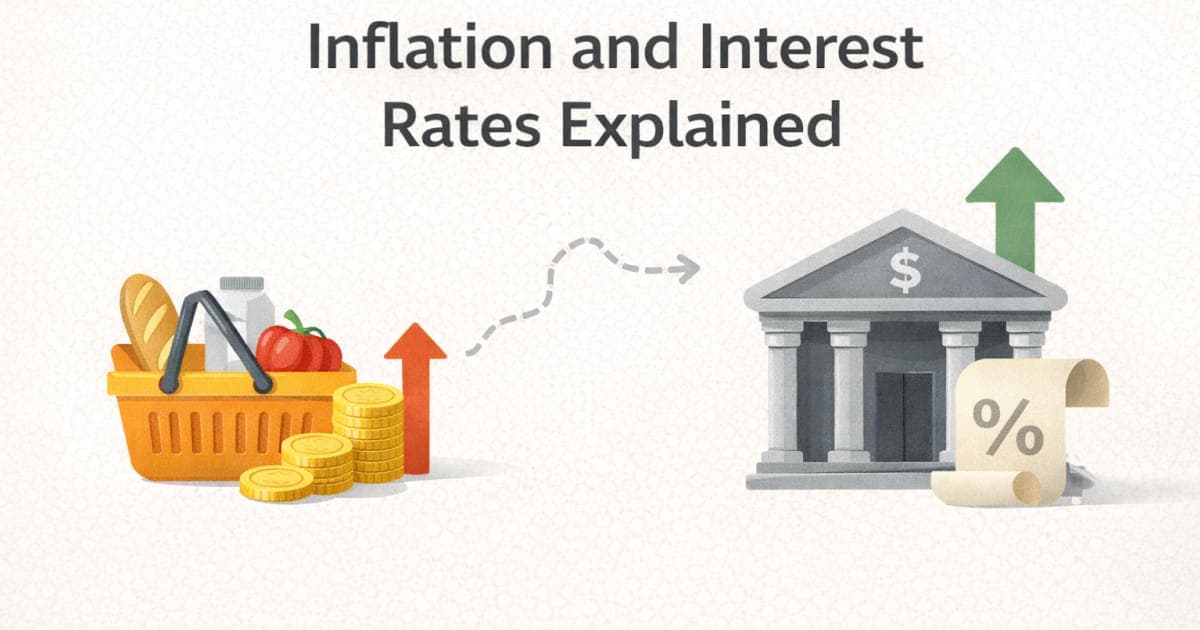
This article is a market reaction guide, not a basic inflation-and-rates textbook. It explains how markets may react when CPI surprises, central-bank guidance, Treasury yields, real rates, USD/KRW, and KOSPI expectations move after inflation or rate news.
This is educational market analysis, not a forecast, trading signal, or investment advice. For the broad foundation, start with Inflation and Interest Rates: A Long-Term Investor's Core Framework.
Quick Answer
| Question | Short answer |
|---|---|
| What is the main idea? | Markets react to inflation surprises and rate expectations, not just the headline CPI number. |
| Why can stocks fall after strong data? | Strong inflation or jobs data can push yields and real rates higher, pressuring valuations. |
| Why can stocks rise after weak data? | Softer data can lower rate expectations, but only if growth risk does not dominate. |
| Why does this matter for Korea? | U.S. yields, DXY, USD/KRW, foreign flows, and KOSPI often react together after macro surprises. |
Use the Market Indices dashboard to compare KOSPI, USD/KRW, U.S. 10Y yield, DXY, WTI, and global equity benchmarks after major macro data.

Start With the Foundation: Inflation vs Rates
Inflation tells investors how fast prices are rising. Interest rates tell investors how expensive money is becoming. That broad relationship belongs in the foundation guide: Inflation and Interest Rates.
This page focuses on the next question:
What happens to markets when inflation data or rate guidance differs from expectations?
The answer depends on three layers:
- Was the data above or below consensus?
- Did rate expectations or market yields move?
- Did the move tighten or loosen financial conditions for risk assets?
For the mechanics of policy rates, deposits, loans, and bonds, see How Interest Rates Work.
What Is an Inflation Surprise?
An inflation surprise happens when CPI, core CPI, PCE, or another inflation measure differs from what markets expected.
| Inflation data result | Market interpretation | Possible first reaction |
|---|---|---|
| Higher than consensus | Inflation is stickier than expected. | Yields up, real rates up, stocks down, dollar stronger. |
| In line with consensus | No major new information. | Smaller move unless guidance changes. |
| Lower than consensus | Inflation pressure may be easing. | Yields down, risk assets up, dollar weaker. |
| Lower headline, sticky core | Mixed signal. | Market may focus on core services or wages. |
The important word is "surprise." Markets often price in the expected number before release. The move after release comes from what changes.
Why Rate Expectations Move Before Policy Rates
The policy rate is what the central bank sets. Market yields are what investors trade every day. They are related, but they are not the same.
| Item | Who controls it? | What moves it? |
|---|---|---|
| Policy rate | Central bank | Official decisions and guidance. |
| 2-year yield | Bond market | Expected policy path over the next few years. |
| 10-year yield | Bond market | Growth, inflation, term premium, and policy expectations. |
| Real rate | Market-implied or calculated | Nominal yield minus inflation expectation. |
That is why markets can react before the central bank actually changes rates. A CPI surprise can move the expected rate path within minutes.
For a deeper distinction between official policy rates and borrowing costs, read A Rate Cut Doesn't Guarantee Lower Borrowing Costs.
Nominal Yields, Real Rates, and Risk Assets
Nominal yields are the rates investors see directly, such as the U.S. 10-year Treasury yield. Real rates adjust nominal yields for inflation expectations.
Real rate = nominal yield - expected inflation
Both matter, but real rates often explain why long-duration assets are sensitive to inflation and rate news.
| Market variable | If it rises | Why it matters |
|---|---|---|
| Nominal yield | Discount rates rise. | Bonds reprice and equity valuations face pressure. |
| Real rate | Inflation-adjusted return rises. | Growth stocks and long-duration assets often struggle. |
| Inflation breakeven | Expected inflation rises. | Can support commodities but pressure policy expectations. |
| Dollar index | Dollar strengthens. | Non-U.S. assets and FX-sensitive markets may face stress. |
For a focused explainer, see Real Rates and Breakevens. For the U.S. 10-year yield channel, read How U.S. 10-Year Treasury Yields Impact Global Markets.
Market Reaction Map
Inflation surprises do not move every asset in the same direction. The path usually runs through yields, real rates, the dollar, and risk appetite.
| Surprise or guidance | Yields | USD / DXY | Growth stocks | Duration assets | USD/KRW | KOSPI / Korea risk assets |
|---|---|---|---|---|---|---|
| Hot CPI surprise | Up | Stronger | Pressure | Pressure | Often higher | Often weaker if foreign flows turn cautious |
| Cool CPI surprise | Down | Weaker | Supportive | Supportive | Often lower | Often supportive if growth fear is limited |
| Hawkish central-bank guidance | Up | Stronger | Pressure | Pressure | Higher risk | Foreign outflow risk can rise |
| Dovish guidance | Down | Weaker | Supportive | Supportive | Lower risk | Can support risk appetite |
| Weak growth + sticky inflation | Mixed to higher | Defensive USD bid possible | Pressure | Mixed | Higher risk | Stagflation-style stress |
This table is a map, not a rule. Earnings, positioning, valuation, geopolitics, oil prices, and China/Asia sentiment can override the first reaction.
Korea Market Connection: USD/KRW and KOSPI
For Korea investors, the macro reaction is often visible through USD/KRW, KOSPI, and foreign flows.
| Korea signal | What to check after inflation/rate news | Why it matters |
|---|---|---|
| USD/KRW | Is the won weakening with DXY and U.S. yields? | A weaker won can reduce USD-based returns for foreign investors. |
| KOSPI | Are semiconductors, growth stocks, or exporters leading? | Sector leadership shows whether the market sees risk-off or export support. |
| U.S. 10Y yield | Did yields move because of inflation or growth expectations? | Higher yields can pressure valuations globally. |
| DXY | Is dollar strength broad or mostly euro-driven? | The dollar channel affects Asia FX and foreign flows. |
| WTI | Are oil prices amplifying inflation pressure? | Korea is energy-import sensitive, so oil can affect margins and inflation. |
| Foreign flows | Are foreigners buying or selling Korean equities? | Confirms whether global macro pressure is reaching local markets. |
Useful Korea market reads:
- USD/KRW Exchange Rate and KOSPI
- What Is DXY? Dollar Index, USD/KRW, and KOSPI
- WTI Oil Price and Korea KOSPI
Market Reaction Checklist
Use this checklist after a CPI release, rate decision, or central-bank speech:
- Was inflation above or below consensus?
- Did the market focus on headline CPI, core CPI, services inflation, wages, or shelter?
- Did the expected policy path move?
- Did the 2-year or 10-year Treasury yield move more?
- Did real rates rise or fall?
- Did DXY and USD/KRW confirm a dollar move?
- Did KOSPI react through broad selling, sector rotation, or foreign-flow pressure?
- Did WTI or commodity prices change the inflation story?
- Did the first reaction reverse after the press conference or bond-market close?
The Market Indices dashboard is the fastest way to compare several of these signals on one screen.
Common Mistakes
| Mistake | Why it causes bad interpretation |
|---|---|
| Reading CPI without consensus | Markets react to surprises, not just the level. |
| Treating policy rates and market yields as the same thing | Bond yields can move before official policy changes. |
| Ignoring real rates | Nominal yields alone can hide the valuation pressure on risk assets. |
| Assuming lower inflation is always bullish | If inflation falls because growth is breaking, risk assets may still struggle. |
| Reading KOSPI without USD/KRW | FX can change foreign investor returns and flows. |
Calculator CTA: Use as a Secondary Step
This article is mainly about market interpretation. Calculators are useful only after you translate the macro backdrop into more conservative or optimistic assumptions.
- Use the Compound Interest Calculator to test lower or higher long-term return assumptions.
- Use the DCA Calculator if monthly investing is part of the plan.
Do not treat a macro reaction as a guaranteed return assumption.
Bottom Line
Markets react to the gap between inflation data and expectations. A hot CPI print can lift yields, real rates, DXY, and USD/KRW while pressuring growth stocks and KOSPI. A cool print can do the opposite, but only if growth risk does not dominate. The best workflow is to read inflation surprises through market yields, real rates, dollar moves, foreign flows, and Korea-specific signals together.
FAQ
What is an inflation surprise?
An inflation surprise is the gap between reported inflation data and market expectations. Markets usually react more to the surprise than to the headline number alone.
Why can markets move before central banks change rates?
Bond yields and rate futures price expected policy changes before official decisions. That means CPI data or guidance can move yields even when the policy rate is unchanged.
Why do real rates matter for growth stocks?
Higher real rates increase the inflation-adjusted discount rate applied to future earnings. That can pressure growth stocks and other long-duration assets.
How can inflation data affect USD/KRW and KOSPI?
Hot inflation can lift U.S. yields and the dollar, which can push USD/KRW higher and pressure foreign flows into Korean equities. Cool inflation can help risk appetite if growth fears stay contained.
Should I trade based on one CPI release?
Most investors should avoid relying on one release. Compare the surprise, yields, real rates, DXY, USD/KRW, KOSPI, and foreign flows before drawing a conclusion.