10-Sentence Summary
- Many investors judge ETFs and funds based solely on their latest 1-year performance.
- However, the true driver of long-term wealth is not “how fast it went up,” but “how steadily it grew.”
- CAGR (Compound Annual Growth Rate) measures this consistency.
- Total return hides the volatility and losses that occurred along the way.
- The higher the volatility, the bigger the gap between total return and CAGR.
- Two ETFs with the same total return can have completely different CAGR values depending on their volatility.
- Leveraged and thematic ETFs especially require a strict CAGR check.
- Professionals evaluate ETF quality using 3-year and 5-year CAGR rankings.
- Beginners can drastically improve results simply by prioritizing ETFs with strong long-term CAGR.
- Ultimately, long-term success depends not on dramatic gains, but on consistent CAGR-driven growth.
In short: CAGR reveals the quality of growth, not just the quantity. It is one of the most important metrics for choosing ETFs wisely.
Related reads: CAGR calculator guide, Diagnosing investing skill with CAGR, and 7% annual return reality check. Compare your own fund data in the CAGR Calculator.

1. Why Evaluating ETF Performance Is More Complicated Than It Looks
At first glance, ETF selection seems simple.
“If it went up the most, it must be the best.”
But in reality, ETF and fund performance is influenced by:
- tracking method,
- internal structure,
- volatility patterns,
- leverage,
- and even the rebalancing rules of the underlying index.
This means the ETF with the highest recent return is not necessarily the best choice for long-term investors.
When you compare long-term outcomes,
CAGR often reveals a completely different ranking than the 1-year return list.
2. What CAGR Really Means
2-1. Definition
CAGR (Compound Annual Growth Rate) answers the question:
“If my investment grew at a steady rate every year, what would that rate be?”
Even if the actual yearly returns fluctuate dramatically,
CAGR smooths it all into a single clean number — the average annual growth speed.
This is why professionals rely on CAGR to compare ETFs fairly.
2-2. Hero Layout Summary
CAGR is Your ‘Cruise Speed,’ Not Your Peak Speed
An ETF can fly up one year and crash down the next. CAGR compresses all the turbulence into a single, meaningful measure of long-term performance. It tells you how fast the investment effectively grew per year, despite volatility.
Why CAGR Matters
- Total return shows the destination only
- CAGR shows the average pace of the journey
- Ideal for long-term ETF and fund comparison
2-3. CAGR Formula
CAGR =
Ending Value
Starting Value
1 / Years − 1
Example:
$800 → $1,280 over 3 years
1.61/3 ≈ 1.1699
CAGR ≈ 16.99%
Meaning:
“Although the returns fluctuated, the investment behaved as if it grew 16.99% every year.”
3. Total Return vs CAGR — Why Total Return Alone Misleads Investors
3-1. Total Return Hides Volatility
Simple Return =
Ending − Starting
Starting
Example:
(1280 − 800) / 800 = 60%
A 60% total return sounds great,
but:
- Did it drop -40% in the middle?
- Did it spike due to short-term hype?
- Did it steadily grow or violently swing?
Total return does not tell you any of this.
CAGR exposes the truth.
3-2. Comparison Table ① Total Return vs CAGR
| Metric | Meaning | Strength | Weakness | When It Matters |
|---|---|---|---|---|
| Total Return | Overall change from start to end | Simple & intuitive | Hides volatility & drawdowns | Short-term comparison |
| CAGR | Annualized growth rate assuming steady growth | Shows quality & consistency | Slightly more complex | Long-term ETF comparison |
| Year-by-year Returns | Actual yearly fluctuations | Excellent for risk analysis | Hard to interpret quickly | Professional risk management |
3-3. Visual Comparison Layout
When You Rely Only on Total Return
- You cannot see volatility or drawdowns
- Leveraged ETFs look deceptively strong
- 1-year return rankings become misleading
When You Consider CAGR as Well
- You understand the real annual growth pace
- You avoid ETFs with unstable long-term track records
- You choose ETFs suitable for long-term investing
4. ETF 3-Year and 5-Year CAGR Comparison (Sample Data)
Note: The table uses sample data for educational purposes.
| ETF | Asset Type | 3-Year CAGR | 5-Year CAGR | Category Position | Notes |
|---|---|---|---|---|---|
| KOSPI 200 Core | Domestic Equity | 6.5% | 5.8% | Middle | Stable index tracking |
| S&P 500 Global | U.S. Large Cap | 10.2% | 11.5% | Top-tier | Excellent long-term performance |
| NASDAQ Growth | U.S. Growth | 13.0% | 12.2% | High | Larger swings up and down |
| EV Battery Theme | Thematic | -4.1% | — | Poor | Short-term hype, weak durability |
| NASDAQ 2X Leverage | Leverage | 14.0% | 9.2% | Highly volatile | Great in bull markets, risky long-term |
Key insight:
CAGR quickly reveals whether an ETF’s return pattern is sustainable.
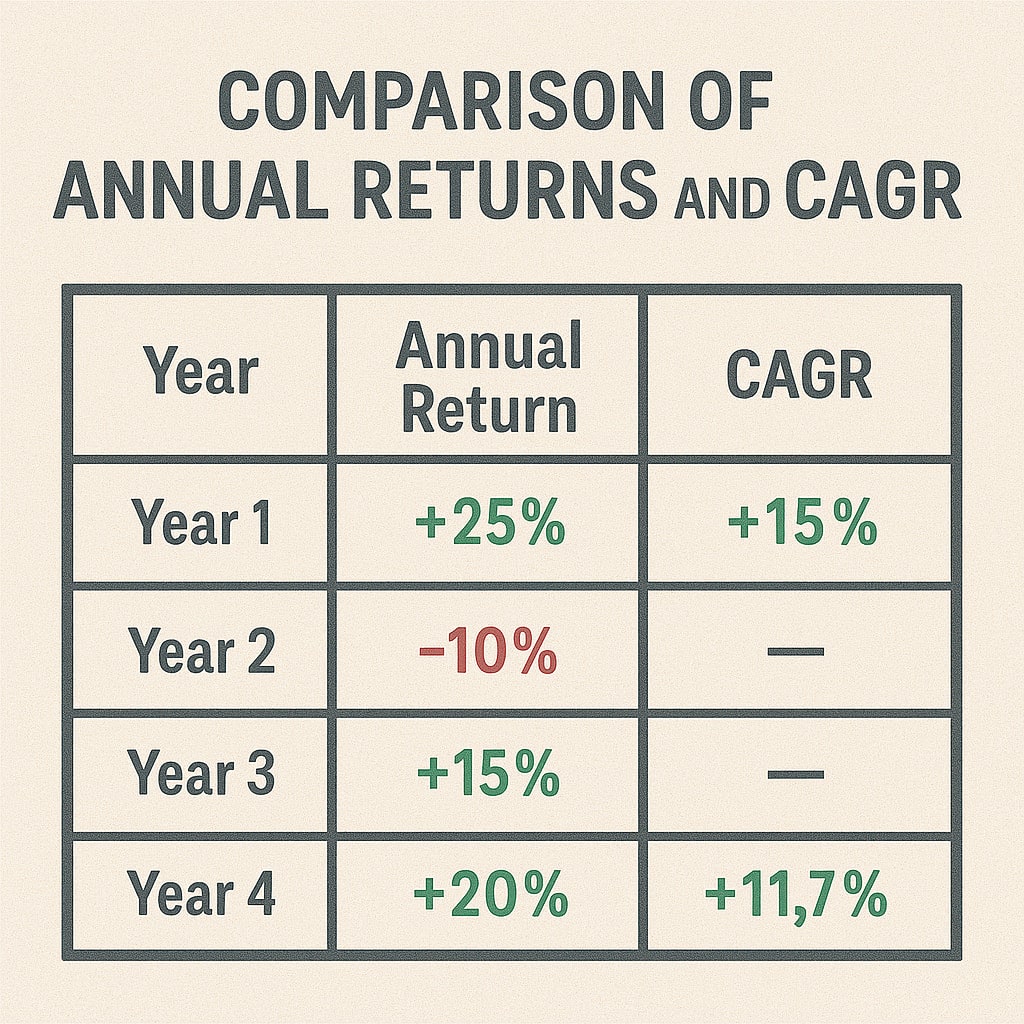
5. Visual Range: CAGR and Total Return Compared


6. How to Use CAGR Depending on Your Investing Skill Level
6-1. For Beginners — Start With “ETFs With Strong 3- and 5-Year CAGR”
Beginner-friendly checklist:
- Choose ETFs with at least 3 years of history
- Prefer ETFs with steady positive CAGR, not flashy recent gains
- Compare CAGR within the same category (U.S. Equity, Tech, Value, etc.)
- Avoid thematic ETFs unless for very small exploratory amounts
- Prioritize long-term stability over short-term excitement
Example scenario:
- Nasdaq 2× ETF: +80% in the last year
- S&P 500 ETF: +25% in the last year
But 5-year CAGR:
- Nasdaq 2×: 9.2%
- S&P 500: 11.5%
The safer long-term choice is clear: consistent growth wins.
6-2. For Intermediate and Professional Investors — Combine CAGR with Volatility
Professionals don’t just check CAGR.
They compare CAGR relative to volatility to estimate risk-adjusted performance.
Key techniques:
- CAGR ÷ Volatility as a simple Sharpe-ratio proxy
- Use slowing 3-year & 5-year CAGR trends as rebalancing signals
- Rank ETFs within the same category by CAGR → keep top 20–30%
- For leveraged ETFs, use CAGR only for short-term signals, not long-term holding
Example comparison:
- S&P 500 ETF → CAGR 10%, Volatility 13% → Ratio ≈ 0.77
- NASDAQ ETF → CAGR 13%, Volatility 20% → Ratio = 0.65
Despite higher CAGR, NASDAQ is less efficient risk-adjusted.
A professional might overweight S&P 500 for better portfolio stability.
7. Practical Checklist Before Choosing an ETF
- Check the ETF’s operating history (at least 3 years)
- Compare 3-year & 5-year CAGR
- Compare within the same category
- Check volatility & max drawdown
- Check expense ratio (TER)
- Check trading volume & AUM
- If leveraged: Avoid long-term holding unless strategy-specific
This simple checklist dramatically improves the quality of ETF selection decisions.
8. Conclusion – Long-Term Investment Success Is Built on Consistent CAGR
- Total return shows the final result
- CAGR shows the quality of the journey
- Backward-looking 1-year numbers can be dangerously misleading
- Consistent CAGR is the foundation of long-term wealth building
- Beginners: prioritize ETFs with strong and stable CAGR
- Professionals: combine CAGR with volatility & rebalancing signals
ETF selection becomes far clearer when anchored in CAGR.
FAQ
Q1. Is a higher CAGR always better?
A1. Not necessarily. High CAGR with extreme volatility may be risky. Combine CAGR with volatility and expenses for balanced evaluation.
Q2. Should I calculate CAGR for ETFs younger than 1 year?
A2. No. It provides little insight. Use at least 3 years of data for meaningful CAGR.
Q3. Does CAGR assume dividend reinvestment?
A3. Ideally yes. For accurate comparisons, use total-return datasets including dividends.
Q4. Should beginners avoid leveraged ETFs?
A4. In most cases, yes. Their long-term CAGR often suffers due to volatility drag.