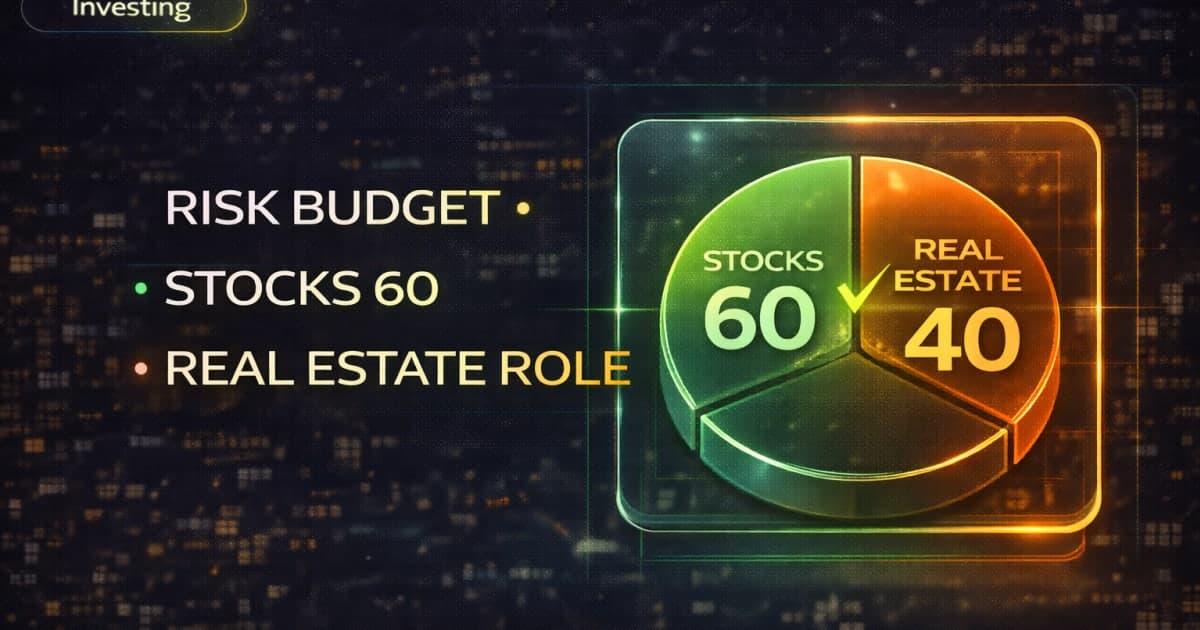
- Real estate shouldn’t be treated as a “default core weight”; it should be treated as a role with explicit failure conditions.
- In Korea, the real estate role is often “inflation-sensitive defense,” but it can also become a liquidity trap when volume dries up.
- If you can’t sell within your expected window (or only at a large discount), your portfolio’s risk budget is already broken.
- Two households with the same net worth can have opposite risk because liquidity and concentration matter more than total assets.
- The apartment dashboard helps you turn “I feel anxious” into observable signals: volume, recovery pace, and downside defense.
- Rates matter, but the channel that dominates changes: funding costs, demand elasticity, and sentiment/flow regimes rotate.
- A modern 60/40 is not “60% stocks, 40% bonds”; it’s a risk budget with stress-action rules and rebalancing triggers.
- You don’t need a prediction; you need a plan for what you will do when spreads widen, volume collapses, or FX stress spikes.
- Your best allocation is the one you can keep through a drawdown without forced selling—especially with mortgages.
INVESTING · REAL ESTATE ROLE
“My home is my biggest asset—so it must be the safest.”
That belief can be expensive when liquidity disappears or when your mortgage and cash flow collide. Real estate can defend purchasing power, but it can also trap your risk budget if you don’t define exit rules.
This post gives you a rules-based framework: assign roles (defense/growth/liquidity), diagnose concentration risk using the apartment dashboard, and write stress-action rules you can follow without forecasting.
- A simple “role map” for real estate, stocks, bonds, cash (and gold) in a Korea household portfolio
- A dashboard-driven way to measure concentration risk (region/price band/volume sensitivity)
- A stress playbook: what to rebalance, what to pause, and what to protect when conditions flip
Scope/limits: No short-term price prediction, no specific property recommendations. Focus is “signals → rules → actions” and how to avoid forced selling.

Start with roles, then allocate risk
Most portfolios fail in stress not because the owner picked the “wrong asset,” but because they assigned the wrong job to the asset.
If you treat housing as “safe,” you’ll over-allocate to it and under-prepare for two things that are common in Korea:
- Concentration risk: one city, one price band, one lifestyle plan, one mortgage structure.
- Liquidity risk: when transaction volume collapses, the “mark-to-market” you see becomes less tradable in practice.
A practical reframe is: weights are the output; roles and failure conditions are the input.
Here’s the role language that usually works for households:
- Defense: reduces the chance your plan breaks (cash flow and drawdown control).
- Growth: compounds long-run purchasing power (but can be volatile).
- Liquidity: lets you survive stress without forced selling (and seize opportunities).
- Inflation / rate sensitivity: tells you which asset becomes fragile when the macro regime flips.
The three axes that define “real estate risk” in Korea
Think of Seoul–Gyeonggi–Incheon not as three preferences, but as three exposures you can budget:
- Volatility: how wide price swings can get in your chosen segment.
- Liquidity: how quickly you can transact at a fair price when you must.
- Recovery resilience: how fast your segment tends to stabilize after a shock.
These are not perfect, but they’re measurable enough to guide rules.

Table 1) Portfolio role map and the rule you should attach to each asset
| Asset | Primary role in a household | Strength (when it works) | Weakness (when it breaks) | Stress-action rule (simple) |
|---|---|---|---|---|
| Korea apartment (owned) | Inflation-sensitive defense + lifestyle stability | Can anchor living costs and reduce rent risk; can feel stable over long horizons | Illiquid; concentration risk; vulnerable to volume freezes and credit regime shifts | If liquidity dries up, protect cash and avoid leverage expansion; postpone upgrades unless cash-flow safe |
| Global equities | Growth engine | Long-run compounding; flexible sizing; high liquidity | Drawdowns can trigger panic; FX sensitivity for KRW investors | Rebalance by rule; if cash flow is threatened, reduce risk before stress forces you |
| Bonds (Korea/US) | Shock absorber + rebalancing fuel | Can stabilize portfolio; provides “dry powder” for rebalancing | Can suffer when inflation/rates surge; duration risk | Define duration and hedge needs; use as rebalancing tool, not a return chase |
| Cash | Survival + optionality | Prevents forced selling; funds emergencies and opportunities | Purchasing power erodes in inflation; “cash drag” emotionally | Keep a floor (months of expenses); raise floor when leverage rises |
| Gold (optional) | Regime hedge | Can hedge extreme regime stress; diversifier | No yield; can be volatile | Small, rules-based allocation; rebalance mechanically |
Interpretation:
- Notice the stress-action column: the goal is not to be “right,” but to avoid the moment you must sell the wrong thing at the wrong time.
- Real estate is not “bad.” It can be a powerful stabilizer, but only if you acknowledge its liquidity and concentration weaknesses.
- Your plan breaks when your “defense” asset becomes illiquid at the same time your cash flow weakens. That’s why roles matter more than weights.
One-line takeaway: Allocation is a spreadsheet; survival is a cash-flow and liquidity plan.
Diagnose concentration risk with the apartment dashboard before you talk “allocation”
Before debating “real estate should be 60% or 30%,” do a quick diagnosis using the dashboard.
Open the apartment dashboard here: South Korea Apartment Transaction Dashboard
Use it to answer a question households rarely quantify: “How exposed am I to a volume freeze in my region and price band?”
What to read on the dashboard (quick checklist)
- □ Distribution: In your target region and segment, what’s the central price band and how wide is the dispersion?
- □ Trend: Over the last 6–12 months, is the move steady, choppy, or flat with sudden jumps?
- □ Volume & recovery signals: Are transactions returning smoothly, or is it a “dead-cat bounce” with thin prints?
If you only look at price, you’re looking at the most seductive and least actionable signal. Volume and recovery behavior are what tell you whether you can exit.
How to use it for your personal “risk budget” (not a forecast)
- Pick your candidate region and price band on South Korea Apartment Transaction Dashboard.
- Write your portfolio constraint: “I must not need to sell this home within X months unless volume is normal.”
- Translate the constraint into rules: cash floor, leverage cap, and upgrade pause triggers.

Table 2) Dashboard metric → interpretation → next action
| Dashboard metric (what you can observe) | Interpretation (what it usually means) | Next action (rules-based) |
|---|---|---|
| Price band dispersion widens (upper/lower tail spreads) | Segmentation is rising; liquidity is uneven; “average” becomes less reliable | Narrow your candidate band; raise cash buffer; avoid stretching leverage |
| 6–12 month trend is flat but jumpy (few prints move the line) | Thin market; price is less “real” and more “negotiated” | Treat as higher liquidity risk; lengthen your minimum hold horizon |
| Transaction volume falls sharply while prices drift | Standoff regime; sellers hold, buyers wait; exit becomes slower | Pause upgrades; avoid adding leverage; focus on cash flow stability |
| Volume recovers before prices stabilize | Tradability returning; price discovery improving | Resume planned actions gradually; re-check mortgage affordability at current rates |
| Volume stays weak and prices break below recent support | Risk budget stress: selling pressure + credit tightening may be rising | Enact defense rule: increase liquidity, reduce risky exposure, postpone big commitments |
Interpretation:
- This is a tradability framework. It doesn’t predict the next move; it tells you how risky it is to rely on selling.
- The same price can be safe or unsafe depending on volume. A stable print in a thin market can hide risk.
- Rules beat feelings: if a metric says “thin,” your action is to protect liquidity, not to argue with the chart.
One-line takeaway: If you can’t sell on your timeline, it’s not a “safe asset”—it’s a plan risk.
The misconception that breaks Korea household portfolios
Misconception: “Real estate is always your safest asset in Korea, so it should dominate your net worth.”
Why it’s incomplete: Safety depends on cash-flow stability and exit liquidity, not just long-run price history. In a credit-driven market, the same property can shift from “stable” to “fragile” when rates rise and volume freezes.
Better rule: Treat housing as defense only if your cash flow survives stress and you have a time horizon that doesn’t require selling into a thin market.Two checks to replace the misconception:
- □ Liquidity check: could you sell within your expected window if volume is weak?
- □ Cash-flow check: could you hold through +1–2%p rate stress (or income shock) without forced selling?
Build a modern 60/40 risk budget that fits a Korea household
“Modern 60/40” is a helpful mental model for Korea households, but only if you treat it as a risk budget:
- The goal is not “60/40 weights,” but stress survivability.
- Real estate acts like a leveraged, illiquid position when you include mortgages.
- Therefore, your liquid portfolio (stocks/bonds/cash) must compensate for real estate’s liquidity weakness.
If you want a full blueprint, this is the closest “parent framework” to what we’re doing here:
Now layer a Korea-specific lens on top:
- FX matters. Your global equity exposure and your USD assets create hidden volatility in KRW terms.
- Rates matter differently. Mortgage repricing can hit cash flow even if the property price doesn’t move immediately.
For the rate channel that often anchors global risk regimes, you can refresh the basics here:
Table 3) Base / Stress / Relief scenarios with triggers and cross-asset reactions
| Scenario | Observable triggers (not predictions) | Real estate (Korea apartments) | Stocks | Bonds | Cash |
|---|---|---|---|---|---|
| Base (normalization) | Volume stable or improving; credit spreads calm; mortgage rates stabilize | Prices may be range-bound; tradability improves | Risk assets behave normally; dispersion rises by sector | Bonds act as ballast; carry matters | Keep cash floor, don’t over-optimize |
| Stress (liquidity tightening) | Transaction volume drops; spreads widen; FX stress; refinancing costs rise | Tradability risk rises; upgrades become dangerous; downside defense matters | Drawdowns worsen; correlations rise | Long duration can help or hurt depending on inflation shock | Cash becomes king; optionality value spikes |
| Relief (conditions ease) | Spreads tighten; volume returns; financial conditions improve | Tradability returns before broad price strength | Risk-on leadership; flows improve | Bonds may lag if growth re-accelerates | Reduce excess cash gradually by rule |
Interpretation:
- Triggers are the point. You’re not forecasting; you’re defining what you will do when the regime looks like “stress.”
- Real estate’s key stress variable is liquidity. Even without a visible price crash, your plan can break if you must transact in a thin market.
- Cash is not an investment idea; it’s a constraint. The more leverage and illiquidity you carry, the more cash you need.
One-line takeaway: A risk budget is a plan for what you do when the market stops cooperating.
Case study 1: The “house-rich, rule-poor” household
Profile: 38-year-old dual-income household, one apartment, large mortgage, small liquid portfolio.
- They feel safe because “it’s Seoul.”
- Their real risk is not price; it’s timing: they plan an upgrade in 12 months.
Using the dashboard (South Korea Apartment Transaction Dashboard), they notice:
- Price looks stable, but volume is thin and recovery is uneven.
Rules that fix the plan:
- Upgrade pause rule: if transaction volume stays weak for 2–3 months, postpone upgrade and rebuild cash.
- Liquidity floor: keep a higher emergency cash buffer until upgrade is completed.
- Leverage cap: do not increase leverage when volume is collapsing, even if rates “might fall later.”
Outcome:
- They stop treating “Seoul” as an insurance policy and start treating liquidity as a measurable constraint.
Case study 2: The “balanced but FX-blind” household
Profile: A household with diversified liquid assets (global equities + bonds) and a smaller property exposure, but they ignore KRW FX swings.
What breaks them is not housing; it’s FX + risk sentiment:
- Global risk-off can push USD/KRW higher and change how their portfolio feels in KRW terms.
Rules that stabilize behavior:
- Define a rebalancing band for global equities in KRW terms.
- Keep a cash buffer sized to avoid selling risk assets during FX-stress drawdowns.
This is where understanding “macro-to-Korea” chains helps:
- Near the end, use the next links to complete the macro map (USD/KRW, DXY, US yields).
Your “real estate role” checklist (write it like an operating system)
Use this to turn a vague belief into a ruleset you can keep:
- □ Role statement: “My home is primarily for (stability / inflation defense / lifestyle), not for short-horizon returns.”
- □ Minimum hold horizon: “I will not rely on selling within ___ months unless volume is normal.”
- □ Leverage rule: “I do not increase mortgage leverage when volume is falling or refinancing costs rise.”
- □ Liquidity floor: “I hold at least ___ months of expenses (and/or ___% of property value) in liquid assets.”
- □ Upgrade pause trigger: “If volume weakens and spreads widen, I pause upgrades for ___ months.”
- □ Rebalancing rule: “I rebalance liquid assets on schedule or band, not on headlines.”
How to translate “risk budget” into an action plan this month
- Inventory your exposures: region concentration, mortgage structure, time horizon.
- Use the dashboard to label liquidity: thin vs normal volume in your target segment.
- Write three rules: cash floor, leverage cap, pause trigger.
- Stress-test the plan: a rate shock, a volume freeze, and an income shock.
- Only then consider allocation changes: because weights should follow rules.
If you want a simple calculation to support “down payment growth vs timeline,” use a compounding or CAGR calculator as a sanity check (not a forecast):
- Compounding check: what monthly saving rate builds your target liquidity floor?
- CAGR check: what growth rate is required for a goal to be realistic within your timeline?
Continue with the macro links that complete the picture
If you want to connect “real estate role” to the macro variables that often move Korea risk regimes, these posts help:
- See why USD/KRW often changes KOSPI sentiment through earnings, inflation, and foreign flows
- Understand how DXY tightens or loosens global financial conditions and why Korea reacts
- Learn how US 10-year yields transmit into Korea’s market regime and risk appetite
FAQs
1) Is real estate always the safest asset in Korea?
No. It can be a stabilizer over long horizons, but safety depends on liquidity and cash flow. If you might need to sell within a short window, transaction volume matters more than price history.
2) How does the apartment dashboard help with portfolio decisions?
It helps you observe tradability signals: distribution, trend quality, and volume/recovery behavior. Those signals let you write rules for cash buffers, leverage, and upgrade timing without predicting prices.
3) What does “risk budget” mean in a household portfolio?
It’s the maximum stress your plan can survive without forced selling. It’s defined by drawdowns you can tolerate, cash flow stability, and liquidity constraints—not by “what you think will go up.”
4) How many internal assets should I hold if I already own a home?
There’s no universal number. The key is that your liquid portfolio must compensate for real estate illiquidity and mortgage leverage. If your housing exposure is concentrated, your liquid allocation needs stronger defense rules.
5) What is the biggest hidden risk of a mortgage-backed household portfolio?
Forced selling. If refinancing costs rise or income falls while the property market is thin, you may be forced to sell at a bad time. A larger liquidity floor and leverage caps are the best defense.
6) Should I reduce equity exposure if I’m highly concentrated in real estate?
Not automatically. First define your cash-flow and liquidity rules. If your plan is fragile, de-risking may be appropriate, but do it by rule (rebalancing bands, cash floor) rather than headlines.
7) Which signal matters more for housing stress: price or volume?
Often volume. Price can look stable in thin markets, but tradability may be deteriorating. If you care about exit timing, volume and recovery signals are usually more actionable than price alone.
8) How do FX and global risk sentiment affect Korea household portfolios?
They can change the KRW value of global assets and influence domestic risk appetite. In stress, correlations can rise, and FX moves can amplify drawdowns—making rule-based rebalancing and cash buffers essential.