
- Gold is not “the fear trade” by default; it usually responds to a package that includes real rates, the dollar, and the type of uncertainty driving flows.
- Geopolitical stress can lift gold when real rates fall and uncertainty widens, but gold can stall if real yields rise or the USD surges on funding stress.
- A Middle East shock can transmit through energy, inflation expectations, and financial conditions; the market reaction flips depending on whether it becomes an inflation scare or a cash squeeze.
- Real rates matter because gold has no yield; when real yields climb, the opportunity cost of holding gold rises even if headlines are alarming.
- The dollar matters because gold is priced in USD and because a strong USD often signals tighter global financial conditions.
- “Uncertainty” is not one thing; policy/geopolitical uncertainty can support gold, while liquidity stress can cause forced selling that temporarily hurts gold.
- The most practical way to stay consistent is a simple scoreboard plus a matrix of regimes, rather than reacting to each headline.
- A rules-based plan should define weekly signals (real yields, DXY, spreads) and monthly confirmations (regime persistence, crowding), with clear add/hold/reduce triggers.
- This framework avoids price targets and forecasts; it teaches interpretation and repeatable monitoring rules you can apply in any stress episode.
ECONOMICS · GOLD REGIMES
“Geopolitical risk is rising—so gold should rally.”
That shortcut can be costly because markets price a bundle: real rates, USD strength, and how uncertainty shows up in positioning and liquidity.
This post gives you a three-variable framework and a rules-based monitoring plan so you can interpret gold moves without forecasting.
- A clean scoreboard (real rates + DXY + uncertainty type)
- A matrix table that explains “supported vs disappoints” regimes
- Weekly/monthly triggers for add/hold/reduce decisions in a hedge sleeve
Scope/limits: No price targets and no predictions. This is “macro interpretation → repeatable rules,” not trade calls.
Most people learn one story about gold: “When the world feels unsafe, gold goes up.”
That story sometimes works—and then fails in the most confusing moments: the headlines are terrifying, but gold is flat (or down). The missing piece is that gold is not priced by emotion alone. It is priced by a macro bundle that changes from regime to regime.
This post is written for U.S.-first readers and uses U.S./global macro conventions. We’ll talk about real rates, DXY, credit spreads, and financial conditions. We will briefly mention CPI vs PCE only where it helps interpretation, not as a textbook.
What you’ll walk away with:
- A framework to decode gold moves in geopolitics through three variables
- A matrix to map “supported vs disappoints” regimes without making forecasts
- A rules-based plan to monitor weekly and monthly signals with clear triggers
The three-variable scoreboard that explains most “gold surprises”
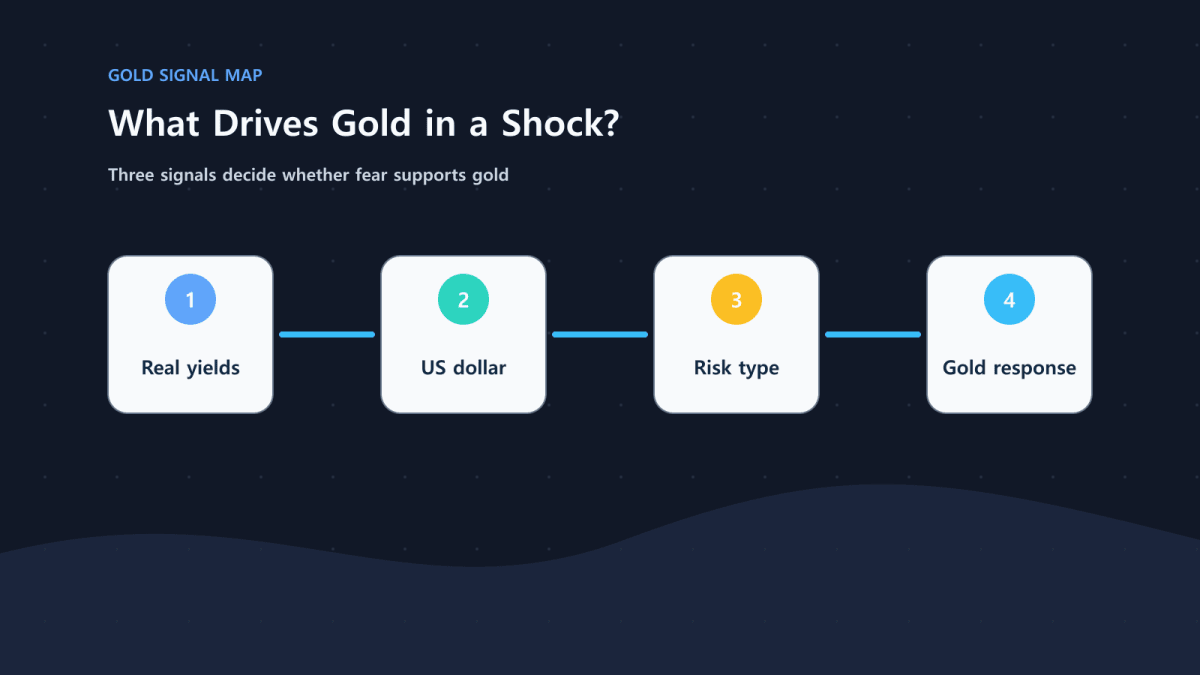
If you want one stable mental model, use a scoreboard with three items. In geopolitical stress, gold’s bias is often best explained by:
- Real rates (the opportunity-cost engine)
- USD strength (pricing currency + global funding tone, often proxied by DXY)
- Uncertainty type and positioning (hedge demand vs cash demand, and whether the trade is crowded)
To make this actionable, each variable below is described in a simple three-line set: definition, what to watch, and the common trap.
1) Real rates (opportunity cost)
- Definition: the return you can earn on “safe” assets after inflation; often proxied by U.S. TIPS real yields or by nominal yields minus inflation expectations.
- What to watch: direction and speed of real yields; whether yields are rising faster than inflation expectations; whether the curve move is “growth scare” or “policy re-tightening.”
- Common trap: focusing on inflation headlines while missing that real yields can rise even when inflation worries are prominent.
2) USD strength (broad USD tone)
- Definition: the broad dollar’s strength versus major peers; DXY is an imperfect proxy but useful for regime interpretation.
- What to watch: DXY direction and acceleration; correlation with risk assets; whether USD strength looks like “risk-off bid” or “funding stress bid.”
- Common trap: assuming “USD up means gold down” in all cases; the speed and the reason for USD strength matter.
3) Uncertainty type and positioning (fear vs liquidity)
- Definition: uncertainty is “distribution widening,” not just bad news; positioning determines whether new fear creates incremental buying or simply confirms a crowded trade.
- What to watch: volatility regime, credit spreads, and signs of forced de-risking; crowding signals like one-way narratives and flow concentration.
- Common trap: treating all uncertainty as hedge-friendly, when liquidity stress can become “sell what you can to raise cash.”
How a Middle East shock can reach gold through U.S. macro channels
Geopolitical risk is not a single input. It travels through channels that affect inflation expectations, growth expectations, and financial conditions. In U.S. markets, the same headline can push investors toward “inflation fear” or “funding fear,” and those two paths can produce very different gold behavior.
A simplified transmission chain looks like this:
- Geopolitical risk → energy and supply risk → inflation expectations (CPI/PCE implications) → policy expectations → Treasury yields and real yields → USD and financial conditions → gold
The key nuance: CPI and PCE are both inflation measures, but markets often react to the policy function embedded in inflation expectations. If the shock makes investors think policy must stay tighter, real yields can rise—an unfavorable condition for gold—even as inflation risk is discussed.

Here is a practical “channel table” you can use when reading headlines:
| Shock channel | What tends to move first | Macro interpretation | Gold bias (typical) | Common flip condition |
|---|---|---|---|---|
| Energy / supply risk | Oil, inflation expectations | “Inflation risk up; policy may stay tighter” | Mixed | If real yields rise, gold can disappoint |
| Growth / demand risk | Equities, curve slope | “Growth fear; policy may ease later” | Often supportive | If USD spikes on risk-off, support can weaken |
| Funding / liquidity stress | Credit spreads, USD funding tone | “Cash first; forced selling risk” | Often disappoints early | Gold improves after USD/spreads stabilize |
| Risk premium widening | Volatility measures, safe-haven flows | “Hedge demand rising” | Supportive | If hedge trade becomes crowded, upside can cap |
Interpretation:
- The table is not a forecast. It is a map of how the market often translates the same headline into different “first moves.”
- If your first move is “credit spreads widen + USD accelerates,” treat it like funding stress, not like a pure hedge regime.
- If your first move is “real yields easing,” gold has a clearer tailwind even if USD is not weak.
A regime matrix: real rates × USD × uncertainty → supported vs disappoints
Now we turn the scoreboard into a matrix. The goal is to decide which regime you are likely in, and whether gold is more likely to be supported or to disappoint given that regime.
This table intentionally uses bias language (“supported,” “mixed,” “disappoints”) instead of price targets.
| Real rates | USD (DXY) | Uncertainty / positioning | Likely gold bias | Why this happens | What to watch next |
|---|---|---|---|---|---|
| Falling | Flat to weaker | Geopolitical/policy uncertainty widening | Supported | Opportunity cost falls as hedge demand rises | Is uncertainty persistent or fading quickly? |
| Falling | Stronger | Uncertainty widening, not a cash squeeze | Mixed to supported | Real-rate tailwind offsets USD headwind | Is USD strength accelerating or stabilizing? |
| Stable | Flat | Uncertainty rising, positioning not crowded | Mildly supported | No strong headwind; incremental hedge demand helps | Is the hedge trade becoming crowded? |
| Rising | Stronger | Inflation-scare regime (tighter policy priced) | Disappoints | Real yields raise carry penalty; USD tightens conditions | Are real yields rising faster than breakevens? |
| Rising | Stronger | Funding stress (cash first) | Often disappoints early | Liquidity preference can trigger forced selling | Do spreads and USD momentum start to stabilize? |
| Rising | Flat | Uncertainty rising but growth fear rising too | Mixed | Real-rate headwind remains even without USD surge | Does growth fear begin pulling real yields down? |
Interpretation:
- If gold is flat in a scary week, check whether you are in “rising real yields” or “funding stress” rows; both can neutralize fear.
- If gold is up while DXY is also up, don’t force a contradiction; check whether real yields are falling and whether uncertainty is hedge-type rather than cash-type.
- The most common reason for disappointment is simple: real yields up while the narrative says “fear up.”

Misconception box: “Fear is enough” (when gold disappoints)
Misconception: “If geopolitical fear rises, gold should rise.”
Why it fails: Gold can disappoint when the stress event pushes real yields higher (opportunity cost rises) or when markets enter funding stress where cash is preferred to hedges and forced selling appears.
Instead, check this:
1) Are real yields falling or rising this week?
2) Is the USD move a slow risk-off drift or a fast funding-stress spike?
Two scenarios that look similar in headlines but behave differently in markets
You can cover most geopolitical stress episodes with two scenario lenses. They can even occur sequentially: a shock starts as “funding stress,” then transitions to “policy uncertainty,” or vice versa.
Scenario A: Funding stress (cash-first behavior)
This is the regime where liquidity and collateral matter more than narratives.
Common signal set:
- DXY accelerates quickly; the USD acts like a funding magnet
- Credit spreads widen; financial conditions tighten
- De-risking is broad; “sell liquid assets to raise cash” behavior increases
- Gold can fall early because it is liquid and can be sold to meet margin or reduce exposure
What would change the regime:
- DXY stops accelerating and starts moving sideways
- Credit spreads stabilize (even if they remain elevated)
- Real yields ease or stop rising
Why gold can improve later:
- Once cash urgency fades, investors can re-express hedge demand
- Falling or stabilizing real yields reduce the opportunity-cost headwind
Scenario B: Inflation scare (supply shock → policy anxiety)
This is the regime where the market interprets the shock as inflationary and prices tighter policy or delayed easing.
Common signal set:
- Inflation expectations rise; investors debate inflation persistence
- Nominal yields rise; real yields can rise if the market prices a tighter real policy stance
- USD can strengthen on relative policy expectations
- Gold outcome depends on whether real yields rise (headwind) or remain contained (tailwind)
Key fork:
- If inflation expectations rise but real yields stay contained, gold is often more supported.
- If real yields rise meaningfully, gold can disappoint even as inflation fear dominates headlines.
A required 3-scenario table with observable flip triggers
Even if you focus on the two scenarios above, it helps to add a “base case” and define flip triggers. The purpose is to avoid overfitting a single day and to make your process repeatable.
| Scenario | What the market is really pricing | Observable flip triggers | Gold bias (typical) | Rules-based response |
|---|---|---|---|---|
| Base uncertainty | Risk premium up, but conditions orderly | Real yields stable; DXY not accelerating; spreads contained | Mildly supportive | Hold framework; avoid chasing crowded narratives |
| Inflation scare | Supply risk → tighter policy expectations | Real yields rising; policy path repriced; USD firm | Mixed to disappoints | Reduce “fear trade” assumptions; watch real yields weekly |
| Funding stress | Liquidity preference → cash first | DXY spike; spreads widen quickly; disorderly moves | Disappoints early | Avoid judging gold by day one; wait for USD/spreads stabilization |
Interpretation:
- Your first job is labeling which row you are in, not guessing where gold goes.
- A move from “funding stress” to “base uncertainty” often shows up as USD momentum breaking and spreads stabilizing.
- A move into “inflation scare” often shows up as real yields rising alongside policy-path repricing.

Mid-article essentials: two short primers that prevent most interpretation errors
If you find yourself confused by “gold vs rates” or “gold vs the dollar,” these two references make the matrix easier to apply:
A rules-based monitoring plan (weekly and monthly) with add/hold/reduce triggers
This plan is designed to reduce headline-driven decisions. It does not tell you what to own; it tells you what to monitor and when to treat gold as more or less likely to behave like a hedge.
Use weekly checks for momentum and stability, and monthly checks for regime confirmation and crowding.
| Cadence | Dashboard items | Trigger (observable) | Add / Hold / Reduce bias | Why it’s rational |
|---|---|---|---|---|
| Weekly | Real yields direction and speed | Real yields falling or stabilizing after a rise | Add / hold | Lower opportunity cost supports gold’s hedge role |
| Weekly | DXY momentum | DXY acceleration breaks (moves sideways after spike) | Add / hold | Funding stress is easing; forced selling pressure can fade |
| Weekly | Credit spreads | Spreads widening rapidly (stress intensifying) | Hold / reduce adding | Cash-first regimes can pressure gold early |
| Monthly | Regime persistence | Real yields rising persistently + USD strong + uncertainty fading | Reduce | Carry is attractive; hedge bid is less urgent |
| Monthly | Crowding and narrative | One-way “everyone owns gold” narrative, crowded positioning signals | Reduce / rebalance | Crowding raises disappointment risk and mean reversion odds |
| Monthly | Cross-check | Real yields contained while uncertainty remains elevated | Hold / add | Hedge demand can stay bid without opportunity-cost penalty |
Interpretation:
- Weekly rules help you avoid “buying the most obvious headline.” A supportive gold regime often requires real yields not rising.
- Monthly rules prevent drift: regimes persist, and gold can lag when carry conditions dominate.
- The plan is intentionally asymmetric: it is easier to “hold and wait for stabilization” in funding stress than to chase fear on day one.
Checklist 1: the 60-second scoreboard (weekly)
- □ Real yields: falling / stable / rising (and how fast)
- □ DXY: accelerating / stable / reversing
- □ Credit spreads: widening fast / stable / tightening
- □ Uncertainty type: policy/geopolitical risk vs liquidity/funding risk
- □ Crowding: does the hedge trade feel universally agreed upon?
Checklist 2: monthly regime confirmation
- □ Are real yields rising persistently, or did they roll over?
- □ Is USD strength structural (policy differential) or episodic (stress spike)?
- □ Is uncertainty fading, or does it keep re-widening the distribution?
- □ If you use gold as a hedge sleeve, is your sizing consistent with your risk budget?
Use the CAGR tool to keep long-horizon expectations honest
One common mistake is judging gold by one week of headlines. A better habit is to sanity-check the annualized return over your actual holding window and compare it to your risk-budget expectations for a hedge sleeve.
Related calculator: Open CAGR calculator
This calculator helps you validate the annualized return implied by a gold move over a chosen period, which reduces narrative-driven recency bias. Input: starting value, ending value, and the time span (years/months); use it to compare regimes without needing forecasts.Continue the puzzle with these exact next pieces (near the end)
- DXY market impact
- TNX explained (the discount-rate backbone)
- Modern 60/40 risk budget (where gold fits)
FAQs (search-style)
1) Why can gold be flat during major geopolitical headlines?
Gold is often pulled by opposing forces. If real yields rise or the USD surges on tightening conditions, those headwinds can offset hedge demand. Labeling the regime using real yields, DXY momentum, and spreads usually explains the “flat gold” puzzle.
2) What is the simplest way to think about real rates and gold?
Gold has no yield, so real rates represent the opportunity cost of holding it. When real yields rise, gold often faces pressure; when real yields fall or stabilize, gold’s hedge role tends to show up more cleanly. This is a tendency, not a law, and uncertainty type can still matter.
3) Does a stronger USD always mean weaker gold?
Not always, but sharp USD strength often coincides with tighter financial conditions and can pressure gold. Gold can rise alongside USD in certain extreme uncertainty regimes, especially if real yields are falling. The more useful question is whether the USD move is accelerating like a funding stress episode.
4) What is the difference between a funding-stress shock and an inflation-scare shock?
Funding stress is “cash first”: spreads widen and USD demand spikes, sometimes forcing selling in liquid assets. Inflation scare is “policy path repricing”: inflation risk rises and real yields can rise if tighter policy is priced. The two regimes have different gold behavior and different stabilization signals.
5) Should I watch CPI or PCE for gold?
Both matter mainly through how they affect real yields and policy expectations. PCE is often emphasized in U.S. policy discussions, while CPI is a dominant headline series. For gold interpretation, the key is not the label but whether real yields are tightening or easing.
6) What indicators belong on a practical weekly gold dashboard?
Real yields (direction and speed), DXY momentum, credit spreads, and a quick assessment of uncertainty type (policy risk vs liquidity risk). Add a simple crowding check to avoid chasing a consensus hedge narrative. This set is usually enough to place the market into the matrix.
7) When does gold tend to disappoint the most?
Gold tends to disappoint when real yields rise persistently or when markets enter cash-first funding stress where forced selling appears. In those regimes, the headline may look supportive, but the opportunity-cost and liquidity channels dominate. Watching for stabilization in USD and spreads can prevent premature conclusions.
8) How do I use this framework without turning it into a prediction game?
Treat it as a regime-labeling tool and a monitoring routine. Decide which signals you will check weekly and which confirmations you will check monthly, then follow the triggers for add/hold/reduce bias within your own risk budget. The win condition is consistency, not perfect timing.