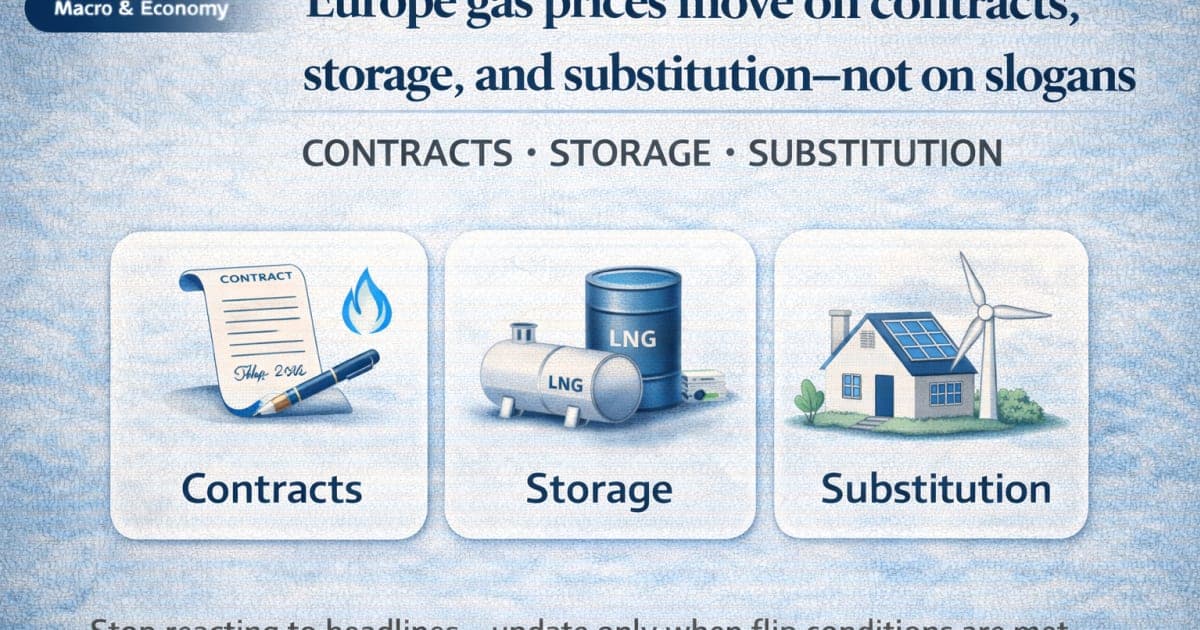
- A “Russian gas phaseout” headline doesn’t automatically mean lower prices—gas often reprices through contracts, storage, and substitution costs long before physical shortages show up.
- When the market moves first in the forward curve (next month/next quarter), it’s usually pricing risk and replacement cost, not “today’s spot supply.”
- Storage is not just a statistic; it’s a battery—the level matters, but the weekly draw/fill speed often matters more in winter.
- Substitution is rarely free: replacing pipeline gas with LNG can raise the marginal cost that sets the floor, even if demand is soft.
- Policy headlines change expectations, but price persistence depends on whether storage trends improve and whether LNG replacement becomes cheaper and reliable.
- The same news can produce opposite reactions depending on the regime: high storage = shorter spikes, low storage = longer stress.
- The useful question is not “Will gas go up?” but “Which channel is moving right now—and what would flip it?”
- Europe’s gas stress can leak into broader macro through inflation narratives, growth sentiment, and risk-on/risk-off positioning.
- This post avoids predictions and instead gives a rules-based reading routine you can apply to today’s headlines.
ECONOMICS · EUROPE GAS
“Europe is phasing out Russian gas—so energy prices should calm down, right?”
That intuition often loses money because prices don’t move on policy slogans—they move on *replacement mechanics*. Sometimes prices stay sticky even when the headline sounds “relieving.”
This post gives you a simple interpretation frame: classify every headline into contracts, storage, or substitution cost, then update only when your flip triggers appear.
- A three-variable map (contracts / storage / substitution) you can reuse every time
- A winter scenario table (Base / Stress / Relief) with observable flip conditions
- Two case studies + checklists that turn news into a calm action plan
Scope: no short-term price forecasts, no trade calls. This is about “data interpretation → personal decision rules.”

The core idea: gas prices are a three-channel story, not a one-line headline
Europe’s shift away from Russian pipeline gas is often reported as a simple supply story: “Less Russian gas → higher prices” or “Phaseout policy → long-run stability.”
But the market usually prices the story through three channels:
- Contracts (the pricing “rails”): what is fixed, what floats, and how quickly risk passes into delivered cost
- Storage (the buffer “battery”): how much cushion exists, and how fast it’s being used or replenished
- Substitution cost (the marginal “replacement bill”): what it costs to replace missing pipeline volumes—often LNG-related, sometimes demand destruction-related
If you only watch spot supply, you will miss why prices can move before confirmed shortages—and why “good headlines” sometimes fail to push prices down.
One-line takeaway: Treat “phaseout” as a regime change, then ask which channel is currently setting the marginal price.
Define the three variables like a pro: what it is, how to observe it, where it breaks
Below is the “three-line set” for each variable (definition / how to observe / limits). Keep this framework close; it’s the difference between reacting to headlines and reading the mechanism.
1) Contracts (pricing rails)
- Definition: How gas is bought and priced: long-term vs short-term share, indexation (hub-linked vs oil-linked), flexibility, and renegotiation power.
- How to observe: What part of demand is exposed to spot/near-month prices, and whether risk is migrating into forward contracts (next month/quarter).
- Limit: Contract terms are often opaque, so markets infer them indirectly—expect “pricing the rumor” behavior.
2) Storage (buffer battery)
- Definition: Inventory that absorbs weather shocks and supply interruptions; in winter it decides whether a move is a spike or a season-long stress.
- How to observe: Storage level vs seasonal norms, plus the weekly pace of draws/fills (speed often matters more than level).
- Limit: High storage doesn’t eliminate spikes (logistics can still bite), and low storage can improve fast if demand collapses.
3) Substitution cost (replacement bill)
- Definition: The marginal cost of replacing pipeline gas—often LNG procurement + shipping + regas constraints + competition with other regions.
- How to observe: Signs that replacement is getting cheaper or harder: cargo availability, price spreads, bottlenecks, and demand-side adjustments.
- Limit: LNG is global; Europe’s substitution cost can rise even without a Europe-only shock if global competition tightens.
Table 1 — The three-channel dashboard you should update for every headline
| Channel | What it changes first | Quick diagnostic question | Typical price behavior | Common mistake |
|---|---|---|---|---|
| Contracts | The forward curve (next month/quarter) | “Is risk moving into future delivery prices?” | Fast repricing before spot is “confirmed” | Treating a forward move as “manipulation” rather than risk pricing |
| Storage | Persistence and volatility in winter | “Is storage draw speed accelerating?” | High storage = shorter spikes; low storage = sticky stress | Watching the level only, ignoring weekly pace |
| Substitution cost | The floor (marginal price) | “Is replacement cheaper or structurally expensive?” | Expensive substitution = higher floor even after headlines fade | Assuming demand relief automatically equals cheap replacement |
Interpretation (read this slowly):
- The market can “tighten” on contracts even when physical supply hasn’t visibly changed—because future delivery is where risk gets priced.
- Storage decides whether you get a headline-driven spike or a durable regime shift. Speed matters.
- Substitution cost often sets the floor—if replacing is expensive, “relief headlines” can bounce off.
Why policy headlines often disappoint: the “headline → channel → price” translation
A key reason investors get whipsawed is that they confuse policy intention with delivery economics. Policy can change direction; the molecule still needs a route, a contract, and a buffer.
Table 2 — Common headlines and what they really move
| Headline type | What your brain hears | What it usually changes | What to check in 60 seconds |
|---|---|---|---|
| “Phaseout plan / new restriction” | “Supply down, prices up” | Contracts (risk premium) | Does the forward curve move more than spot? |
| “Storage is high” | “Prices should fall” | Storage buffer confidence | Is weekly draw speed slowing, or just the level high? |
| “LNG cargoes arriving / terminals expanding” | “Replacement solved” | Substitution capacity (sometimes) | Are bottlenecks shifting to shipping/regas/demand? |
| “Industrial slowdown / weak PMI” | “Demand down, prices down” | Demand channel | Does demand relief appear in storage pace? |
| “Winter weather scares” | “Spike incoming” | Storage + risk | Are draws accelerating beyond seasonal norms? |
Interpretation (2–3 lines):
- Most headlines are incomplete: they signal a directional story but not the binding constraint.
- Your job is to identify the binding constraint: forward pricing (contracts), buffer health (storage), or replacement bill (substitution).
- The “right reaction” is not a trade—it’s updating your scenario only if the relevant checks confirm it.
The winter regime: Base / Stress / Relief with flip triggers you can actually observe
Winter is where Europe gas becomes a true macro variable. Not because “winter is cold,” but because storage becomes the central buffer and substitution becomes the marginal bill.

Table 3 — Winter scenarios with flip conditions (this is your calm decision sheet)
| Scenario | Contracts (pricing rails) | Storage (buffer battery) | Substitution cost (replacement bill) | What the market tends to price | Flip condition (observable) |
|---|---|---|---|---|---|
| Base (manageable) | Risk priced but contained | Storage level comfortable; draw pace stable | Replacement available at tolerable cost | Range-bound with episodic spikes | Draw pace not accelerating; replacement signals stable |
| Stress (tight) | Forward curve reprices sharply | Storage draw pace accelerates; buffer anxiety | Replacement cost rises / bottlenecks appear | Spikes become stickier; floor rises | Draw pace speeds up + replacement indicators worsen |
| Relief (easing) | Risk premium fades | Storage stabilizes or refills faster | Replacement becomes cheaper/more available | Volatility falls; curve relaxes | Draw pace slows + replacement cost signals improve |
Interpretation (2–3 lines):
- This table is not a forecast. It’s an update rule: you only switch scenarios when the flip conditions show up.
- In practice, “Stress” often begins with storage pace (speed), then gets reinforced by substitution cost (floor).
- “Relief” is rarely a headline; it’s a trend change in pace and replacement.
One-line takeaway: Your best edge is not predicting winter—it’s recognizing when the scenario flips.
A misconception that keeps hurting people (and how to replace it with a better check)
Misconception: “A phaseout is a path to lower prices, so prices should trend down over time.”
Why it’s wrong (2–3 sentences): Prices are set at the margin: what it costs to secure the next unit of supply and protect against shocks. If substitution remains expensive or contract exposure rises, the floor can stay elevated even when the policy direction is “stabilizing.” In winter, storage pace can dominate the narrative regardless of long-term intent.
Instead, check this (two boxes):
- □ Is the forward curve moving because contracts are repricing future delivery risk?
- □ Is storage pace improving and is substitution getting cheaper or more reliable?
Two case studies that teach the mechanism (without pretending to predict)
These are simplified, recurring patterns. The goal is to recognize the channel, not to bet on the headline.
Case study A — “Policy relief headline” but prices don’t fall much
- What happens: A headline suggests easing (more LNG capacity, diplomatic progress, or a reassuring policy statement). Spot prices may dip, but the forward curve stays firm.
- Channel explanation: Contracts are still pricing risk into future delivery, and substitution cost remains high enough to keep the floor elevated.
- How to respond (rules): Don’t declare “relief” from a single headline; wait for storage pace to improve and replacement signals to soften.
One-line takeaway: If the curve doesn’t relax, the market isn’t buying your relief story yet.
Case study B — Storage looks fine, then a short spike appears anyway
- What happens: Storage levels are decent, yet prices spike on weather/logistics or sudden risk events.
- Channel explanation: High storage reduces duration, not spikes. If draw pace jumps or delivery bottlenecks appear, spot can jump even in a “healthy” storage level regime.
- How to respond (rules): Treat it as a volatility episode unless the spike changes storage pace or substitution cost trends.
A practical reading routine: turn headlines into a 10-minute checklist
This is the “do this today” part. You don’t need to be a gas trader to use it.
Checklist 1 — The 10-minute “headline → channel → scenario” workflow
- □ Classify the headline into contracts, storage, or substitution cost. (Pick one primary channel.)
- □ Ask the diagnostic question from Table 1. (One question, not ten.)
- □ Update your winter scenario only if the flip condition in Table 3 is met.
- □ If you can’t observe the flip condition, label it “noise” and do nothing.
- □ Write a one-sentence note: “Today’s move is driven by ___; I would change my view only if ___ happens.”
Midway skill-builder (macro context helps you interpret demand and activity signals that feed into gas):
- How to read GDP, unemployment, and PMI in practice
- Inflation and rates explained (the core regime map)
How Europe gas stress spills into global macro (without overclaiming)
Europe’s gas stress matters to global investors because it can act like a tax on activity and a catalyst for inflation narratives. The point is not “Europe gas will cause X,” but that it can influence the inputs markets use to price risk.

Table 4 — Spillover map: from Europe gas to broader market narratives
| Europe gas channel | Macro narrative it can touch | What tends to move first | What to watch (non-predictive) |
|---|---|---|---|
| Substitution cost stays high | “Sticky inflation risk” | Inflation-sensitive assets react to narrative | Whether energy shock shows up as persistent cost pressure |
| Storage pace worsens in winter | “Growth drag / risk-off” | Risk sentiment and cyclicals wobble | Whether the shock looks temporary vs structural |
| Contracts reprice forward risk | “Volatility regime change” | Curves and volatility measures react | Whether repricing spreads across maturities |
| Demand weakens (industry) | “Disinflation vs recession debate” | Activity proxies become more important | Whether demand relief stabilizes storage pace |
Interpretation (2–3 lines):
- Energy stress is not a single macro outcome—it’s a set of narratives markets can rotate through.
- Your job is to avoid story-trading: connect the channel to the narrative, then demand a confirming flip trigger.
- This is especially important when markets are already sensitive to rates and global liquidity.
Korea overlay (for global readers): why this topic can still matter for Korea-linked risk sentiment
Even if you’re not trading European gas, Europe’s energy stress can influence global risk-on/risk-off and USD strength. That can matter for Korea-linked assets because Korea is a trade-heavy economy and often sensitive to global liquidity conditions.
- A “risk-off” turn can show up in USD strength and global equity sentiment, which sometimes affects Korea flows and exporters’ narrative.
- This is not a claim of direct causality—think of it as a transmission possibility you keep on your radar.

A rules-based action plan: what to do (and what not to do)
This plan is deliberately boring. Boring is good when news is loud.
Checklist 2 — The “don’t get whipsawed” plan
- □ Don’t change your macro view on a single policy headline. Require a flip trigger (Table 3).
- □ Don’t confuse spot spikes with regime shifts. Ask: did storage pace or substitution cost trend change?
- □ If you invest long-term, measure outcomes with a long-term yardstick, not a daily headline.
Tool CTA (optional but useful): If your portfolio decisions are being pushed around by macro headlines, run a quick CAGR check. It reframes performance in a single annualized number.
Inputs are simple: starting value, ending value, and time period.
- Open the CAGR tool: CAGR calculator
If you want the “next pieces” that complete the map
(These are placed near the end on purpose—use them after you’ve built the three-channel frame.)
- Interest rates 101: policy vs market vs real-world borrowing
- Why rate cuts don’t guarantee lower borrowing costs
- How DXY tightens global financial conditions
- S&P 500 risk-on/off chain into Korea
Where to verify the data (official / primary sources you can trust)
If you want to sanity-check the “storage / flows / macro” inputs without relying on social media:
- EU gas storage dashboards (industry/official reporting)
- Gas transmission and flow transparency platforms (pipeline flows and constraints)
- Euro-area inflation and activity releases (official statistics portals)
- Central bank communications (rate narrative context)
(Use these as “reference checks,” not as daily trading signals.)
FAQs people actually search (and short answers that keep you grounded)
Does phasing out Russian gas guarantee lower European gas prices?
No. Policy direction can reduce certain risks over time, but prices are set by the marginal replacement cost and the buffer regime. If substitution remains expensive or contracts reprice forward risk, prices can stay sticky even with “phaseout” messaging. Use the three-channel frame before drawing conclusions.
Why does the forward curve move before spot supply looks tight?
Because the curve prices the cost of future delivery under uncertainty—contracts are where risk migrates first. Spot can stay calm while the market buys insurance for the next month or quarter. That’s why “contracts” is its own channel.
If storage is high, can prices still spike?
Yes. High storage reduces duration risk but doesn’t erase short volatility. Spikes can still happen due to weather shocks, logistics constraints, or sudden risk events. The key is whether the spike changes storage pace or substitution cost trends.
What is “substitution cost” in plain English?
It’s the replacement bill: what Europe has to pay to secure the next unit of gas when pipeline supply is reduced. Often this is tied to LNG economics, shipping, and regas constraints. If that bill is high, it can raise the effective floor.
How should I read winter headlines without getting whipsawed?
Pick the primary channel first (contracts, storage, or substitution). Then only switch scenarios if your flip condition appears (Table 3). If you can’t observe a flip condition, treat it as noise and do nothing.
Can Europe gas stress affect global markets even if I never touch gas?
It can, through inflation narratives, growth sentiment, and risk-on/risk-off positioning. That doesn’t mean a deterministic outcome. It means the topic can influence the inputs markets watch, especially in rate-sensitive environments.
What’s the single most useful metric to monitor in winter?
For most readers: storage pace (weekly draw/fill speed), not just the storage level. Pace tells you whether the buffer is being consumed faster than expected. Combine it with a simple read on whether substitution is getting cheaper or more constrained.
How do I keep long-term investing decisions stable during macro noise?
Use a rules-based update process and a long-horizon metric. Don’t let daily headlines reset your plan. A simple CAGR check can help you re-anchor performance to time and compounding rather than to daily narratives.