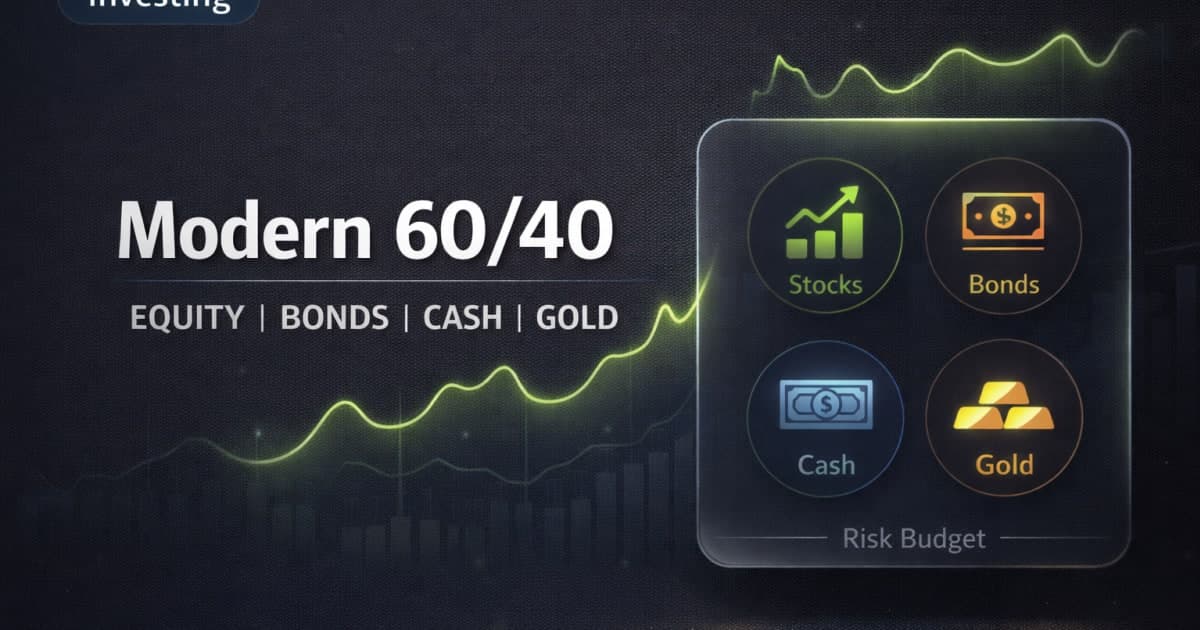
- Modern 60/40 is not “60% stocks, 40% bonds” — it’s a risk budget: how much volatility and drawdown you can realistically live through.
- Anxiety is mostly a decision problem, not a math problem. A good portfolio is one that leaves you with clear actions on bad days.
- Stocks, bonds, cash, and gold/commodities should be chosen by role (engine, shock absorber, ammo, insurance), not by recent performance.
- Bonds can lose money when rates jump; cash is not “lazy,” it’s liquidity + optionality; gold/commodities are regime insurance, not a guaranteed return engine.
- The goal is not the “best” allocation — it’s a repeatable operating system: triggers, rebalancing rules, and life-event stop conditions.
- A simple rebalancing design (calendar + bands) beats clever timing. Rules protect you from “news-driven” portfolio drift.
- Your plan should include two red lines: (1) drawdown limit and (2) cash-flow stress limit (job risk, debt, near-term expenses).
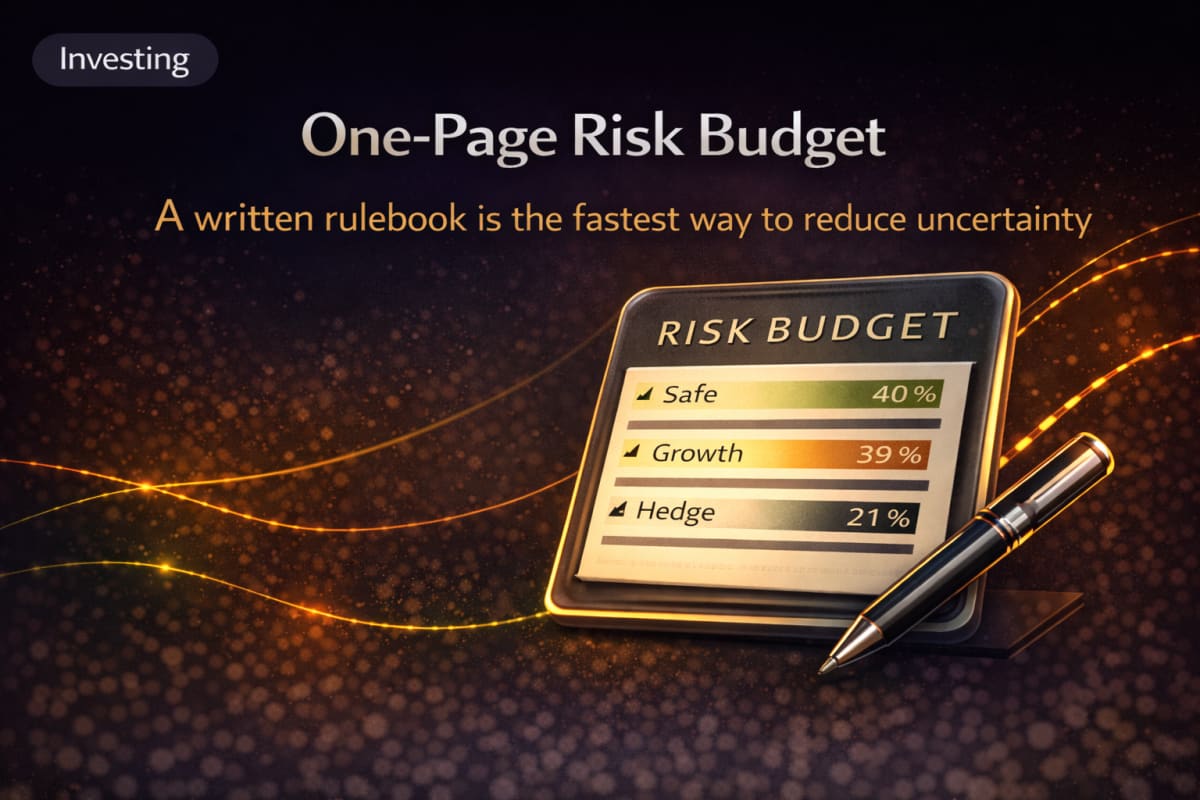
- A one-page “risk budget sheet” makes markets easier to interpret: it tells you what today’s headline means and what you do about it.
- The biggest failure mode is not picking the wrong assets — it’s breaking the plan in a drawdown because the plan had no survival logic.
- By the end, you’ll have a ready-to-copy template for weights + roles + triggers + stop conditions, plus a FAQ rulebook.

Why 60/40 feels broken in modern markets (and why that’s the wrong takeaway)
If you’ve ever thought, “Stocks are down and bonds are down — what’s the point of diversification?”, you’re not alone.
The classic 60/40 story people remember is simple:
- Stocks grow your wealth.
- Bonds cushion the fall.
- Rebalance occasionally.
- Repeat.
That story works well in many regimes — but it’s not a law of physics. In some environments, stocks and bonds can fall together:
- when inflation shocks hit,
- when central banks reprice rates quickly,
- when risk premia widen across assets at the same time.
The mistake is concluding that “diversification is dead.”
A better conclusion is: fixed weights are fragile; risk budgets are durable.
A weight-based portfolio answers: “What do I hold?”
A risk-budget portfolio answers: “What am I trying to survive, and what will I do when it happens?”
That second question is how you reduce anxiety.
The core shift: from “weights” to “risk budget”
A risk budget is simply a plan for how much portfolio pain you can absorb without blowing up your life or your discipline.
Most people try to budget returns:
- “I want 8% per year.”
- “I need to beat inflation.”
- “I want to double my money.”
But in real life, what breaks investors is not the average return.
It’s the path: the drawdowns, the uncertainty, and the moment you pause or sell at the worst time.
So your first target is not a CAGR.
Your first target is a maximum tolerable drawdown and a cash-flow survival buffer.
The two numbers that matter more than your expected return
- Drawdown limit (behavior + psychology)
- “At what point do I stop sleeping well?”
- “At what point will I change the plan?”
- Cash-flow stress limit (life + math)
- job stability,
- debt obligations,
- near-term big expenses (moving, wedding, tuition, medical),
- family dependency.
If your cash-flow stress is high, your portfolio must be more resilient even if it’s less “efficient” on paper.
Assign roles first: engine, absorber, ammo, insurance
Modern 60/40 works when each asset has a job.
Here’s the clean mental model:
- Stocks = return engine (growth)
- Bonds = shock absorber (rates + duration matters)
- Cash / T-bills = ammo + survival liquidity
- Gold / commodities = regime insurance (not a return promise)
If you treat everything as “return assets,” you end up overexposed to the same risk factor: risk-on sentiment.
Table 1 — Role-based asset map (what each piece is for)
| Asset sleeve | Primary job | Often helps when… | Often struggles when… | What to manage |
|---|---|---|---|---|
| Stocks | Long-run growth | steady growth, stable liquidity | recession shocks, valuation repricing | drawdown tolerance, equity risk exposure |
| Bonds (esp. high-quality) | Cushion + ballast | growth slows, yields stabilize/fall | yields spike, inflation surprises | duration (rate sensitivity), credit risk |
| Cash / T-bills | Survival + optionality | volatility rises, you need flexibility | inflation stays high for long | size of buffer, “ammo” rules |
| Gold / commodities | Regime hedge | inflation shocks, policy uncertainty | rising real yields, strong USD | treat as insurance, size modestly |
Key point: bonds can be risky; cash can be smart; gold/commodities are not “guaranteed winners.”
The misunderstanding that destroys modern 60/40
Reality: Bonds are safe in credit terms (if high quality), but they can be volatile in price terms when rates move fast. Your bond sleeve needs an explicit duration choice, not blind faith.
A lot of “60/40 disappointment” comes from mixing up:
- default risk (will you get paid?) vs
- price risk (what happens to market value today?).
For modern 60/40, you must decide what you want from bonds:
- a true stabilizer (often shorter duration),
- an interest-rate play (longer duration),
- or a diversified mix.
Build your risk budget in 4 steps
You can do this in one sitting. Don’t aim for perfect — aim for usable.
Step 1) Define your survival constraints (non-negotiables)
Check the boxes that apply:
- □ I have high fixed monthly obligations (mortgage, rent, loans).
- □ My income could drop within 12 months (job uncertainty, commission-based).
- □ I have a big expense within 24 months (move, wedding, tuition, car).
- □ I support family members financially.
- □ I’ve sold in panic before (drawdowns hit me hard).
Rule: the more boxes you check, the more your plan must prioritize cash + stability + smaller equity drawdown.
Step 2) Pick a drawdown range you can live with
You don’t need one exact number. Choose a range:
- Low stress: “I can handle ~10–15% peak-to-trough.”
- Moderate: “I can handle ~15–25%.”
- High: “I can handle 25%+ without breaking rules.”
Your drawdown limit is your behavioral circuit breaker.
Step 3) Allocate sleeves by role, then set initial weights
You can start with a “modern 60/40 family” instead of a single point:
Growth-tilted (higher drawdown tolerance):
Stocks 60–70 / Bonds 20–30 / Cash 5–10 / Gold/Commodities 5–10Balanced (most people):
Stocks 45–60 / Bonds 25–40 / Cash 5–15 / Gold/Commodities 5–10Stress-aware (high cash-flow stress):
Stocks 30–50 / Bonds 25–40 / Cash 10–25 / Gold/Commodities 5–10
These ranges are not “recommendations.” They’re starting families that you tune using rules.
Step 4) Write rules for rebalancing and “stop conditions”
This is the part that reduces anxiety the most, because it answers:
- “What do I do when things get ugly?”
Rebalancing: your anxiety-reduction engine
Most investors think rebalancing is a performance trick.
It’s not. It’s a behavioral safety system.
You want a rule that is:
- simple enough to follow while stressed,
- strict enough to stop emotional timing,
- flexible enough to avoid constant tinkering.
Table 2 — Three rebalancing designs (pick one and commit)
| Design | Rule | Pros | Cons | Best for |
|---|---|---|---|---|
| Calendar | rebalance quarterly / semi-annually | easiest to execute | slow in sudden shocks | busy investors |
| Bands | rebalance when sleeve drifts ±X% | corrects big drift fast | can trigger often | people who like systems |
| Hybrid | calendar + band override | practical balance | needs clear thresholds | most investors |
A good default for global retail investors is hybrid:
- check quarterly,
- rebalance only if a sleeve drift exceeds your band.
Example band logic (keep it simple):
- Equity sleeve: ±5 percentage points
- Defensive sleeves (bonds/cash/hedge): ±3 percentage points
You’re not optimizing — you’re stabilizing.

The “ammo rule”: cash is not idle, it’s optionality
People hate holding cash because it feels like “missing returns.”
But cash has two jobs that returns cannot replace:
- Survival liquidity
- Rebalancing ammo (buying when risk assets are cheaper)
A practical cash rule that prevents panic
- Keep a baseline buffer (e.g., 3–12 months of essential expenses depending on your life risk).
- Only deploy cash into risk assets via predefined triggers, not vibes.
Example trigger (choose one):
- Market-based: deploy X% of cash when equity sleeve drawdown crosses a threshold.
- Portfolio-based: deploy cash when equity sleeve drops enough to breach your band.
This is not “market timing.” It’s risk-control.

Gold or commodities: treat it like insurance (and price the premium)
Gold/commodities can help in certain regimes, but they are not magic.
The cleanest way to use them is:
- decide your “insurance budget” (small),
- rebalance it like the rest,
- don’t expect it to always offset losses.
If you oversize the hedge sleeve, it becomes a second “engine” you’ll chase emotionally.
A reasonable behavior-first rule:
- hedge sleeve stays modest,
- you only increase it when your risk budget requires it (e.g., higher inflation uncertainty) — and even then, you cap it.

The one-page “risk budget sheet” you should actually keep
This is the template you can copy into a note app.
Fill it once, update quarterly.
Table 3 — Your modern 60/40 risk budget sheet
| Sleeve | Target weight | Role (one sentence) | Rebalance band | Trigger action | Life-event stop condition |
|---|---|---|---|---|---|
| Stocks | “Return engine; I accept drawdowns up to ___.” | ±__%p | rebalance quarterly; band override | income drop / big expense within 24m | |
| Bonds | “Ballast; duration chosen for ___.” | ±__%p | rebalance via bands | rates shock → shorten duration / reduce sensitivity | |
| Cash / T-bills | “Survival + ammo; never fully zero.” | ±__%p | deploy only via triggers | used for emergencies, not fear | |
| Gold / commodities | “Regime insurance; premium is acceptable.” | ±__%p | rebalance, no chasing | if I start ‘believing’ in it, reduce |
Two sentences at the bottom (mandatory):
- “When headlines spike, I check my bands — I don’t improvise trades.”
- “If my life risk rises, I reduce portfolio risk first, not after I panic.”
Common failure patterns (and how to prevent them)
Here’s how modern 60/40 usually fails in real life:
- Cash goes to zero (then drawdowns force selling)
- Bonds are treated as always-safe (duration ignored)
- Hedge sleeve becomes a “story trade” (gold/commodities oversized)
- Rebalancing becomes emotional timing (“I’ll wait for confirmation…”)
- Rules are not written (so the plan changes under stress)
- No stop conditions (job risk and debt changes ignored)
Prevention checklist (print-worthy)
- □ I have a minimum cash rule that I will not violate.
- □ My bond sleeve has an explicit duration stance (short / intermediate / mixed).
- □ My hedge sleeve is sized like insurance, not like a second engine.
- □ I rebalance with calendar + bands, not news.
- □ I have at least one “stop condition” tied to life risk.
- □ I review quarterly — that’s it.
A practical interpretation framework for news (so you don’t spiral)
You don’t need more news. You need a translator.
Use this simple mapping:
Table 4 — Headline → What it usually hits → What you do
| Headline type | Usually impacts | Typical portfolio effect | Your action |
|---|---|---|---|
| “Rates repricing” | bond prices + equity valuations | stocks and bonds can fall together | check duration exposure + rebalance bands |
| “Inflation surprise” | real yields + hedges | hedges may help; bonds may struggle | keep hedge rules; avoid chasing |
| “Risk-off shock” | equity risk premium | stocks down fast | deploy ammo via trigger, not instinct |
| “FX stress (Korea)” | KRW assets + foreign flows | correlation shifts | treat FX as risk factor, not a story |
If you want a deeper macro lens for why yields matter across assets, this explainer helps mid-article:
And if you often feel confused about “strong dollar vs stocks,” this is a good companion:
Korea context (optional): when your base currency is KRW
If you invest from Korea (or you hold meaningful KRW liabilities), you have a built-in extra risk factor: FX.
You don’t need to obsess over USD/KRW daily — but you should acknowledge:
- your liabilities are in KRW,
- many risk assets are priced in USD,
- global stress can transmit through FX quickly.
A simple rulebook upgrade:
- keep your emergency liquidity in your spending currency (KRW for Korea),
- treat FX as part of your risk budget (not as a separate bet).
If that’s relevant, this chain-of-impact post is a strong reference:
How to choose “better” funds without overfitting to recent performance
Modern 60/40 is an operating system. But you still need instruments.
The easiest way to avoid performance chasing is to judge long-term outcomes with robust metrics:
- long-run CAGR for reality checks,
- drawdown and volatility for survivability.
This article explains why CAGR beats “total return” for comparing funds:
Action plan: build a rules-based portfolio in 30 minutes
If you only do one thing after reading, do this.
10-minute setup
- Pick your drawdown range.
- Choose your role sleeves (stocks/bonds/cash/hedge).
- Choose a starting family (growth / balanced / stress-aware).
10-minute rules
- Pick rebalancing design (hybrid is fine).
- Set band thresholds.
- Write 1–2 stop conditions (job risk, debt, near-term expense).
10-minute execution
- Put your rulebook in one note.
- Set a quarterly reminder.
- Do nothing else until review day.
If you tend to drift or pause contributions, this post helps you build consistency rules:
Tool CTA: turn the framework into your numbers
If your risk budget is written, the next step is sizing: “How much do I invest per month, and what outcome is realistic?”
You can sanity-check with FinMap tools:
Related calculator: Open goal simulator
Related calculator: Open DCA calculator
Related calculator: Open CAGR calculator
Related reads that complete the picture
If you want to deepen your macro intuition and keep your rules stable across regimes:
- 🔗 How U.S. 10Y Yield (TNX) Affects ETFs: Growth, Value, EM, and Korea
- 🔗 Diagnosing Your Investing Skill Using CAGR: Understanding MDD, Volatility, and Sharpe Ratio
- 🔗 How WTI Oil Shapes Korea’s Economy and KOSPI: Inflation, FX, Rates, and Earnings in One Chain
FAQs (rulebook style)
Q1) Is modern 60/40 “better” than classic 60/40?
Not always. It’s better at one thing: survivability. You’re upgrading from a static weight recipe to a rules-based operating system.
Q2) Why include cash when it “doesn’t earn” much?
Because cash buys optionality. It prevents forced selling and lets you rebalance into risk assets without panic.
Q3) Aren’t bonds supposed to always hedge stocks?
Often — but not always. When rates reprice quickly, bonds can fall with stocks. That’s why your bond sleeve needs explicit duration logic.
Q4) Should I choose gold or broad commodities?
Gold tends to behave more like “regime insurance.” Broad commodities can hedge inflation but often carry higher volatility and strong cycles. Choose based on the job you want.
Q5) How often should I rebalance?
Quarterly review is enough for most people. Use bands to avoid unnecessary tinkering. The goal is consistency, not optimization.
Q6) What’s the simplest “stop condition” I can write?
Tie it to life risk: “If my income becomes uncertain or I have a large expense within 24 months, I reduce risk and increase liquidity.”
Q7) If markets crash, should I deploy all my cash?
Not automatically. Deploy cash through predefined triggers. Otherwise, you’re just replacing one emotion (fear) with another (urgency).
Q8) Can I run modern 60/40 with fewer sleeves (e.g., only stocks + bonds)?
You can, but you lose two stabilizers: liquidity and regime hedge. If you drop sleeves, compensate with stricter risk limits and simpler rules.