
- “Oil up, KRW down” is not a law—USD/KRW reacts through three channels that rarely peak at the same time.
- The fastest USD/KRW moves usually come from flows and hedging, not from the trade balance headline you see in the news.
- Oil shocks split into “cost premia” (insurance, freight, detours) versus “physical supply”—the FX response differs in speed and persistence.
- Import inflation matters when it changes expectations (policy, yields, growth), not simply because CPI will print higher later.
- Trade-balance pressure is real, but it’s often slow—monthly settlement and invoicing lags can hide the mechanism in daily price action.
- When global risk sentiment breaks, USD/KRW can jump even if Korea’s near-term fundamentals look unchanged.
- The most useful approach is a state machine: Base / Stress / Relief, each with observable flip triggers.
- Your best “FX edge” is not prediction—it’s mapping your exposure (import costs, USD liabilities, foreign assets) and acting only on triggers.
- If you can name the dominant channel today, you can stop overreacting to headlines and start following a repeatable checklist.
ECONOMICS · OIL → USD/KRW
“Oil is spiking—USD/KRW is going to rip higher, right?”
That assumption can be expensive because the same oil headline can travel through different channels (and those channels have different timing). Sometimes the move fades; other times it persists.
This post gives you a three-channel interpretation framework and a rules-based action plan (flip triggers + checklists) to read the next oil shock without guessing.
- A three-channel lens: trade balance, import inflation, flows/hedging
- Decision tables that help you identify the dominant channel in minutes
- A Base / Stress / Relief regime map with observable flip triggers
Scope/limits: No stock/ETF picks, no short-term price prediction. Focus is “interpretation → rules you can apply today.”

Why “oil up, KRW down” is conditional
USD/KRW is the price of one US dollar in Korean won. When it rises, the won is weakening; when it falls, the won is strengthening.
Oil shocks can push USD/KRW up—but the “why” matters because it determines speed, persistence, and what flips the move.
A helpful mental model is to separate oil headlines into two types:
- Cost premia shocks: insurance, freight, routing detours, risk premia. These can move prices quickly but may fade if physical supply remains intact.
- Physical supply shocks: actual production/outage constraints or sustained supply disruption. These often last longer and can pull expectations and policy into the story.
Now add Korea’s transmission lens: oil doesn’t “hit FX” directly. It comes through (1) the trade balance, (2) import inflation expectations, and (3) flows and hedging.
If you can identify the dominant channel, you can respond with rules instead of emotion.
The three variables that make oil headlines simple again
Below are the three variables you want to define early. Each comes with a definition, how to observe it, and its limitations.
Variable 1: USD settlement pressure(trade balance and energy import bill)
- Definition: Higher oil prices can raise Korea’s USD import bill, increasing structural demand for dollars over time.
- How to observe: Trade balance trends, import value and unit prices, energy import share (usually better in monthly/quarterly data than in daily moves).
- Limitation: Timing lags are large, and strong exports or services surplus can offset the pressure; daily FX can move ahead of the data.
Variable 2: Import inflation pressure(expectations and policy/yield repricing)
- Definition: Oil can lift import prices and inflation expectations, changing how markets price growth and the policy path.
- How to observe: Import price indices, PPI/CPI energy contribution, and especially market expectations(rates/yields reacting as “this might stick”).
- Limitation: Pass-through depends on demand and pricing power; if the shock is seen as temporary, expectations may not move much.
Variable 3: Risk-off flows and hedging(foreign positioning and USD liquidity)
- Definition: In stress regimes, investors reduce risk, hedge exposures, and prefer USD liquidity—USD/KRW can jump quickly.
- How to observe: Foreign equity/bond flows, volatility spikes, and whether USD strength broadens (e.g., DXY up) alongside Korea FX.
- Limitation: Flow-driven moves can reverse fast if stress fades; fundamentals may look “unchanged” while price still whipsaws.

A decision table to identify the dominant channel today
Most mistakes happen because you react to the “oil number” without checking what actually changed in the transmission chain. Use the table below as a quick classifier.
Table 1: Channel classifier(what moves first, what it means, what would invalidate it)
| Dominant channel | What’s really driving USD/KRW | What tends to move first | Typical USD/KRW behavior | What invalidates the story |
|---|---|---|---|---|
| Trade balance | USD import bill rises over time | Monthly trade/import unit price trends | Slow grind higher rather than a vertical spike | Exports offset, trade balance stabilizes, or oil rally fades quickly |
| Import inflation | Expectations shift (policy/yields/growth) | Import prices/PPI + rates/yields repricing | Early FX move before CPI prints | Demand weakens, pass-through fails, market treats shock as temporary |
| Flows/hedging | Risk-off de-risking + USD liquidity preference | Volatility + foreign flows + broad USD strength | Fast jump + wide intraday swings | Volatility drops, flows stabilize, USD strength narrows |
Interpretation (2–3 lines):
- If you see a vertical USD/KRW move on the day of the headline, flows/hedging is often the first suspect.
- If oil rises but USD/KRW barely moves, the market may be tagging it as cost premia rather than persistent inflation or settlement stress.
- Your job is not to “pick the future”—it’s to pick the dominant channel and follow its flip triggers.
Trade-balance pressure is real, but it’s rarely the fastest
Korea imports a large share of its energy. Over time, higher oil can widen the import bill, which can weigh on the currency.
But this channel typically operates with lags: contracts, shipping, invoicing, and settlement don’t transmit instantly into daily FX prints.
A practical way to think about it:
- Daily FX can move on sentiment, positioning, and hedging.
- Trade balance shows up as the slow gravity if higher energy costs persist and exports don’t offset.
Table 2: Trade-balance channel—what to watch vs what to ignore
| Item | Why it matters | Best frequency | Common trap |
|---|---|---|---|
| Import value and unit price | Separates “price shock” from “volume change” | Monthly | Overreacting to one-day oil moves |
| Export resilience | Offsets USD settlement pressure | Monthly/quarterly | Assuming oil dominates when exports are strong |
| Current account context | Adds services/income flows | Quarterly | Treating trade balance alone as the whole story |
Interpretation (2–3 lines):
- If oil is up but exports are holding and the current account looks stable, trade-balance pressure may be slow or muted.
- If oil stays high and exports soften, the same shock becomes structural USD demand and USD/KRW can trend higher.
- This is where patience helps: don’t force a daily narrative onto a monthly mechanism.
Import inflation is about expectations, not just CPI
Oil can lift import prices and inflation—but the FX market often reacts to expectations before the CPI release.
The key question is whether the market believes the oil move will stick and spread beyond energy.
This is why “oil up → CPI up → FX up” is too linear. The market asks:
- Will firms pass costs through, or absorb them due to weak demand?
- Will policy expectations shift, or will the shock be labeled temporary?
- Will growth sentiment deteriorate (stagflation fear), amplifying risk premia?
Misconception box: “Oil is a safe-haven trigger, so USD/KRW must rise”
Why it’s wrong: Some oil spikes are risk premia that fade when supply remains intact. Others are demand-driven (growth improving), which can even support risk assets. FX responds to expectations and positioning, not just the headline price.
Instead, confirm like this(2 checks):
□ Are inflation expectations and yields repricing in a sustained way, or is it a one-day blip?
□ Is USD strength broadening (risk-off), or is the move localized?
Table 3: Import inflation channel—when oil turns into FX pressure
| Signal | What it suggests | USD/KRW implication | Watch-out |
|---|---|---|---|
| Import prices and PPI broaden | Cost pressure may spread beyond energy | FX can react early | Demand weakness can cap pass-through |
| Rates/yields shift with inflation language | Expectations move (“this might persist”) | FX tends to follow expectations | Policy signaling can reverse quickly |
| Growth sentiment worsens with higher energy | Stagflation risk premium rises | FX weakens via risk channel too | If growth holds, the story changes |
Interpretation (2–3 lines):
- Inflation channel is strongest when it changes expectations, not when it merely changes “later CPI.”
- A useful rule: if oil rises but expectations/yields don’t respond, the FX impact is often less persistent.
- If expectations move and risk sentiment weakens at the same time, channels can stack and USD/KRW can overshoot.
Flows and hedging are the “fast lane” into USD/KRW
In real time, USD/KRW often moves because of flows: foreign investors adjusting exposure, hedgers managing risk, and the global market demanding USD liquidity.
This is why USD/KRW can jump even before trade balance or CPI data changes.
Two patterns matter:
- Stress regime: oil spike is interpreted as instability; volatility rises; investors de-risk; USD liquidity becomes expensive; USD/KRW jumps.
- Relief regime: premium fades; volatility falls; flows stabilize; USD/KRW retraces.
Case study A: Premium-led oil spike (fast move, faster fade)
- Oil jumps on shipping/insurance premia and routing risk.
- If physical supply stays intact, the market often rewinds the premium.
- USD/KRW can spike intraday, then compress once volatility drops.
Case study B: Persistent shock + risk-off stacking (fast move, lasting pressure)
- Oil rises and stays high; inflation expectations move; growth sentiment weakens.
- Foreign flows turn defensive; hedging demand increases.
- USD/KRW can move in steps and stay elevated until flip triggers appear.
Two quick primers that make the chain “click” (mid-read)
If you want the mechanics behind today’s framework in plain language, these two are the best complements:
The Base / Stress / Relief regime map (with flip triggers)
Predictions are fragile. A regime map is durable.
Use the table below like a state machine: you stay in a regime until observable triggers flip you to the next one.
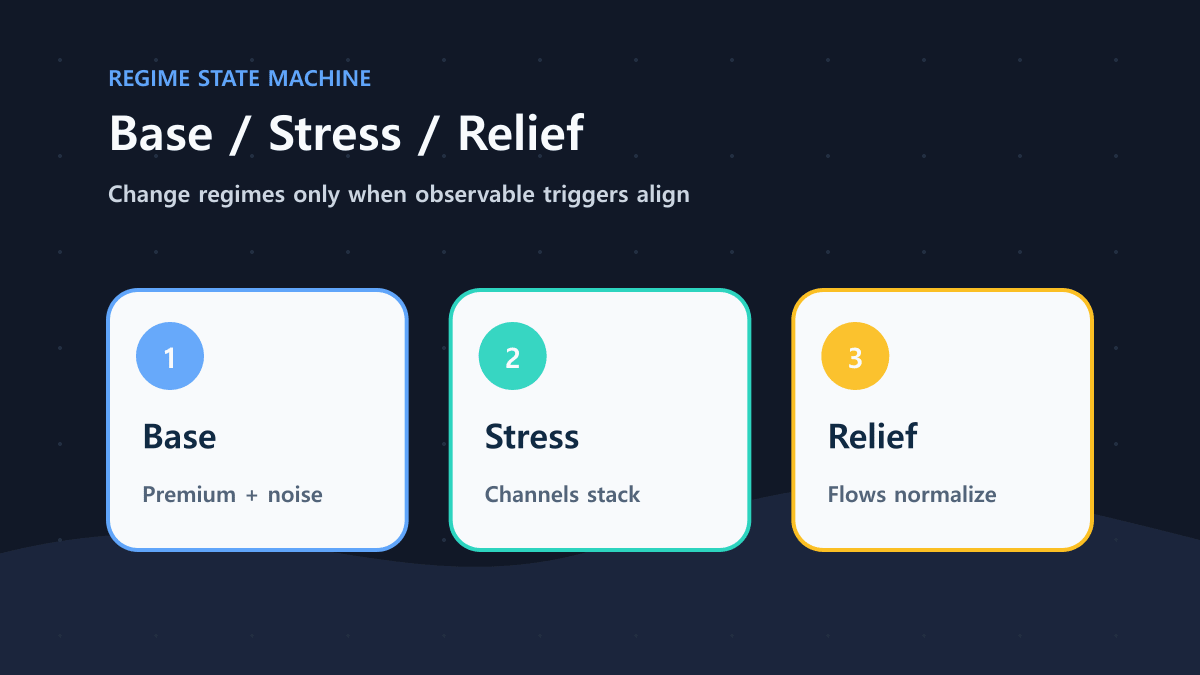
Table 4: Regimes + what the market is pricing + flip triggers + action rules
| Regime | What’s being priced | Typical USD/KRW feel | Observable flip triggers | Action rule (example) |
|---|---|---|---|---|
| Base (noise + premium) | Risk premia (freight/insurance), short volatility | Choppy, not one-way | Premium fades + broad USD strength slows | Reduce impulsive trades; focus on exposure mapping |
| Stress (stacked channels) | Risk-off flows + expectation shift | Sharp jumps, wide ranges | Volatility falls twice + flows stabilize | Prioritize hedging/liquidity; avoid leverage |
| Relief (normalization) | Premium compresses, expectations stabilize | Retrace or sideways | Oil stabilizes + USD breadth narrows + flow normalizes | Gradually unwind defensive positioning in steps |
Interpretation (2–3 lines):
- The point is not “which regime will happen next,” but what must be true to claim you are in that regime.
- Relief is not a one-day bounce; it’s a cluster of confirmations (volatility, USD breadth, flows).
- This framework reduces the two classic errors: chasing a spike and panicking at the bottom.

Two checklists you can run in 10 minutes
The goal is speed with discipline: classify the channel, then follow rules.
Checklist 1: “Dominant channel” classifier (10-minute routine)
- □ Is the oil move mostly risk premia (freight/insurance/detours) or physical supply (actual constraints)?
- □ Did USD/KRW move too fast for trade/inflation data → treat flows/hedging as primary until proven otherwise.
- □ Are inflation expectations/yields repricing in a way that suggests persistence?
- □ Are foreign flows/volatility confirming risk-off, or is this localized noise?
- □ Write one line: “I will change my stance only if ___ (flip trigger) happens.”
Checklist 2: Personal exposure map (what matters for your life/portfolio)
- □ Do you have near-term USD spending (travel, tuition, imports, business costs)?
- □ Any USD liabilities or USD-linked cashflows?
- □ What’s your foreign-asset share (a weaker KRW can be a hedge in some portfolios)?
- □ Separate near-term needs from long-term holdings (don’t hedge everything the same way).
- □ Any leverage/margin structure that becomes fragile when volatility spikes?
Reduce headline timing mistakes by using a rules-based contribution plan
In volatile macro regimes, the most common failure is not “being wrong once”—it’s stopping or overreacting.
A simple way to reduce timing stress is to follow a contribution rule and adjust only when regime triggers flip.
Related calculator: Open DCA calculator
Continue the macro chain (near the end)
If you want the bigger map around USD/KRW and oil shocks, these four links complete the puzzle:
Official data sources to verify the story (optional, but recommended)
You don’t need to read every report—just know where to verify when headlines feel noisy.
- Bank of Korea ECOS (macro time series)
- Korea Customs Service trade statistics
- International Energy Agency (oil market context)
Questions people ask about oil shocks and USD/KRW (FAQ)
Does USD/KRW always rise when oil rises
No. The relationship is conditional because USD/KRW reacts through trade balance, import inflation expectations, and flows/hedging. Oil can rise on risk premia that fade, or on demand strength that doesn’t trigger broad risk-off.
Why can USD/KRW jump before any trade balance or CPI data changes
Because flows and hedging can move FX in real time. Foreign positioning, volatility, and USD liquidity demand often dominate the first reaction, while trade balance and inflation data show up with lags.
What’s the fastest way to tell if the move is “premium” versus “physical supply”
Premium-led moves often show rapid price jumps with volatility and shipping/insurance language, then partial unwind if supply remains intact. Physical supply shocks tend to persist and are more likely to shift expectations across inflation and growth.
If oil is up but USD/KRW is flat, what could that mean
It often means the market treats the oil move as temporary or localized, or that other forces are offsetting it (exports, stable flows, limited USD breadth). In that case, focus on whether expectations and flows confirm a broader regime change.
How does a weaker KRW affect the stock market in Korea
It depends on the channel. FX weakness tied to risk-off and outflows can pressure equities broadly, while FX moves tied to export competitiveness can have mixed effects across sectors. That’s why the dominant channel matters more than the FX level alone.
What should individuals do in an oil-driven FX shock
Start by mapping your exposure: near-term USD needs, USD liabilities, and foreign-asset buffers. Then use flip triggers to avoid overtrading—adjust hedges or cash plans only when multiple confirmations appear.
Is the trade balance channel useless for short-term FX reading
Not useless—just slow. It’s better for understanding persistent pressure when oil stays high and exports soften. Short-term spikes are more often explained by flows, hedging, and expectation shifts.
What’s the single most important “rule” in this framework
Classify the dominant channel first. If you can’t name it, you’re probably trading a narrative. If you can name it, you can wait for the flip trigger instead of reacting to headlines.