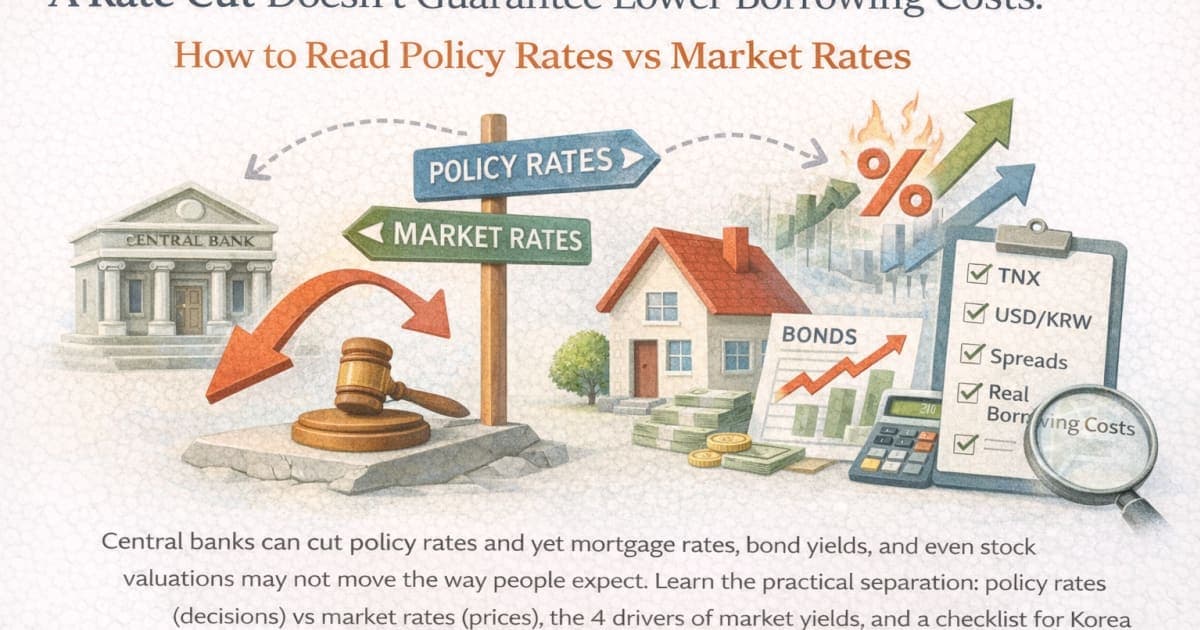
Summary (10 sentences)
- “Rate cuts” in headlines usually mean a policy rate move, but most real-world prices are driven by market rates.
- Policy rates are central bank decisions; market rates are prices formed by expectations, risk premia, and funding conditions.
- That’s why market yields can stay high—or even rise—after a policy rate cut.
- Market rates often move before the announcement because markets price the expected path of future policy.
- Long-term yields depend on inflation expectations, the expected path of short rates, term premium, and credit/liquidity spreads.
- Borrowing costs add another layer: reference rate + bank spread (margin + risk) = what households feel.
- “Cut = stocks up” is not automatic; if cuts happen due to growth fear or credit stress, risk assets can wobble.
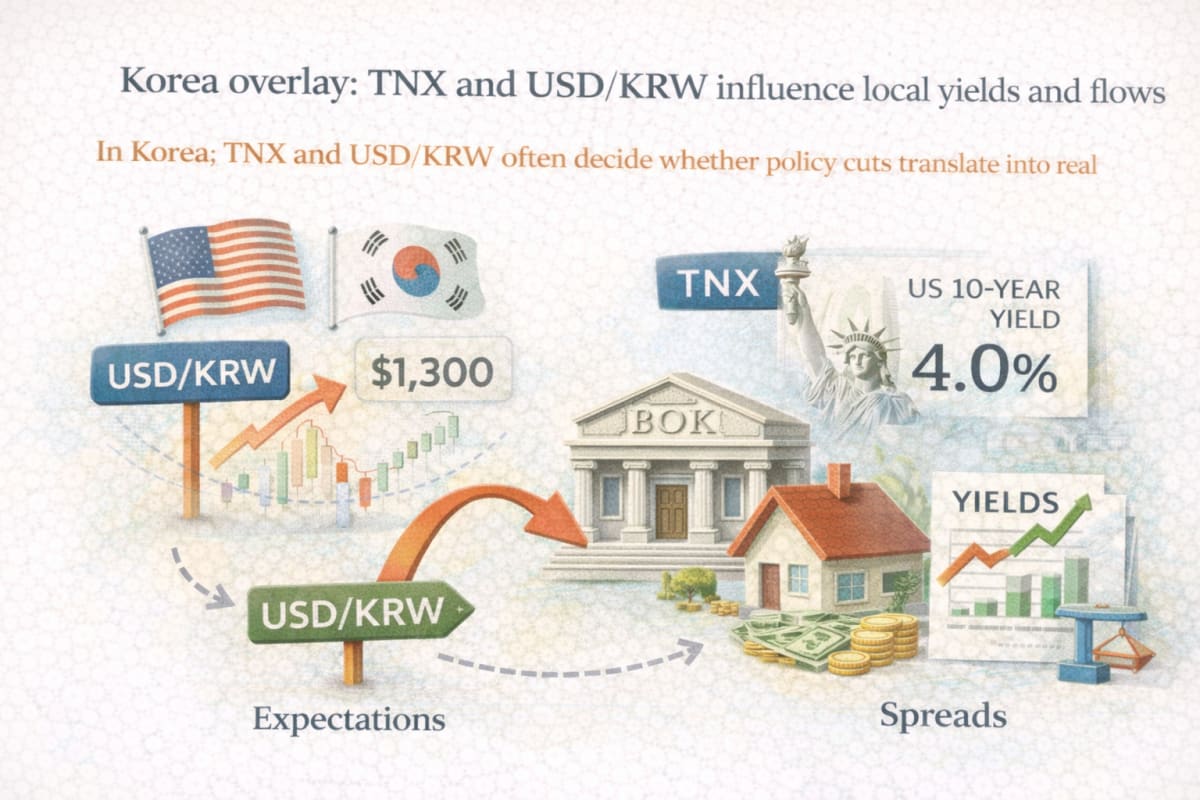
- In Korea, USD/KRW and U.S. 10-year yields (TNX) can dominate local rate dynamics and foreign flows.
- To read rate news properly, watch the curve (3Y/10Y), spreads, USD/KRW, and TNX—not just the policy headline.
- This post gives a practical framework and checklist so you don’t overreact to a single word: “cut.”
One-paragraph overview
Many people treat rate cuts as a simple lever: “policy rates down → loan rates down → assets up.” But the economy runs on market prices, not press releases. Market rates embed expectations about where policy will go, plus extra compensation for inflation uncertainty and risk. Banks also price loans with their own spreads. When you separate “decision” (policy) from “price” (market), you can understand why your mortgage rate doesn’t budge, why bond yields don’t fall, and why stocks sometimes drop even as rates are cut.

1) The core confusion: mixing “a decision” with “a price”
Headlines say “rates were cut,” and people naturally expect:
mortgage rates down, deposit rates down, bond yields down, stocks up.
But that chain only works when the policy move actually translates into market pricing.
- Policy rate = a central bank decision about a short-term anchor
- Market rate = a price investors demand to hold bonds, fund banks, and lend
So when you ask “Why didn’t my rate change?”, the answer is usually:
you’re paying a market rate (plus spreads), not the policy rate.
If you want a bigger “how rates flow through the system” primer, start here:
2) Definitions that matter in real life
2-1) Policy rates (the central bank’s lever)
Policy rates influence overnight or short-term funding conditions. They matter, but they’re not the full story.
2-2) Market rates (bonds, funding benchmarks, and what loans price off)
Market rates are yields across the curve: short, intermediate, and long.
They move based on future expectations and the compensation investors require for uncertainty.
A useful mental model:
Policy rate = decision. Market rates = prices.
3) Market rates move first: expectations are priced ahead of announcements
In many cycles, market yields drop (or rise) before the central bank acts.
That’s because markets price the expected path of future policy.
This is why a cut can feel “disappointing”:
if markets already priced it, the announcement adds little new information.
If you’re trying to interpret “curve” headlines without mixing signals (e.g., 2s10s vs 3m10y), this guide helps you convert the headline into a rules-based reading:
4) The 4 drivers of market yields (the decomposition that explains surprises)
A simplified but practical breakdown:
Long-term market yield ≈ expected inflation + expected path of short rates + term premium + spreads
(1) Expected path of short rates
If investors believe cuts will be shallow or short-lived (and hikes may return), long yields may not fall much.
(2) Inflation expectations
If inflation is expected to re-accelerate, investors demand higher yields to compensate for lost purchasing power.
To connect inflation to rates and why markets react, see:
If you want to know whether yields are moving because of real rates or inflation compensation, start here:
(3) Term premium (uncertainty compensation)
Term premium is extra yield required for holding long-duration bonds amid uncertainty (volatility, fiscal risk, supply shocks).
(4) Credit/liquidity spreads (risk & plumbing)
Even if the “risk-free” government yield falls, credit markets can stay tight:
- corporate spreads widen in stress
- bank funding becomes expensive
- liquidity is scarce
When spreads widen, borrowing costs may not follow policy cuts.
5) Why “cut = asset rally” can fail (and sometimes reverses)
People often think lower rates automatically boost valuation multiples. Sometimes they do.
But the reason for the cut matters:
- “Good cut” narrative: inflation easing + growth stable → yields fall, risk appetite improves
- “Bad cut” narrative: growth deteriorating or financial stress → earnings expectations drop, risk appetite shrinks
If the cut is responding to trouble, the market can treat it as confirmation of weakness.
6) Rate cut, different market outcomes
| Policy move | Market’s interpretation | What market yields might do | What risk assets might do |
|---|---|---|---|
| Cut | growth slowing but inflation falling | long yields ↓ (often) | mixed: valuation tailwind vs earnings headwind |
| Cut | inflation risk still high | long yields ↑ (possible) | valuations pressured; volatility rises |
| Cut | credit stress / liquidity issues | gov yields ↓ but spreads ↑ | risk-off: equities may wobble |
| Cut | already priced | little change | limited reaction (“news is priced”) |
| Cut | U.S. yields rising / USD strong | local long yields sticky | FX and foreign flows matter more |
7) Korea-specific overlay: USD/KRW and TNX can overpower local policy
Korea’s rate story can’t be read in isolation.
Foreign flows and global discount rates matter:
- TNX (U.S. 10-year yield) influences global valuations and cross-border capital allocation
- USD/KRW reflects risk appetite, dollar demand, and foreign investor behavior
- When USD strengthens and global yields rise, local long yields can remain sticky even if domestic policy turns dovish
Related internal posts:
- TNX Explained: Why the 10-Year Treasury Yield Drives Markets
- USD/KRW Exchange Rate: What It Means for Korea’s Economy and the KOSPI
- For a broader map: Global Indicators That Move KOSPI Most
- How DXY Moves the Market: Impact on U.S. Stocks, USD/KRW, and KOSPI
- When Geopolitics Turns Into Dollar Strength: Read It as USD Liquidity, Not Just “Fear”
8) What households should check: your loan isn’t “the policy rate”
When people say “rates were cut but my payment didn’t change,” it usually comes down to two things:
- Your reference rate (what your loan is indexed to)
- Your spread (bank margin + credit risk + product pricing)
Even if the reference rate falls, spreads can stay wide.
If you’re turning a target amount into a monthly plan (and want realistic assumptions), this reverse-calculation guide is a practical companion:
9) The 9-item checklist to read rate news like the market
Use this checklist in order:
- the policy statement tone (not just the cut size)
- 3-year government yield (short-to-mid expectations)
- 10-year government yield (long expectations + term premium)
- curve slope (10Y–3Y) as a growth/expectation signal
- credit spreads (corporate vs government)
- bank funding yields (where available)
- USD/KRW (risk appetite / flows)
- TNX (global discount rate)
- whether the move was priced ahead of the meeting
10) What NOT to do vs what to do
| Area | Reactive move (risk) | Rule-based move (better) |
|---|---|---|
| loans | switch products on the headline | confirm benchmark + spread structure first |
| deposits | delay everything expecting instant drops | ladder maturities to reduce timing risk |
| investing | “cut = buy” | check curve direction + spreads + FX |
| bonds | “cut = all-in long duration” | scale duration gradually; monitor term premium |
| interpretation | one-line conclusions | separate reason (macro) from price (market) |
11) Visual Overview


12) Conclusion
- A policy rate cut is a central bank decision—not a guarantee that market prices will follow.
- Market rates embed expectations, inflation risk, term premium, and credit/liquidity conditions.
- Separate “decision” from “price,” and you’ll read rate news with far less confusion.
13) A good piece of writing to read together
- How Interest Rates Work: From Policy Rates to Deposits, Loans, and Bonds
- Inflation & Rates Basics: Why Markets Shake When Rates Rise
- FX Basics: What Really Moves USD/KRW
- TNX Explained: Why the 10-Year Treasury Yield Drives Markets
- USD/KRW Exchange Rate: What It Means for Korea’s Economy and the KOSPI
- Global Indicators That Move KOSPI Most
- Why 2s10s and 3m10y Disagree: A Practical Recession-Signal Reading Guide
- Real Rates & Breakeven Inflation: The Asset-Pricing Thermometer Most Investors Ignore
- How DXY Moves the Market: Impact on U.S. Stocks, USD/KRW, and KOSPI
- When Geopolitics Turns Into Dollar Strength: Read It as USD Liquidity, Not Just “Fear”
- How Much Should You Invest Each Month to Reach $100,000?