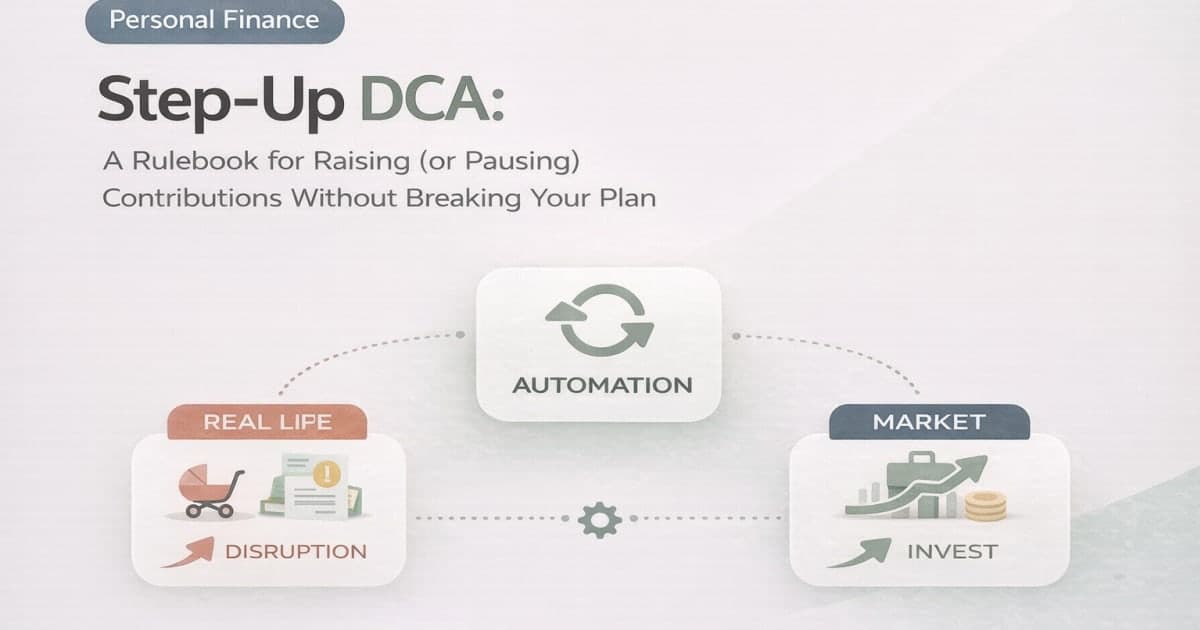
- Step-Up DCA isn’t “invest more when you feel confident”—it’s a pre-written rule that keeps your plan alive during normal life chaos.
- Your contribution amount should live in zones (base / stretch / crisis), not as a single heroic number you eventually abandon.
- The most common failure mode is not low returns—it’s cash-flow stress that forces pauses at the worst time.
- A step-up rule works best when it is tied to income changes and buffer health, not to market moves.
- Pausing can be rational—but only if you define pause triggers and resume triggers in advance (and keep the pause short and specific).
- Contribution growth (0/3/5/8%) changes the ending number, but also changes the behavioral risk: bigger payments can mean bigger quit risk.
- Taxes and fees matter, but you can model them conceptually as “friction” (lower net return) rather than pretending they don’t exist.
- If you invest globally, FX is simply additional volatility—don’t build a step-up rule on currency predictions.
- The simplest “win condition” is consistency: a plan that survives 10–20 years beats a plan that looks perfect on paper.
- Use the DCA calculator to stress-test sensitivity (returns / inflation / fees / pauses) before you lock your rules in writing.
PERSONAL FINANCE · DCA RULES
A Step-Up DCA plan is a small operating system: it tells you exactly when to raise contributions, when to cut back, and when a pause is allowed—without turning your future into a forecasting contest. This post gives you a rules-first blueprint you can run on autopilot.
- Design a base contribution you can pay in “boring months,” not just in good months
- Add step-up and pause triggers tied to cash flow and buffers (not market headlines)
- Stress-test the plan so you can stick to it when volatility hits
Scope: No stock/ETF recommendations. This is a rules + checklist framework only.

Step-Up DCA is a behavioral system, not a math trick
Most people don’t abandon a long-term investing plan because the spreadsheet was wrong. They abandon it because the plan demanded too much at the exact moment life got expensive: a rent increase, daycare, a medical bill, a car repair, or a slow business month.
That’s why “monthly contribution design” is the true core of DCA. Your plan must survive:
- Income variability (bonus season vs normal months, commissions, freelance cycles)
- Expense spikes (insurance deductibles, home repairs, travel, family support)
- Market volatility (drawdowns that test patience and confidence)
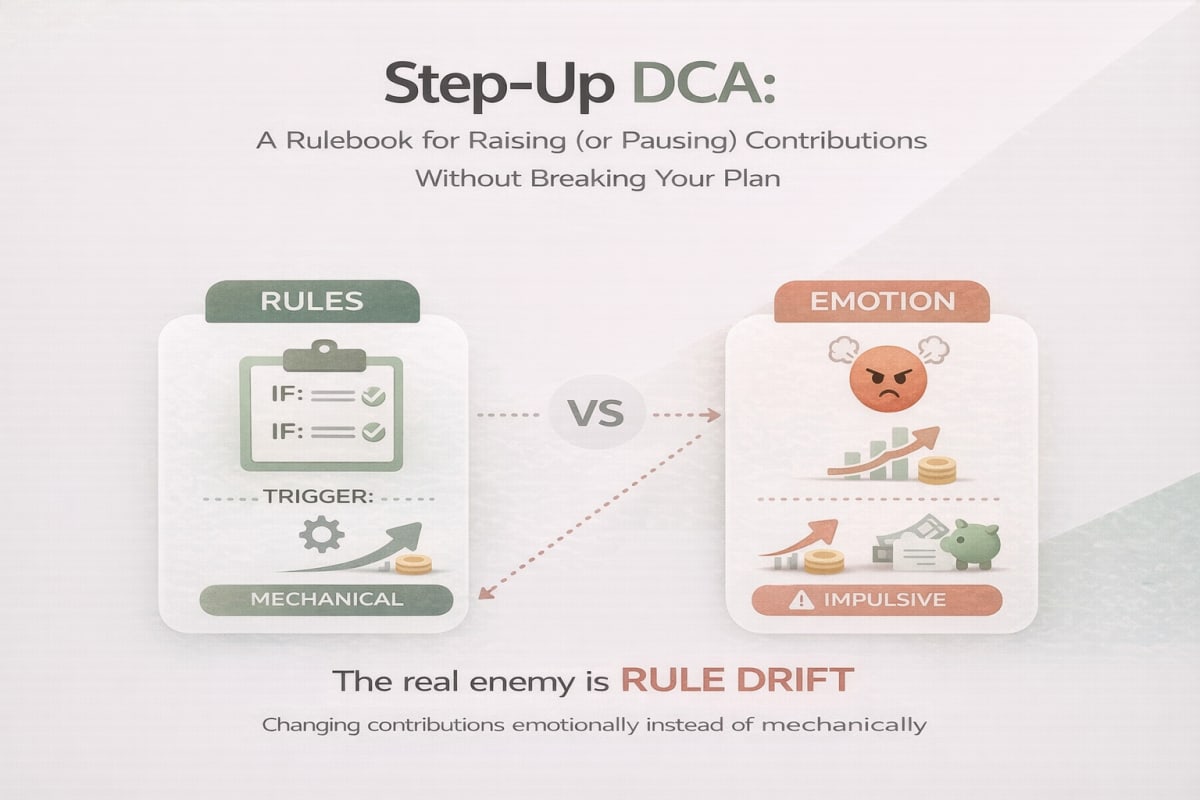
A Step-Up DCA rulebook treats “contributions” like a thermostat, not a light switch: you adjust within defined bounds, and you don’t improvise.
Define three contribution zones: Base, Stretch, and Crisis
A single monthly number is fragile. Zones are resilient.
1) Base contribution (non-negotiable)
This is the amount you can pay even in a “boring” month. If your plan depends on motivation, it’s not a plan.
2) Stretch contribution (optional)
This is the “good month” layer: you add it when buffers are healthy and cash flow is stable.
3) Crisis contribution (temporary minimum)
This is the controlled step-down amount used when your buffer triggers fire. It’s a planned retreat with a return path.
Here’s a simple structure that many US households can adapt:
| Zone | What it feels like | Funding source | Rule goal |
|---|---|---|---|
| Base | “I can do this even when life is normal” | payroll/bank auto-transfer | consistency |
| Stretch | “I can do this when buffers are full” | surplus cash flow / bonus slice | acceleration without stress |
| Crisis | “I can do this without borrowing” | reduced spend + short pause window | prevent plan abandonment |
Interpretation (how to use this table):
If your “base” requires constant discipline, it’s actually a stretch number. Lower it until it becomes boring. Your stretch layer is where acceleration happens—but only under rules.
Write the step-up rule: raise contributions without betting on the market
Step-ups fail when they’re attached to mood (“I feel good, so I’ll invest more”) or to market narratives (“stocks are cheap right now”). A stable step-up rule is attached to income and buffer health.
The 3-part step-up trigger (simple and effective)
Trigger A — Income step:
If net monthly income increases by X% (raise, new client, promotion), allocate a fixed slice to the plan.
Trigger B — Buffer step:
Only step up if your emergency fund / cash buffer is above your minimum threshold.
Trigger C — Expense stability step:
Only step up if fixed expenses (housing + insurance + debt minimums) are within a target ratio of income.
A practical example (purely illustrative, not advice):
- Step-up amount = 30–50% of your net income increase
- Buffer requirement = emergency fund meets your risk target
- Fixed-expense guardrail = fixed expenses stay under a level you can sustain
If you want a separate buffer framework, read:

Write the pause rule: pausing is allowed, but only with guardrails
A pause is not automatically a failure. A pause becomes a failure when it is:
- open-ended (“until I feel better”)
- shame-based (“I messed up”)
- market-timing flavored (“I’ll restart when things look safer”)
A good pause rule has three properties:
- Specific trigger (what must be true to pause)
- Time box (how long the pause lasts)
- Resume trigger (what must be true to restart)
The most common “legit pause triggers” (US household reality)
- Emergency fund breach (cash buffer falls below your minimum)
- High-interest debt pressure (rates/terms create guaranteed stress)
- Short-term known expenses (deductible, taxes due, relocation, required repairs)
- Income interruption (layoff, client loss, medical leave)
If you want a clean way to size buffers so you pause less often, use:
Why this breaks people: Average returns don’t pay your bills. If your contribution schedule is too aggressive, you’ll pause during stress, restart late, and drift into a pattern where the plan only runs in easy months.
Replacement belief: “A plan that survives volatility beats a plan that models volatility.”
The rulebook table: what to do, what lever to pull, and what counts as a failure signal
This is the “no drama” table you want during stressful months. It keeps you from inventing new rules on the fly.
| Situation | Control lever | Default action | Failure signal (means your plan is oversized) |
|---|---|---|---|
| Income rises | step-up % of raise | increase contributions within cap | you must cut essentials to fund the step-up |
| Bonus / windfall | fixed split | allocate a slice to investing + a slice to buffers | you spend it all or invest it all (no buffer) |
| Expenses spike | buffer first | pause stretch layer, keep base if possible | you use credit for predictable expenses |
| Market drawdown | behavior guardrail | keep base; step-up only if buffers are safe | you stop contributions “until it feels safe” |
| Debt stress | priority rule | stabilize cash flow; reduce stretch | you borrow to invest or miss minimum payments |
Interpretation (how to read this):
The “failure signal” column is the point. If you keep hitting it, don’t try harder—resize the base. Your plan should protect essentials, not compete with them.
Stress-test the plan with the DCA calculator (mid-article checkpoint)
Before you lock your step-up and pause rules, run a simple sensitivity pass using the DCA calculator: ETF/Stock DCA Simulator
Validation: Use this calculator to test step-up rate vs. pause windows and see how sensitive your outcome is to returns/inflation changes.
What to input: starting balance, monthly contribution (base), contribution growth rate, years, return assumption, inflation, and a rough “fees & taxes” friction assumption.
A required reality table: contribution growth (0/3/5/8%) changes the math—and the quit risk
Below is a modeling example (not a promise): starting balance $10,000, base contribution $500/month, 25 years, 6% nominal return. Contributions grow annually at the listed rate.
| Contribution growth rate | Total contributed (25y) | Ending value (25y) | Time-to-$500k (approx) | Max drawdown proxy* | Failure signal |
|---|---|---|---|---|---|
| 0% | $150k | ~$381k | ~28.8y | ~$51k | base already feels “tight” |
| 3% | $219k | ~$494k | ~25.2y | ~$74k | stretch becomes “mandatory” |
| 5% | $260k | ~$598k | ~23.0y | ~$89k | frequent pauses after expense spikes |
| 8% | $355k | ~$815k | ~20.4y | ~$123k | contributions dominate budget; burnout risk |
*Max drawdown proxy: a simple “30% drop on the account size around year 15” dollar-impact estimate (used to visualize emotional pressure, not to forecast markets).
Interpretation (what this table is telling you):
Higher growth rates can accelerate the finish line—but they also raise the cash-flow commitment and increase the probability of “rage-pausing” during stress. The best growth rate is the one you can keep through real life.

Two case studies: how the rulebook changes for salary vs. variable income
A rulebook should match your income shape. Below are two templates you can copy.
Case 1: Salary household (payroll stability, expense pressure)
Profile (example):
Two W-2 incomes, mortgage/rent, childcare, health insurance premiums, retirement accounts (401(k)/IRA), limited monthly slack.
Rulebook:
- Base: automatic payroll or bank transfer that never touches essentials
- Stretch: only after emergency fund threshold is met and fixed costs are stable
- Step-up trigger: raises → allocate a fixed slice (e.g., 30–50%) to contributions
- Pause trigger: emergency fund falls below threshold OR major known expense window opens
- Resume trigger: buffer restored + expenses normalized for 2 consecutive months
Behavior trap to avoid:
Raising contributions and raising lifestyle at the same time. Most plans break when “new income” gets spent twice.
Case 2: Variable income (self-employed, commissions, freelance cycles)
Profile (example):
Income arrives in clusters, seasonal dips, tax payments, health insurance volatility, higher uncertainty.
Rulebook:
- Base: smaller “always-on” contribution (to keep continuity)
- Stretch: funded from “income surplus buckets” (a percentage of each deposit)
- Step-up trigger: trailing 3–6 month average income exceeds a threshold
- Pause trigger: next-quarter tax/insurance payment not fully funded
- Resume trigger: tax bucket funded + buffer above minimum
Behavior trap to avoid:
Treating a good month as a permanent new baseline. For variable income, step-ups should be based on averages, not peaks.

Taxes, fees, and inflation: model them as friction, not as a guess contest
You don’t need perfect tax knowledge to build a durable plan. You do need to avoid pretending taxes and fees don’t exist.
A practical modeling mindset:
- Treat fees (expense ratios, advisory, account costs) as a small reduction in net return.
- Treat taxes as “friction” that reduces what you keep when you sell (conceptually—no personalized tax advice here).
- Treat inflation as the reason your contribution and spending targets need periodic updates.
If you want a broader “debt vs investing” framing (still rules-based, not advice), see:
Checklist: a 15-minute Step-Up DCA setup (copy/paste)
□ Write your Base / Stretch / Crisis contribution numbers
□ Define your emergency fund minimum (risk-based, not vibes)
□ Choose a step-up rule (income-based + buffer-based)
□ Choose a pause rule (trigger + time box + resume trigger)
□ Add a cap: “stretch cannot exceed X% of net income”
□ Automate the base; schedule a monthly review for the stretch layer
□ Run a sensitivity check in ETF/Stock DCA Simulator (returns / inflation / fees / pause months)
□ Put the final rulebook in a note titled “Do not change this during drawdowns”
What to do when markets drop: guardrails that prevent panic pauses
Even if you never forecast markets, you will live through drawdowns. Your rulebook should already answer:
- “Do I keep the base?”
- “Do I pause the stretch?”
- “Do I step up?”
Here are two guardrails that reduce panic:
The “buffer first” guardrail
If buffer is below threshold → pause stretch, keep base if possible.
If buffer is above threshold → base continues; stretch is allowed only if cash flow is stable.The “two-month rule” guardrail
Never pause solely due to market fear. If you think you need to pause, wait two months and reassess using the pre-written triggers.
If inflation is distorting your household budget and pushing you toward stress-pauses, this helps:

Run the “lock-in” test with the calculator (near the end)
Now do the final pass: open the DCA calculator at ETF/Stock DCA Simulator and test whether your rulebook survives realistic friction.
Validation: Test how your plan behaves when returns are lower, inflation is higher, or you must pause for a defined period—then choose rules you can keep.
What to input: starting balance, base contribution, contribution growth rate (step-up), total years, return assumption, inflation, plus a conservative “fees & taxes” friction line.
The goal isn’t the best projection—it’s the best plan you’ll actually follow
A Step-Up DCA rulebook is successful if it produces one outcome: you keep running the plan.
If your rules make you feel trapped, the rules are wrong. Shrink the base, protect buffers, and keep continuity.
If you want to go deeper (related reading)
Mid-article foundations you can reinforce:
- Stabilize cash flow before scaling investing: the 3 pillars checklist
- Size your emergency fund by risk (job/family/debt), not a generic “months” number
Near-end reinforcement (rules > predictions):
- Debt vs investing in a high-rate era: a threshold rule you can actually follow
- Use a $500/month for 10 years example to calibrate contribution, time, and return assumptions
- Inflation-proof your budget: reduce fixed costs and protect cash flow
- Reality-check return assumptions: what “7% annual return” can mean in practice
FAQ
1) What’s a good default step-up rate?
A good default is the one that doesn’t force lifestyle cuts or borrowing. Many people do better with a small automatic annual increase plus occasional bonus-based boosts than with a single aggressive growth rate.
2) Should I step up contributions when the market drops?
Only if your buffer and cash flow rules allow it. “Market is down” is not a trigger by itself. If your buffer is thin, stepping up can increase stress and cause an eventual panic pause.
3) Is pausing contributions always bad?
No—pausing can be rational if it’s triggered by a real constraint, time-boxed, and paired with a resume rule. The danger is the open-ended pause that turns into permanent drift.
4) How do I model taxes and fees without doing complicated tax math?
Treat them as friction: reduce your net return assumption modestly, and be conservative. This avoids the common mistake of pretending taxes and fees don’t exist while keeping the model simple.
5) What if my income is variable?
Use a smaller base and fund stretch contributions as a percentage of inflows. Build step-up triggers from trailing averages (3–6 months), not from peak months.
6) How does inflation change the plan?
Inflation can increase your cost of living and compress free cash flow. That’s why you want zones: base stays stable, stretch flexes, and crisis rules prevent plan abandonment.
7) Does FX matter if I invest internationally?
FX adds another layer of volatility to your outcome. Don’t build step-up rules on currency predictions; treat FX as additional noise and keep your rules cash-flow based.
8) When should I revisit my rulebook?
At least annually, and also after major life changes (new job, new dependents, housing change, healthcare changes). Don’t rewrite rules during a drawdown.