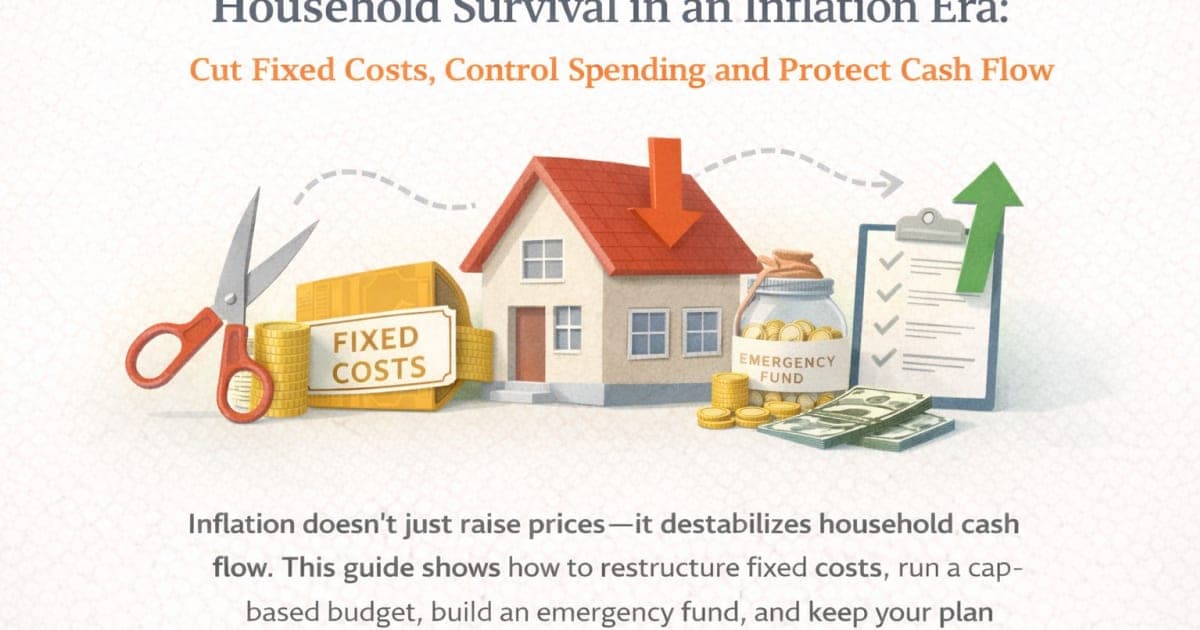
Summary (10 sentences)
- In inflation, households don’t break because income collapses overnight—many break because expenses silently climb.
- The first priority isn’t “extreme saving,” but cash-flow stability: eliminate monthly deficits and build shock absorbers.
- Fixed costs (subscriptions, insurance, telecom, loan payments) are the most powerful lever because they repeat automatically.
- A budget app is useful, but the real engine is a cap-based budget (category ceilings) plus automation.
- Variable spending is easiest to cut, but hardest to sustain—so you need a system, not motivation.
- An emergency fund is not “money you save if you have leftovers,” but a target you build first.
- In inflation, rising rates can turn debt into a stealth fixed cost, so debt structure matters.
- Small leaks (fees, renewals, late charges) compound into major losses over time.
- You should invest after you’ve secured: monthly surplus → emergency fund → debt/rate risk management.
- This post gives you a step-by-step playbook, tables, and checklists to keep your household resilient.
One-paragraph overview
Inflation is a cash-flow problem before it’s an investing problem. When prices rise, the same lifestyle becomes more expensive, and households that rely on “whatever is left at the end of the month” find nothing is left. The solution is a durable operating system: restructure fixed costs (repeatable wins), run spending caps (category ceilings), automate the flow of money (remove decision fatigue), and build an emergency fund as a deliberate target. The goal isn’t to feel disciplined—it’s to design a household that doesn’t collapse under stress.
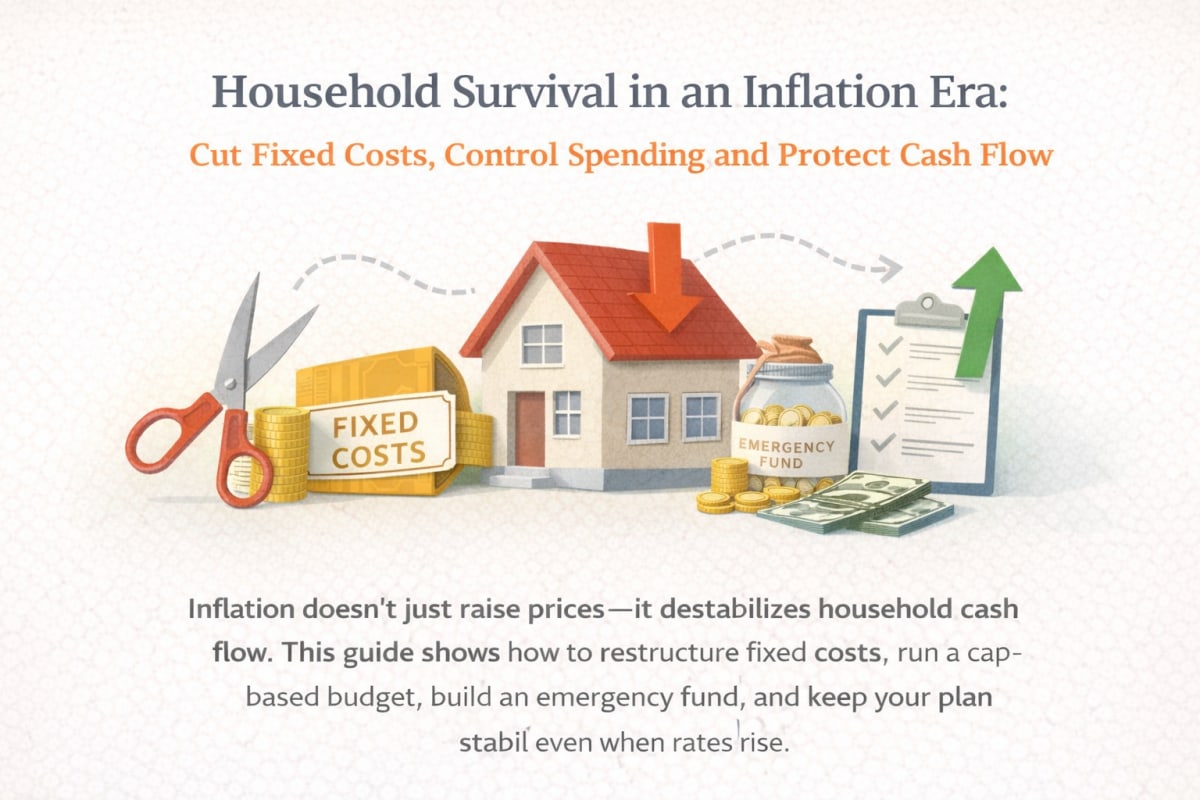
1) The real enemy in inflation: your expense structure, not one “big purchase”
Inflation rarely destroys a household with a single dramatic bill. It usually works like slow water damage:
groceries become slightly higher, transportation creeps up, utility bills jump seasonally—and suddenly your monthly surplus turns into a deficit.
So the correct question isn’t: “How do I save more?”
It’s: “What part of my spending repeats automatically, and how do I redesign it?”
If you want the macro framework behind why inflation and rates show up in everyday life, these internal posts help:
- Inflation and rates basics: why markets react to price pressure
- How interest rates work: from policy rates to deposits, loans, and bonds
2) The 3-layer household defense system
Inflation Household OS
In an inflation era, “discipline” is fragile and motivation fades. A resilient household is built with three layers: (1) fixed-cost restructuring (remove automatic leaks), (2) cap-based budgeting (category ceilings), and (3) an emergency fund (shock absorber). When these layers are in place, rising prices don’t automatically break your month.
Do this today (15 minutes)
- List your top 10 fixed costs
- Set 3 category caps (food, transport, shopping)
- Define an emergency fund target: “3 months of essentials”
3) Step 1 — Cut fixed costs first (the highest ROI with the least stress)
Fixed costs are powerful because they repeat. If you lower them once, you win every month without extra effort.
3-1) The “Top 7 fixed-cost leaks” checklist
- telecom plans and bundles
- insurance premiums and duplicated coverage
- subscriptions (streaming, cloud, memberships, paid apps)
- housing-related recurring fees (maintenance, utilities contracts)
- loan payments and interest structure
- car ownership costs (insurance, parking, maintenance)
- education/lessons that quietly persist
Rule of thumb: don’t start by cutting coffee. Start by cutting the automatic drains.
3-2) The 3 moves that create real monthly relief
- Cancel what you don’t actively use (subscriptions are the classic inflation leak)
- Switch to a lower-cost equivalent (telecom/insurance tiers)
- Renegotiate recurring contracts when possible (rates, bundles, renewal discounts)
4) Step 2 — Control variable spending with “caps,” not guilt
People think they need perfect tracking to save money. They don’t.
They need ceilings.
4-1) Tracking is diagnosis. Caps are treatment.
- A spending log tells you where money went.
- A cap tells you how much money is allowed to go there next month.
The simplest durable setup is the 3-cap system:
- Food (groceries + eating out + delivery)
- Transport (public transit + taxis + fuel)
- Shopping (online, small purchases, “misc.”)
Start with only three. If you start with ten categories, most households quit.
4-2) Weekly budget beats monthly willpower
Monthly budgets often fail on day 20. Weekly budgets usually hold.
- “Food cap per week”
- “Shopping cap per week”
- “Transport cap per week”
When a cap is hit, you don’t panic—you switch to a pre-planned alternative (cook at home, delay non-urgent purchases, walk/public transit).
5) Failing saving vs sustainable saving
Failing approach
- Cut only small pleasures first
- Track everything, but set no caps
- Rely on motivation and “this month I’ll be good”
- Feel guilt, then rebound-spend
Sustainable approach
- Restructure fixed costs first
- Use caps (ceilings) in 3 categories
- Automate transfers to remove decision fatigue
- Recover quickly after slip-ups (system resets monthly)
6) Expense-cutting priority (largest impact first)
| Priority | Target | Why it works | Examples |
|---|---|---|---|
| 1 | Fixed costs | one decision → monthly savings | telecom, insurance, subscriptions, loan structure |
| 2 | Big variable costs | large amounts → meaningful relief | groceries, delivery, commuting, fuel |
| 3 | Small variable costs | easy to notice, hard to sustain | coffee/snacks/impulse buys |
| 4 | Event spending | single month can break the year | holidays, trips, ceremonies, large gifts |
7) Step 3 — Build a cash-flow calendar (money should “arrive and leave” on purpose)
Households with stable finances have one shared habit: money moves automatically.
7-1) The 3-account structure (recommended)
- Bills account: rent, utilities, insurance, loan payments
- Living account: weekly spending (food/transport/shopping caps)
- Goal account: emergency fund, sinking funds, investing
The most important rule:
Pay yourself first, then live on what remains.
“Save what’s left” fails in inflation because there is often nothing left.
8) Emergency fund: not leftover money, but a survival asset
An emergency fund is not “low-return cash.” It’s insurance against plan-breaking events.
8-1) How much is enough?
- baseline: 3–6 months of essential expenses
- higher-risk households: 6–12 months (unstable income, dependents, large rate-sensitive debt)
8-2) Make the target concrete (the only way it actually gets built)
If “emergency fund” stays abstract, it stays empty.
Turn it into a number, a deadline, and an automatic transfer.
Turn your emergency fund into a real plan (not a wish)
Set a target amount and timeline first. Then reverse-engineer the monthly saving required. When the number is clear, the system becomes easier to keep.
Open the Goal Simulator9) Debt in an inflation/rate era: the stealth fixed cost
Inflation eras often come with rate uncertainty. That matters because rate-sensitive debt can increase monthly payments—turning debt into a growing fixed cost.
- variable-rate loans: payments can rise even if lifestyle doesn’t
- high-interest consumer debt: cash-flow killer, especially when prices rise
A practical ordering:
- stabilize monthly surplus
- build a basic emergency buffer
- reduce or restructure the most rate-sensitive/high-cost debt
(Understanding the rate chain helps you make better choices:
10) 3-image summary: Budget System / Emergency Fund / Debt & Interest Rates


11) Budget templates you can actually run (adaptable)
| Template | Essentials | Lifestyle | Goals (savings/investing) | Best for |
|---|---|---|---|---|
| Balanced | 50% | 30% | 20% | stable households, moderate debt |
| Defensive (inflation) | 55–60% | 20–25% | 15–20% | rising prices/rate stress |
| Goal-first | 50% | 20% | 30% | building emergency fund fast |
| Debt-focused | 50–55% | 15–20% | 25–35% | high interest burden |
Note: the exact ratio matters less than consistently respecting the caps.
Run your current spending for 1–2 months, then adjust caps gradually instead of “shock dieting.”
12) The 15-point inflation survival checklist
(A) Fixed costs
- Telecom plan reviewed in the last 6 months
- Insurance overlap checked (duplicate coverage removed)
- Subscription list audited monthly
- Loan/interest structure reviewed (rate sensitivity understood)
(B) Budget system
- Three category caps set (food/transport/shopping)
- Weekly budget used instead of monthly willpower
- Expense tracking used to enforce caps, not to punish yourself
(C) Emergency fund & goals
- Emergency fund target defined (3–6 months essentials)
- Automatic transfer set up (goal account)
- Investing comes after cash-flow stability, not before
(D) Debt & rate risk
- Variable-rate exposure identified
- Payment increase stress tested
- High-interest debt prioritized for reduction
13) Investing comes after survival (a stable order that doesn’t break)
Inflation doesn’t mean “never invest.” It means “don’t let investing destabilize survival.”
A durable order:
- monthly surplus
- emergency fund
- debt/rate risk control
- long-term investing (sustainable contributions)
If you want to sanity-check long-run assumptions (instead of relying on a single hopeful number), start here:
14) Conclusion (3 lines)
- Inflation-era household finance is a cash-flow system problem, not a motivation problem.
- Restructure fixed costs, run spending caps, and build an emergency fund as a shock absorber.
- Once survival is stable, long-term saving and investing becomes sustainable.
15) Turn your plan into numbers
Build your emergency fund plan with a target and timeline
“Save leftovers” fails in inflation. Set a target amount and deadline first, then reverse-engineer the monthly saving needed.
Open the Goal SimulatorWant to see how consistent saving grows over time?
Run conservative/base/optimistic scenarios to see realistic ranges—then choose a plan you can actually keep.
Open the Compound Interest Calculator16) A good piece of writing to read together
- Inflation and rates basics: why markets react to price pressure
- How interest rates work: from policy rates to deposits, loans, and bonds
- FX basics: what really moves USD/KRW
- How USD/KRW influences Korea and KOSPI
- Why “7% per year” needs a reality check (CAGR lens)
- Global indicators that most affect KOSPI (overview)