
- Investing $500 per month for 10 years means contributing $60,000 before any return assumptions.
- The final number depends less on a perfect return forecast and more on whether the contribution survives 120 months.
- The examples below are simplified: no taxes, fees, inflation adjustments, or real-world volatility paths.
- Actual results can differ based on contribution timing, return methodology, taxes, fees, and the investments used.
- Treat the numbers as planning anchors, not promises.
- If $500 is too aggressive, a smaller plan that survives is usually better than a bigger plan that breaks.
- If your income grows, step-up contributions can matter more than trying to forecast the market.
- Use the DCA Calculator to test your own contribution, timeline, and return assumptions.
- If you already have a target amount, the Goal Simulator can reverse-calculate the monthly contribution you may need.
PERSONAL FINANCE · DCA PLAN
“What if I invest $500 a month for 10 years?” sounds like a calculator question, but it is really a behavior question.
The spreadsheet looks clean; real life does not. Rent changes, emergencies, job shifts, and market drawdowns can all interrupt the plan.
This guide turns the $500/month idea into a simple 10-year contribution system you can test and adjust.
- Estimate the 10-year result under simple return assumptions
- Compare $300, $500, and $700 monthly contribution paths
- Use calculators to stress-test the plan before you automate it
Scope: No stock or ETF recommendations. No guaranteed return assumptions. This is a planning framework, not investment advice.
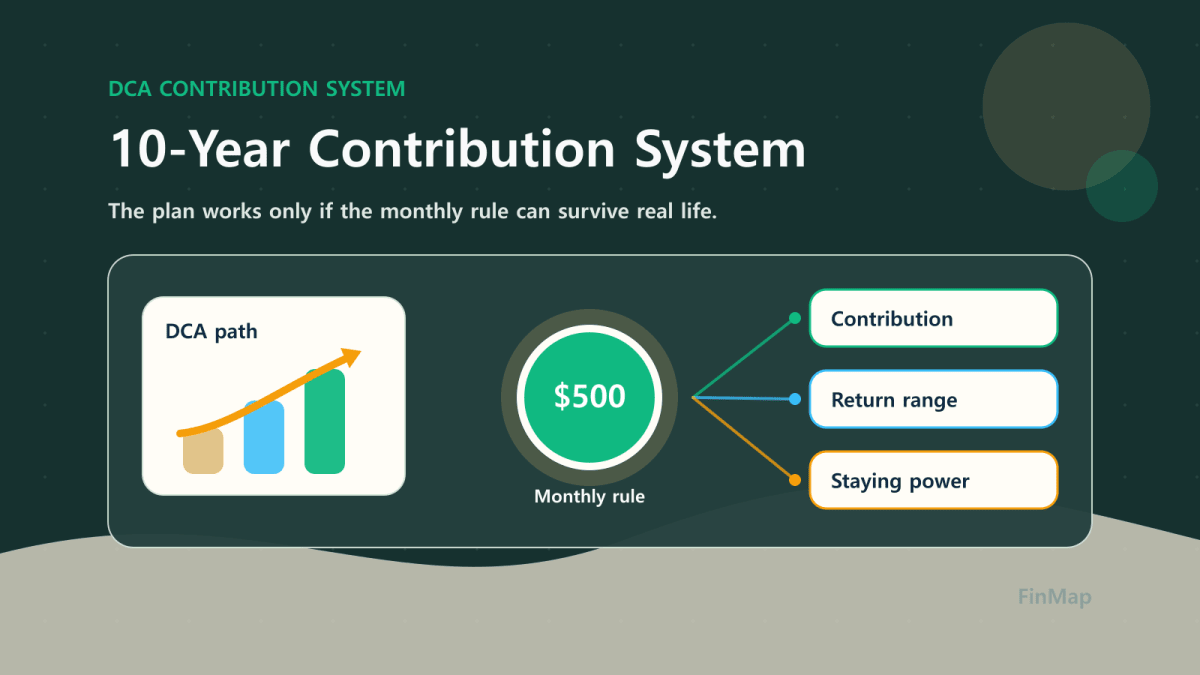
Start with the principal: $500 a month is $60,000 over 10 years
Before talking about returns, lock in the contribution math.
| Input | Calculation | Result |
|---|---|---|
| Monthly contribution | $500 | $500 |
| Time horizon | 12 months × 10 years | 120 months |
| Total principal | $500 × 120 months | $60,000 |
That $60,000 is the foundation. If the plan fails after year two or three, the return assumption becomes secondary. DCA works best when the contribution amount fits normal months, not only optimistic months.

Simple return scenarios: what could $60,000 become?
The table below assumes monthly contributions and a steady annualized return for illustration only. Real markets do not compound in a smooth line. For your own assumptions, change the inputs in the DCA Calculator.
| Annual return assumption | Total principal | Simple 10-year example | Gain above principal |
|---|---|---|---|
| 0% | $60,000 | about $60,000 | $0 |
| 3% | $60,000 | about $69,700 | about $9,700 |
| 5% | $60,000 | about $77,200 | about $17,200 |
| 7% | $60,000 | about $85,500 | about $25,500 |
The useful takeaway is not “7% is the right number.” The takeaway is that contribution, time, and return assumptions interact. If you want to isolate the compounding effect, run the same inputs in the Compound Interest Calculator.
Example 1: $500/month fits your budget comfortably
If you already have an emergency fund and stable income, $500/month may be a clean automated contribution.
- Automate the transfer right after payday
- Keep investing money separate from checking money
- Review the contribution once per year
- Avoid changing the rule after every market headline
For this person, the win condition is consistency. A boring plan that survives beats an ambitious plan that keeps restarting.
Example 2: $500/month is possible but stressful
If $500 is possible only in perfect months, start lower. A contribution you can maintain may beat a larger amount that gets paused repeatedly.
| Monthly contribution | 10-year principal | 5% simple example | Planning note |
|---|---|---|---|
| $300 | $36,000 | about $46,300 | A durable starting point |
| $500 | $60,000 | about $77,200 | A balanced benchmark |
| $700 | $84,000 | about $108,100 | Powerful, but only if cash flow is strong |
If you expect income to rise, write a step-up rule instead of forcing a high contribution today. The framework in Step-Up DCA contribution rules is a useful next step.

Misunderstanding box: a 7% example is not a 7% promise
Misunderstanding: “If the table shows 7%, that means I can expect about $85,500.”
No. The table is a simplified planning example. Real portfolios have volatility, taxes, fees, inflation effects, and sequence-of-return risk. A smooth 7% line is not how real investing feels.
Better check: Run conservative, base, and optimistic assumptions in the [DCA Calculator](/en/tools/dca-calculator). If the plan only works in the optimistic case, the plan is fragile.
Time horizon changes the result more than most people expect
Holding the monthly contribution at $500, here is how the time horizon changes the simple 5% example.
| Time horizon | Total principal | 5% simple example | What it means |
|---|---|---|---|
| 5 years | $30,000 | about $33,900 | Principal does most of the work |
| 10 years | $60,000 | about $77,200 | A useful planning benchmark |
| 15 years | $90,000 | about $132,400 | Time starts doing more work |
If you have a specific target amount, stop guessing and reverse the problem. The Goal Simulator can help estimate the monthly contribution required for a target.
A 15-minute checklist before automating $500/month
- □ I can invest $500 without draining my emergency fund
- □ I can keep contributing during normal expensive months
- □ I have a written pause rule and resume rule
- □ I tested 3%, 5%, and 7% scenarios instead of relying on one number
- □ I know what I will do if income drops for 2–3 months
If you checked fewer than three boxes, start smaller. If you checked four or five, $500/month may be a reasonable benchmark to test.

Related reads that make the plan stronger
- How much should you invest each month to reach $100,000?: reverse-calculate from a target amount
- Reach your target amount faster: decide whether to adjust contribution, return, or time
- Annual vs monthly compounding: understand why compounding frequency changes results
- Simple vs compound interest: build the foundation before adjusting assumptions
- DCA vs lump-sum investing: decide what to do when you have cash available today
Bottom line: $500/month matters because it repeats 120 times
Investing $500 per month for 10 years starts with $60,000 of principal. Under a simple 5% annualized example, the ending value is roughly $77,000, but that is a planning estimate, not a promise.
The practical next step is to test your own contribution, horizon, and return assumptions in the DCA Calculator. Then use the Compound Interest Calculator to compare compounding assumptions and the Goal Simulator if you want to reverse-calculate a target.
FAQ
Q1. How much principal do I invest with $500 per month for 10 years?
$500 per month for 120 months equals $60,000 of total principal.
Q2. What could $500/month become in 10 years at 5%?
In a simplified example with no taxes, fees, or volatility path, it is roughly $77,000. Real results can differ.
Q3. Is DCA better than investing a lump sum?
It depends. DCA can reduce timing regret and make investing easier behaviorally, while lump-sum investing may have a higher expected return when cash is already available. Your cash-flow needs matter.
Q4. What if $500 per month is too much?
Start with a smaller durable amount such as $300 and write a step-up rule for future raises or income increases.
Q5. Which calculator should I use first?
Use the DCA calculator first if you plan to contribute monthly. Use the compound interest calculator to compare compounding assumptions. Use the goal simulator if you already know the target amount.
Q6. Should I assume 7% returns?
Do not rely on one return assumption. Test conservative, base, and optimistic cases, then see whether the plan still works under the conservative case.
Q7. Does pausing contributions matter?
Yes. Pauses reduce both principal and time in the market. If you may need to pause, define pause and resume rules before the pause happens.
Q8. Is this investment advice?
No. This is a planning example. Your actual plan should reflect income, expenses, emergency reserves, taxes, fees, risk tolerance, and investment choices.