

- The most dangerous time for a FIRE plan is not “somewhere in retirement”—it’s the 5 years around the start date.
- The risk is not “low returns” in general, but bad returns early while you’re withdrawing (sequence-of-returns risk).
- Two portfolios can have the same long-run average return, yet end up with very different outcomes depending on the order of returns.
- Inflation-adjusted withdrawals are realistic for lifestyle stability—but they amplify early drawdowns when the market is down.
- The “4% rule” is not a promise; it’s a historical starting point that depends on horizon, fees, taxes, and return paths.
- The most practical fix is not prediction—it’s rules: guardrails, spending tiers, and a cash buffer that buys time.
- Social Security timing can act like a “cashflow lever,” reducing how much your portfolio must fund in early retirement (high-level concept).
- Healthcare costs (especially the years before and after Medicare eligibility) are often the biggest real-world volatility in spending.
- A good plan is one you can stress-test: “What if year 1–2 are ugly?” is the question that matters most.
- You can run a meaningful stress test in about 10 minutes using the FinMap FIRE calculator, then convert it into a rules-based plan.
The first 5 years of retirement decide whether your plan survives.
This guide explains sequence-of-returns risk, shows why “average returns” can be misleading, and gives you a rules-based withdrawal playbook you can validate with the FIRE calculator.
- A simple mental model for sequence risk (no math-heavy finance jargon)
- Withdrawal rules that adapt when early years go bad
- A 10-minute stress-test workflow you can repeat every year
US-based readers planning retirement withdrawals from taxable accounts, 401(k)/IRA balances, and/or other savings, while factoring Social Security and healthcare cost uncertainty (high-level, not legal/tax advice).
Retirement math often gets reduced to a single number—“my average return should be X%.”
That’s exactly the wrong simplification for the moment that matters most: the first five years.
This is the period when:
- you stop earning (or reduce income),
- you start withdrawing (often inflation-adjusted),
- and market volatility has the most leverage over your future.
Let’s make it practical—then we’ll stress-test it.
Why the first 5 years dominate retirement outcomes
Sequence-of-returns risk is simple:
- During accumulation, a bad year early is annoying but recoverable because you’re still contributing.
- During retirement withdrawals, a bad year early is dangerous because you’re selling from a shrinking base.
A large early drawdown combined with withdrawals can permanently reduce the number of “shares” your portfolio has left to compound.

The intuition: you’re pulling from the base while the base is falling
Even if markets eventually recover, the money you withdrew during the drawdown is gone.
You can’t “participate” in the recovery with dollars you already spent.
This is why “retiring into a downturn” feels like a different universe than “retiring into a bull market,” even with the same long-run averages.
A simple proof: same average returns, different outcomes
Below are two 5-year sequences that contain the same set of annual returns—just in a different order.
Assumptions (for illustration):
- Starting portfolio: $1,000,000
- Withdrawal: $40,000 in year 1 (4%)
- Withdrawals increase 3% per year for inflation
- Withdrawal happens at the start of each year (then returns apply)
| Scenario | Year 1 | Year 2 | Year 3 | Year 4 | Year 5 | Total withdrawn (5Y) | Ending balance (after 5Y) |
|---|---|---|---|---|---|---|---|
| Bad early years | -25% | -10% | +12% | +10% | +8% | $212,365 | $655,854 |
| Good early years | +12% | +10% | +8% | -25% | -10% | $212,365 | $728,207 |
Interpretation:
- Both scenarios withdrew the same dollars over 5 years, yet the ending portfolio differs by
$72k (11%). - The damage isn’t the existence of negative years—it’s negative years while you’re forced to sell.
- This “gap” doesn’t magically disappear later; it changes how much compounding power you have for decades.

Average returns ignore timing. In retirement, timing is the risk. The same average can hide a path that forces you to sell low early, permanently shrinking the base your future returns apply to.
If you’re still building your foundation, start here first
Sequence risk is a “retirement problem,” but the solution begins earlier:
- If your budgeting system is unstable, withdrawals in a downturn become emotional and chaotic.
→ Read: The Three Pillars of Personal Finance - If you don’t have a buffer, every down year forces immediate selling.
→ Read: Your Emergency Fund Isn’t a ‘Months’ Number — It’s a Risk Number
Withdrawal rules that survive bad early years
You don’t “solve” sequence risk with a better prediction.
You reduce it with rules that control what you sell and when.
The goal is not to maximize spending in the best case.
The goal is to avoid irreversible damage in the worst case.
The core trade-off: stability vs survivability
- Fixed inflation-adjusted spending feels stable.
- But it can be fragile in the first few years if markets drop.
So many practical plans use guardrails: keep spending mostly stable, but allow small adjustments when risk spikes.
| Withdrawal approach | How it works | Why it helps in bad early years | Main trade-off |
|---|---|---|---|
| Fixed real withdrawals (classic “rule”) | Spend a fixed amount, adjusted for inflation each year | Simple and predictable | Can force selling into a drawdown |
| Percent-of-portfolio | Spend a fixed % of current balance each year | Automatically reduces withdrawals after losses | Spending becomes volatile |
| Guardrails (bands) | Inflate spending normally, but cut/freeze if portfolio drops beyond thresholds | Adds flexibility exactly when you need it | Requires discipline and a written rule |
| Floor + variable (tiers) | Cover essentials with a “floor,” let discretionary spending float | Protects lifestyle basics; reduces panic | Requires clear spending tiers |
| Temporary “pause” rule | Freeze inflation increases (or small cut) during major drawdowns | Reduces early damage with minimal lifestyle change | Needs a trigger definition |
Interpretation:
- The “best” approach is usually the one you can actually follow under stress.
- Guardrails and spending tiers often offer the best real-life balance: stable enough, adaptive enough.
- The first five years are exactly when you want rules that activate automatically.

A practical guardrail template (conceptual)
Here’s a simple way to structure it (conceptual, not advice):
- Base spending: your “normal” inflation-adjusted withdrawal.
- Soft trigger (mild drawdown): freeze inflation increases this year.
- Hard trigger (deep drawdown): reduce discretionary spending by a fixed percentage for 12 months.
- Recovery trigger: when portfolio recovers above a threshold, resume normal inflation adjustments.
The key is that your rule should be:
- measurable,
- written,
- easy to execute without debate.
Cashflow levers that reduce sequence risk
The first five years are fragile because withdrawals start before other cashflow sources stabilize.
So the strongest sequence-risk reducers are not fancy—often they’re cashflow timing decisions.
Social Security timing (high-level lever, not advice)
For many households, Social Security changes the problem from:
- “My portfolio must fund 100% of spending immediately” to
- “My portfolio must bridge until Social Security starts”
A later start can reduce early withdrawal pressure (conceptually), but it’s personal—health, longevity expectations, and household cashflow matter.
Healthcare cost risk (especially around Medicare)
Healthcare is one of the biggest unknowns:
- premiums,
- out-of-pocket costs,
- and unexpected events that create spending spikes.
Even after Medicare eligibility, costs can still fluctuate—so your plan should assume variability rather than a flat line.
| Cashflow lever | What it changes | Why it helps sequence risk | What to watch |
|---|---|---|---|
| Delay Social Security (concept) | Reduces portfolio withdrawals later; increases guaranteed cashflow later | Can lower “portfolio load” in later years, letting early years be more conservative | Personal timing trade-offs; not one-size-fits-all |
| Part-time income / semi-retirement | Adds income during fragile years | Reduces forced selling in drawdowns | Income stability and lifestyle realism |
| Spending tiers (needs vs wants) | Builds flexible spending by design | Creates “automatic cuts” without panic | Must define tiers before retirement |
| Cash buffer (1–3 years of essentials) | Delays selling in downturns | Buys time for recovery without touching core assets | Too much cash can reduce long-run growth; balance matters |
| Healthcare buffer | Pre-planned funding for medical volatility | Prevents medical shocks from becoming portfolio shocks | Don’t underestimate variability |
Interpretation:
- Sequence risk is “portfolio math,” but mitigation is often “cashflow design.”
- A small bridge income or spending tier can outperform complex strategies in real life.
- Healthcare variability is a real-world volatility source that deserves its own buffer logic.
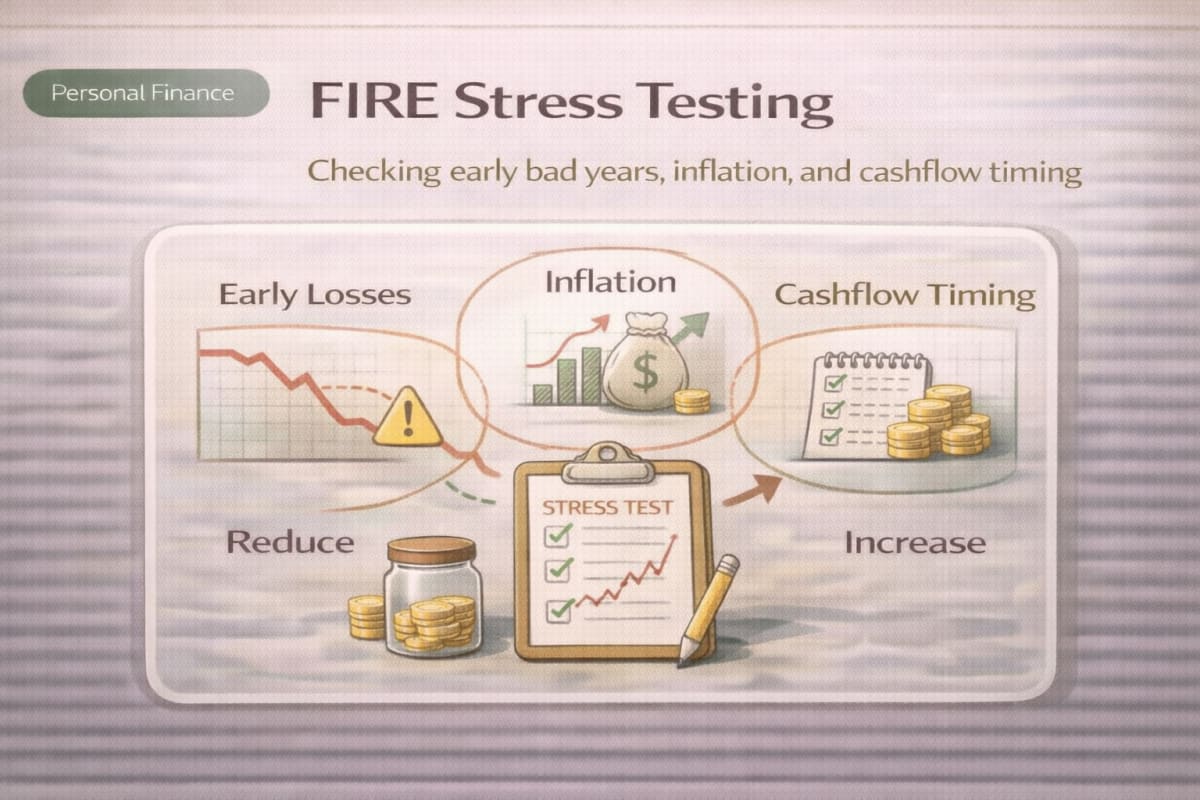
Right after opening the FIRE calculator, start with: annual spending (after tax), retirement horizon (years), expected return, and inflation.
Then stress-test the first five years by lowering early returns (or applying an early drawdown) and checking whether your plan stays inside your guardrails.
A 10-minute stress test using the FIRE calculator
Stress testing means asking: “If the first five years are rough, does my plan still behave predictably?”
Here’s a workflow you can repeat every year.
Step 1) Build a baseline that matches your real life
Use realistic “annual spending” (not aspirational). Include:
- housing (rent/mortgage, property tax, insurance),
- healthcare premiums + expected out-of-pocket,
- transportation, food, utilities,
- plus any “lumpy” annual costs you tend to ignore.
If you’re planning to stop work completely, be conservative about “new lifestyle spending.”
Most plans fail from underestimating basics, not from forgetting luxuries.
Step 2) Convert spending into a portfolio target (rough check)
A simple sanity check many people use:
portfolio_needed ≈ annual_spending / withdrawal_rate
Example:
- $60,000 spending
- 4% withdrawal rate → ~$1.5M
But treat this as a starting point, not an answer—especially if your horizon is long (40+ years) or healthcare risk is high.
Step 3) Apply the “bad early years” shock
The stress test that matters most:
- early drawdown (year 1–2),
- plus inflation staying normal (or higher),
- while withdrawals continue.
Watch what breaks first:
- Do you violate your spending floor?
- Do you deplete the buffer too quickly?
- Do you require selling aggressively at the bottom?
Step 4) Add guardrails and spending tiers
Now define your rulebook:
- “If portfolio drops by X%, freeze inflation increases.”
- “If portfolio drops by Y%, cut discretionary spending by Z% for 12 months.”
- “If portfolio recovers above W, resume normal.”
A written rule turns sequence risk into an operational plan.
Step 5) Add cashflow timing (Social Security / bridge income)
Even a modest bridge cashflow can improve survival odds by reducing early withdrawals.
Use this step to test “What if I partially retire?” or “What if Social Security starts later/earlier?” (high-level exploration).
Two scenario walkthroughs you should rehearse
A good retirement plan is one you can execute under two emotional climates:
- the market hits you immediately, or
- the market rewards you immediately.
Both can cause mistakes—just different ones.

Scenario A: Bad early years (the fragile start)
What typically happens:
- Portfolio drops early, withdrawals feel “too big,” anxiety rises.
- People either cut spending chaotically or sell aggressively (locking losses).
Rules that help:
- Use a cash buffer for essentials (time is the asset you’re buying).
- Activate a pre-written guardrail (freeze inflation increases; cut discretionary tier temporarily).
- Avoid “all-or-nothing” panic decisions. Small, rule-based moves beat big emotional ones.
A practical rehearsal question:
- “If year 1 is -25%, what exactly do I do next month?”
If you can’t answer that in one paragraph, the plan isn’t operational yet.
Scenario B: Good early years (the dangerous confidence boost)
What typically happens:
- Portfolio jumps early, people “upgrade life” quickly.
- Spending baseline rises permanently.
- Then a later drawdown hits—and now the spending floor is too high.
Rules that help:
- Treat early gains as buffer-building, not lifestyle expansion.
- Delay permanent spending increases until you’ve passed the fragile window.
- Keep “wants” in a tier that can float.
A practical rehearsal question:
- “If year 1 is +20%, what do I not change until year 6?”
Checklist: what to lock before you retire (24 months out)
- Build a written spending tier list (essentials / flexible / optional)
- Decide your guardrail triggers (freeze / cut / recover)
- Confirm healthcare assumptions (premiums + out-of-pocket variability)
- Decide your cash buffer policy (what it’s for, how it’s replenished)
- Document Social Security timing scenarios (high-level, with trade-offs)
- Run the “bad early years” stress test and write your month-1 response
- Run the “good early years” test and define a “no lifestyle upgrade” rule
- Review debt structure and required payments (fixed vs variable obligations)
Checklist: your first 12 months after retiring
- Track actual spending monthly (don’t wait for year-end surprises)
- Rebalance with rules, not headlines
- Apply guardrails automatically if triggers hit (no renegotiation mid-crisis)
- Refill buffers when markets are normal (don’t wait for the next downturn)
- Re-run your stress test once per quarter during the first year
- Keep healthcare spending volatility visible (separate category + buffer logic)
The hidden accelerants that make sequence risk worse
Sequence risk gets amplified when you have “hard commitments” that won’t flex:
- high fixed costs,
- debt payments that must be made regardless of markets,
- and lifestyle inflation that becomes permanent.
If you want to make your plan more resilient without changing returns, reduce fragility:
- lower fixed obligations,
- increase flexibility in discretionary categories,
- and keep buffers explicit, not implied.
If you want a practical framework for reducing fixed costs and stabilizing cashflow:
In the FIRE calculator, enter: annual spending, retirement years, expected return, and inflation—then run two passes: “bad first 5 years” and “good first 5 years.”
If your spending rule behaves predictably in both passes (guardrails + tiers), you’ve turned FIRE from a hope into a plan.
Related reading on FinMap
If you want to tighten the logic behind your assumptions and rules:
- The Three Pillars of Personal Finance: Budgeting, Emergency Funds, and Long-Term Investing
- Your Emergency Fund Isn’t a ‘Months’ Number — It’s a Risk Number
- Household Survival in an Inflation Era: Cut Fixed Costs, Control Spending, and Protect Cash Flow
- High-Rate Era: Should You Pay Down Debt or Invest First? (The Interest-Rate Threshold Rule)
- What Does a “7% Annual Return” Really Mean? A Reality Check Using CAGR
FAQs
1) Is sequence-of-returns risk only about stock market crashes?
No. It’s about bad returns early relative to your withdrawal start, regardless of the cause (crash, slow grind down, high inflation, or mixed volatility).
2) Does the 4% rule fail for long retirements?
It can. The longer the horizon, the more important return paths, fees, taxes, and inflation become. Treat “4%” as a historical reference point, not a guarantee.
3) Should withdrawals be inflation-adjusted every year?
Inflation adjustment stabilizes lifestyle—but in bad early years it can increase stress. Many real-world plans use guardrails: adjust for inflation normally, but freeze increases during drawdowns.
4) How big should a cash buffer be?
There’s no universal number. The purpose matters: is it for essentials only, or for total spending? Larger buffers reduce forced selling but can reduce long-run growth—so define what it’s for and how it’s replenished.
5) How does Social Security timing help sequence risk?
Conceptually, it can reduce how much your portfolio must fund in early retirement or change the cashflow shape later. Timing is personal and not one-size-fits-all.
6) Why is healthcare risk a core part of the stress test?
Because spending volatility is not only market-driven. Healthcare costs can spike unexpectedly, and even post-Medicare there are variable premiums and out-of-pocket expenses.
7) What is the single most important stress test?
“Year 1–2 drawdown + continued withdrawals + inflation.” If your plan has rules for that, it’s far more resilient than one that only assumes smooth averages.
8) How often should I re-run the stress test?
At least annually; during the first year of retirement, quarterly can be useful. The first five years are the window where adjustments matter most.